Narrative
Doktor Gjilpëra
Not translated into English
Faik Konica · 1924
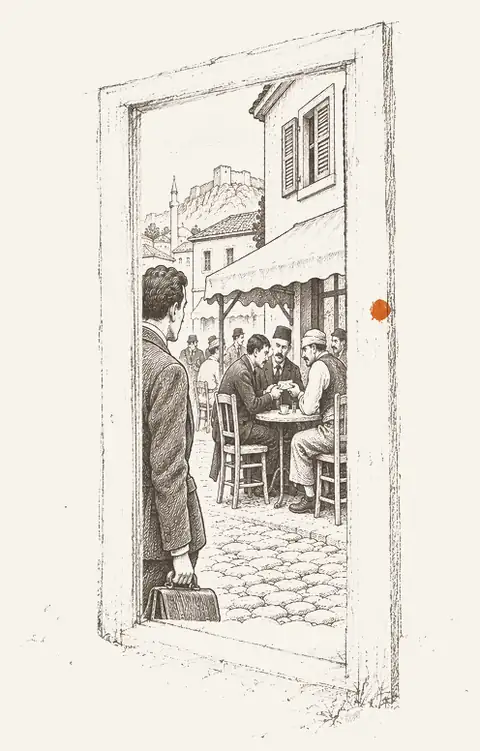
Opening lines
Jashtë Tiranës, mbi një kodër pranë Shkallës së Tujanit, një shtëpi e lyer me gëlqere shkëlqen në diell dhe bardhësia e saj duket për së largu posi një njollë prej dëbore në mes të maleve.
Outside Tirana, on a hill near Shkalla e Tujanit, a whitewashed house shines in the sun and its whiteness can be seen from afar like a patch of snow among the mountains.
Translation by Erostrate
Text quoted from fletoret.com
Synopsis
Doctor Gjëlpëra, trained in Uppsala, returns to Albania in 1920, after the Congress of Lushnjë, with the idea that the doctor is first of all an adviser, who prevents rather than cures. He discovers the Kamorra, whose exactions go as far as murder, and sees how easily people are bought. His dialogues with two colleagues, Emrullah and Protagora Dhalla, set out his programme, while figures from the country's society pass by: state agents, policemen, Muhidin, Zylfikar Agai, Gjylnar or Arife.
Context
The text appeared in instalments in 1924 in Dielli, in Boston, the year of the Mamurras murders, which its author denounces from April to December in his columns; written towards the end of April, it was announced on 29 July. Its full title promises that the doctor discovers the roots of the Mamurras tragedy. Most critics regard it as unfinished, the investigation not having begun after seventy pages; Kristaq Jorgo judges it complete, and Laura Smaqi sees in it a deliberate fragment. The doctor is said to be the double of his author, an admirer of August Strindberg, a dramatist in love with medicine.
Who it is for
A satirical prose work of about seventy pages, in southern Albanian, driven by dialogue; no French translation.
Prizes and reception
His main work of fiction, from an author who wrote little of it: a satirical novel mocking the backwardness of his compatriots.