Tale
Grimm's Fairy Tales
Kinder- und Hausmärchen
Opening lines
In den alten Zeiten, wo das Wünschen noch geholfen hat, lebte ein König, dessen Töchter waren alle schön, aber die jüngste war so schön, daß die Sonne selber, die doch so vieles gesehen hat, sich verwunderte, sooft sie ihr ins Gesicht schien.
In olden times, when wishing still helped, there lived a king whose daughters were all beautiful, but the youngest was so beautiful that the sun itself, which has seen so much, was astonished whenever it shone in her face.
Translation by Erostrate
Text quoted from zeno.org
Synopsis
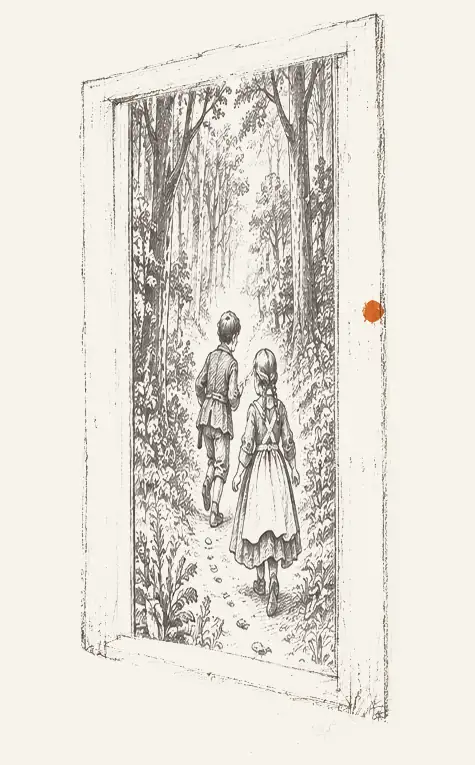
Blanche-Neige, Hansel et Gretel, Cendrillon, le Petit Chaperon rouge, Raiponce, le Roi-Grenouille: two hundred tales and ten legends for children in their final form, where the forests are deep, the stepmothers cruel and the punishments terrible. The first volumes of 1812 and 1815 contained one hundred and fifty-six, accompanied by scholarly notes.
Context
The brothers began around 1806 to collect songs and tales for the Brentano and Arnim collection, among their acquaintances and in books. The first volume, published in Berlin on 20 December 1812, sold poorly. Wilhelm then rewrote the texts from edition to edition: mothers became stepmothers, sexual allusions disappeared, the violence of the punishments remained. The seventh edition, of 1857, fixes the form that the world knows. A storyteller, Dorothea Viehmann, an innkeeper's daughter, supplied a good many tales from 1813. The collection has been inscribed since 2005 in UNESCO's Memory of the World Register.
Who it is for
To be read in an edition that states which version it follows: the 1812 version and the 1857 version do not tell the same story.
Prizes and reception
Translated into more than one hundred and sixty languages, and regarded as the foundational work of Western children's literature.