Poetry
Picada de Marimbondo
Not translated into English
Ernesto Lara Filho · 1961
Synopsis
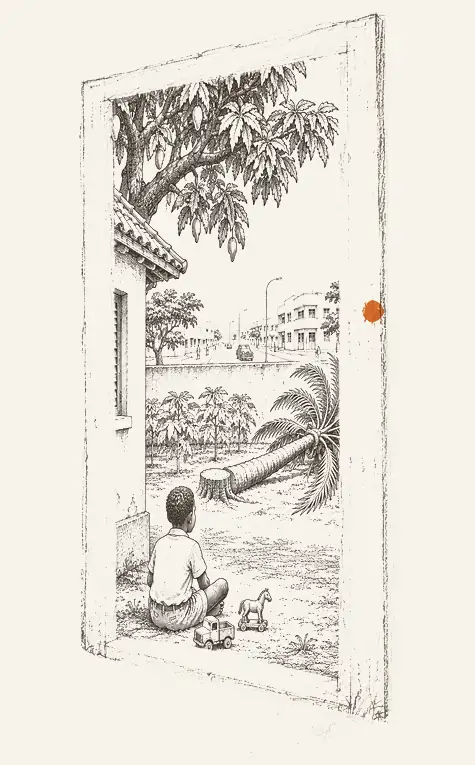
Poems of Benguela, of childhood and of house courtyards. The courtyard is the place of memory: family life, subsistence crops, children's games; a new avenue sweeps it away, a palm tree is cut down. “Infância perdida” draws the town as a geography of childhood, with its friendships and the ways of former times; other pieces, “A casa da velha”, “Maracujá” or “Regresso”, speak of nostalgia and of the tension between colonial society and the black population.
Context
Written in 1959 and 1960, the poems appear in 1961. It is the first of three notebooks, followed by O canto de martrindinde e outros poemas feitos no puto in 1964 and Seripipi na gaiola in 1970, which a volume bearing the second's title brought together in 1974. The whole was reissued in Luanda in 2004 in his poetic works. One study recognises in it the eye of a chronicler, and the echo of two Brazilian writers he admired, including Manuel Bandeira.
Who it is for
Poems in Portuguese, in a concise and familiar language, with repetitions drawn from oral tradition; no French or English translation.
Prizes and reception
“Infância perdida” is regarded as its most emblematic poem; critics read in it a modernism close to the generation of Mensagem.
Sources for this page 3
The pages consulted to check this page.