New Zealand
- works
- 38
- 28 books · 10 films
- period covered
- 1854–1994
- language of writing
- English and Maori
On 6 February 1840, five hundred Māori chiefs signed a treaty that exists in two versions which do not say the same thing. The English text has them cede sovereignty; the Māori text, the one they signed, uses a word that means rather governance and guarantees them authority over their lands and their possessions. The translation had been made in one night by a missionary. A hundred and eighty years later, a tribunal specially created for the purpose is still examining the consequences of that gap, and the reparations it orders are counted in hundreds of millions.
Read moreShow less
A country founded on a misunderstanding of translation grants language a particular importance. Māori had almost disappeared from use by around 1970, the school having repressed it for decades, and it was saved by a device invented in 1982: the language nests, where grandmothers who spoke Māori took in children so that they would hear it before knowing how to read. It has been an official language since 1987, with a television channel, a stabilised orthography and place names that everywhere resume their original form.
Literature follows that chronology. Witi Ihimaera published in 1973 the first novel written by a Māori, about a son mourning his dead father, with the rhythm of the funeral address. Patricia Grace followed, and Keri Hulme won the Booker Prize in 1985 with a book that twelve publishers had refused. Cinema did the same: the first feature film directed by a Māori came out in 1987, and its author then formulated the idea of a fourth cinema, that of indigenous peoples inside colonial states. Katherine Mansfield, for her part, had left the country at nineteen and wrote her best stories in Europe.
What awaits the reader is a literature in which belonging to a place and to a line precedes the individual. The collection that opens this page was written at the other end of the world by a woman who never came back.
A way to begin
The Garden Party and Other Stories
Katherine Mansfield · 1922
Fifteen stories, several of which take Katherine Mansfield back to the New Zealand of her childhood: regarded as the summit of her art. Free of rights.
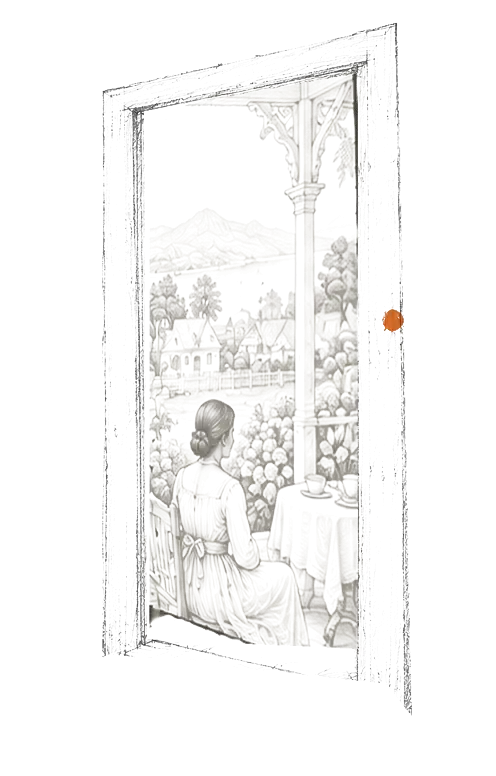
Fifteen stories. The first follows the Burnell family at Crescent Bay from sunrise to evening on a single day. In the title story, young Laura Sheridan is helping prepare a party when news comes of the accidental death of a poor neighbour; she wants to call everything off, her mother and sister refuse. Elsewhere, two elderly sisters find themselves alone after the death of their father, a colonel, and hesitate over everything.
Timeline
- 1870–1922First voicesLady Barker, Jane Mander, Katherine Mansfield. The short story before the novel.
- 1935–1955The Phoenix generationMason, Fairburn, Curnow, Sargeson. Writing a country, not a colony.
- 1958–1975Māori voicesHone Tuwhare, Witi Ihimaera, Patricia Grace enter literature.
- 1978–1989RecognitionKeri Hulme's The Bone People; Janet Frame read all over the world.
- 1940–1994CinemaFrom Rewi's Last Stand to Once Were Warriors; Barclay films in Māori.
Reading keys
- Māori identity is expressed through whakapapa, the genealogy one recites, and through belonging to an iwi, tribe, and a hapū, sub-group. One introduces oneself by naming one's mountain and one's river before one's occupation.
- The marae, ceremonial ground with its meeting house, is the place of belonging, and one is welcomed there by a codified ritual.
- The word Pākehā designates New Zealanders of European origin, without pejorative connotation, and its use is ordinary.
- The macrons on Māori vowels change the meaning and the length: writing them has become an editorial norm and a matter of respect.
- The New Zealand wars, between 1845 and 1872, and the land confiscations that followed are a dispute dealt with by a permanent tribunal since 1975.
- The school repression of Māori, in which children were punished for speaking their language, is a living memory.
- Tapu, sacred prohibition, bounds what may be said or shown, and certain knowledge belongs to a tribe.
- The question of who may write about Māori, and on what conditions, has been an explicit literary debate since the nineteen seventies.
- Christianity is in the majority, with Māori churches of their own, including Ringatū and Rātana, born of nineteenth- and twentieth-century prophets.
- Tapu and noa organise the sacred and the ordinary: a place, an object or a person may be tapu, and transgression has real consequences in the narrative.
- Mana, prestige and power, is acquired, lost and transmitted, and it is the same word as the one documented in Vanuatu in 1891.
- Taniwha, water creatures who guard places, are invoked in planning procedures, which is not a joke.
- The tangihanga, Māori funeral, lasts three days on the marae, with speeches, songs and ritual weeping, and the body remains present. Attending is an obligation that comes before work.
- Black is worn in mourning, with green leaves in the hair.
- The hongi, a greeting in which one presses nose and forehead, exchanges a breath and not a politeness.
- Matariki, the rising of the Pleiades in winter, became a public holiday in 2022, the only feast of Māori origin in the calendar.
- Māui, the demigod who fished up the North Island and tried to defeat death, is the central figure, shared with the whole of Polynesia.
- The collection published in 1855 by a governor, with narratives collected in Māori and translated, is the founding documented corpus, despite its colonial context.
- Rangi and Papa, the sky and the earth separated by their children, open Māori cosmogony.
- The haka, whose words recount a precise episode, and the mourning songs, waiata tangi, are recognised genres.
- The treaty of 1840 is not a single document: its two versions diverge, and it is that divergence that makes current New Zealand law.
- The haka is not a generic war cry: each has an author, a subject and an owner, and the rugby players' one belongs to a particular tribe.
- Mana is not a magical energy but a social prestige that is won and lost, and it is the same notion as in Melanesia.
- Katherine Mansfield, the country's most famous author, spent her adult life in Europe, which makes her national attachment more complex than it appears.
Tales and mythologies 1
- EpicPolynesian MythologyKo ngā mahinga a ngā tūpuna MāoriGeorge Grey · 1854The foundational Maori narratives, gathered in 1854 by a governor who later made war on those who had entrusted them to him.LiteraturePublic domain
A selection to begin with 10 / 38
- NovelThe RaceRuth France · 1958An offshore race between the country's two islands, caught in the storm of 1951.Literature
- NovelSpinsterSylvia Ashton-Warner · 1958A rural schoolteacher, her young Māori pupils and the reading method she invents amid the daily tumult.Literature
- NovelA Way of LoveJames Courage · 1959The life together of two men in London, at a time when their love remained a crime, told by an exiled New Zealander; his native country had the book withdrawn.Literature
- NovelTangiWiti Ihimaera · 1973Maori funeral rites, from Wellington to a village on the east coast, experienced by a son mourning his father.Literature
- NovelThe Bone PeopleKeri Hulme · 1984A reclusive painter, a mute child and a father who beats him, on an isolated coast of New Zealand.Literature
- CinemaVigilVincent Ward · 1984A little girl, a farm lost in the mist, and the stranger who takes the place of the dead father.Cinema
- CinemaNgatiBarry Barclay · 1987A small Maori town in 1948, a sick child, a doctor who discovers his roots and a slaughterhouse under threat.Cinema
- CinemaFlying Fox in a Freedom TreeMartyn Sanderson · 1989A rebellious young Samoan, caught between the old gods, custom and his father's money.Cinema
- CinemaThe End of the Golden WeatherIan Mune · 1992The last childhood summer of a twelve-year-old boy, and his friendship with a dreamer whom everyone rejects.Cinema
- CinemaOnce Were WarriorsLee Tamahori · 1994A Maori family in the southern suburbs of Auckland, under the violence of a jobless father.Cinema