Yemen
- works
- 5
- 5 books
- period covered
- 1400–1984
- language of writing
- Arabic
In 1972, heavy rains damaged the roof of the Great Mosque of Sanaa. Workmen who came to repair it discovered, between the inner roof and the outer roof, a cache filled with parchments stuck together by damp and eaten by insects. They loaded them into some twenty potato sacks and set them down in a stairwell. There were around forty thousand pages there, including the oldest known Quranic fragments, and a palimpsest whose erased layer goes back to the seventh century.
Read moreShow less
That the oldest Quran in the world should have come out of a Yemeni attic is no accident. Yemen is the ancient country of the peninsula, that of Saba and of the queen the Quran mentions, of the Marib dam that irrigated a civilisation, of a South Arabian script that precedes the Arabic alphabet. That priority works through the whole literature of the country: it writes from a centre that has become a periphery, with the acute awareness of having been the place from which wealth came. Sanaa, Zabid and the Hadramawt each have their school and their libraries, and the country exported men of letters throughout the Indian Ocean.
Poetry there has remained a public profession. Verse duelling is practised, as are the occasional poem and the zajal in dialect, and a known poet is a moral authority. Abdallah al-Baradduni, blind from childhood, became the recognised voice of the country by criticising every regime that followed one another, without ever leaving Sanaa. Zayd Mutee Dammaj chose the opposite form, a short dry novel about a child taken hostage and employed as a servant in a governor's palace, a real practice by which power guaranteed the loyalty of the tribes.
What awaits the reader is a literature that speaks of constraint from the inside, without pathos, and that keeps the density of verse even in prose. The novel that opens this page follows a boy taken hostage to guarantee his family's loyalty, and the Arab Writers Union placed it among the hundred best Arabic novels of the century.
A way to begin
The Hostage
Zayd Mutee Dammaj · 1984
A boy taken hostage to guarantee his family's loyalty, in the palace of a governor of the imamate: one of the hundred best Arabic novels of the century.
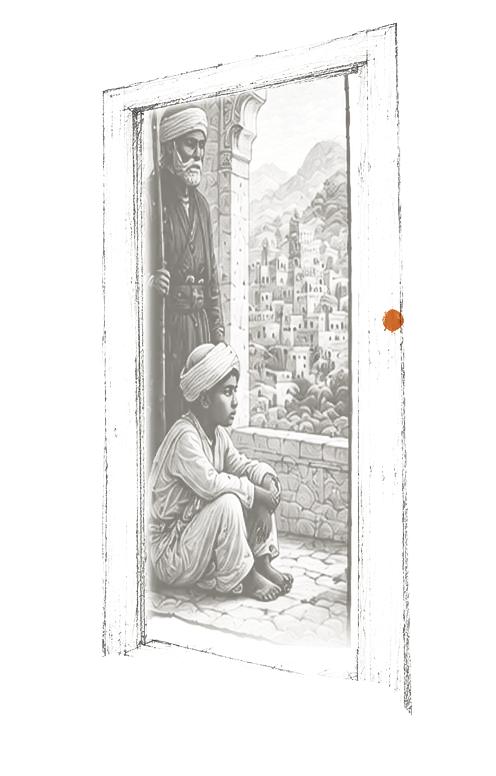
In the Yemen of Imam Yahya, a boy of about twelve is taken hostage to guarantee his family's loyalty. First locked in a fortress, he is sent to the governor's palace in Taiz to serve as a duwaydar, a serving boy who is both prisoner and servant. An older boy initiates him into the secrets of the post and into desire, while the governor's divorced sister claims him in turn; he struggles between desire and revolt.
Timeline
- 1961–1970Two poetsAl-Baraddouni and al-Maqalih, the great voices of modern Yemeni verse.
- 1984The HostageZayd Mutee Dammaj writes imamate Yemen and its closed world.
Reading keys
- The name reads as a genealogy with ibn and bint, and the last element indicates the tribe or the region, a determining social datum in Yemen.
- The title of sayyid designates a descendant of the Prophet, a socially very marked status, notably in the Zaydi north.
- The kunya, "father of" followed by the name of the eldest child, is the ordinary form of address.
- The old status groups, including the akhdam at the bottom of the social scale, appear in the narratives and cannot be understood without that hierarchy.
- The Zaydi imamate overthrown in 1962, the civil war, the unification of 1990 and then the recent wars form a history that literature treats through the childhood narrative or allegory.
- The inherited social hierarchy, between sayyid, tribes and servile groups, is present everywhere and rarely named.
- Qat, a leaf chewed in the afternoon in assembly, organises sociability and conversation. A qat scene is a scene of free speech.
- The women of the narratives speak mostly among themselves, and the passage from one space to another is a narrative event.
- Zaydism, a branch of Shiism proper to the highlands, coexists with a Shafii Sunnism in the south and on the coast. The difference structures the geography of the country.
- A very old Jewish community lived in Yemen until the mass departures of 1949 and 1950, and it appears in the older narratives.
- Sufism is present, notably in Zabid and the Hadramawt, with visited tombs.
- The jinn belong to Quranic cosmology, and practices of protection against the evil eye are common.
- Muslim mourning is brief, burial takes place on the same day, and condolences are received for three days.
- The jambiya, a curved dagger, indicates the status and the region of the man who wears it, and its position on the belt can be read.
- Ramadan and the Eids shift the rhythm of the days.
- Weddings last several days with separate songs for men and women, and the narrative often uses them as a central scene.
- The Queen of Sheba, Bilqis, and her journey to Solomon: a Quranic narrative and a national reference, claimed also by Ethiopia.
- The Marib dam and its breaking, mentioned in the Quran as a punishment, serve as an image of lost greatness.
- The vanished tribes, including the Ad located at Ubar, belong to the Quranic stock and to the memory of the desert.
- The poetry of the Hadramawt and the songs of Zabid form a heritage recognised throughout the Arab world.
- Yemen is not a peripheral country of Arabia: it is its most anciently urbanised and lettered part.
- Qat is not a marginal drug but a daily social institution, and describing it as a vice repeats an outside judgement.
- Zaydism is not assimilable to Iranian Shiism, and the recent geopolitical reading crushes that difference.
- The ongoing war dominates the news but Yemeni literature has more than two thousand years of written precedence.
Tales and mythologies 1
- EpicThe Adventures of Sayf Ben Dhi Yazanسيرة سيف بن ذي يزنAnonymous · 1400The sira was born in Mamluk Egypt, in the time of the wars against the Christian kingdoms of Ethiopia.Literature
Available in English 2
The books from this country that can be read in English, in the original or in translation.
- NovelThey Die Strangersيموتون غرباءMohammad Abdul-Wali · 1971A shopkeeper from Yemen, settled in Ethiopia, torn between piety, affairs and the dream of return, in a short novel of exile.Literature
- NovelThe HostageالرهينةZayd Mutee Dammaj · 1984The novel looks back on the imamate before the revolution, in a society where taking hostages guaranteed the obedience of families.Literature
A selection to begin with 3 / 5
- Poetryمن أرض بلقيسAbdullah al-Baradduni · 1961not translated into EnglishThe collection appeared in Cairo, a year before the revolution that overthrew the imamate in northern Yemen.Literature
- Poetryلا بد من صنعاءAbdul-Aziz al-Maqalih · 1971not translated into EnglishThe author was then living in Egypt, from where he returned to settle in Sanaa only several years later.Literature
- NovelThey Die Strangersيموتون غرباءMohammad Abdul-Wali · 1971A shopkeeper from Yemen, settled in Ethiopia, torn between piety, affairs and the dream of return, in a short novel of exile.Literature