Tale
The Nutcracker and the Mouse King
Nußknacker und Mausekönig
E.T.A. Hoffmann · 1816
Opening lines
Am vierundzwanzigsten Dezember durften die Kinder des Medizinalrats Stahlbaum den ganzen Tag über durchaus nicht in die Mittelstube hinein, viel weniger in das daranstoßende Prunkzimmer.
On the twenty-fourth of December the children of Medical Councillor Stahlbaum were not allowed, the whole day long, to set foot in the middle room, much less in the state room adjoining it.
Translation by Erostrate
Text quoted from zeno.org
Synopsis
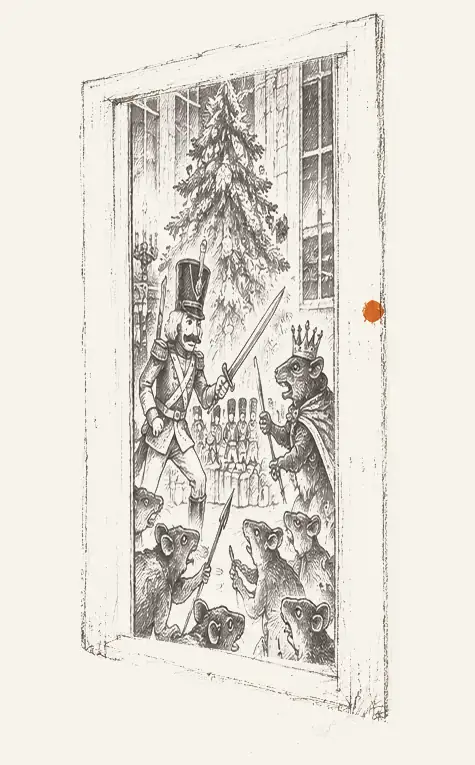
On Christmas Eve, at the home of Medical Counsellor Stahlbaum, little Marie takes into her care a wooden nutcracker that her brother Fritz has damaged. In the night, left alone with the toys, she sees Fritz's hussars, led by the nutcracker, face the seven-headed Mouse King's mice, and throws her slipper to save her protégé. Her godfather Drosselmeier, a judge and clockmaker, then tells her the story of Princess Pirlipat, whom a mouse queen had made ugly, and of the Krakatuk nut that was to deliver her.
Context
The tale appeared in Berlin in 1816 in a volume of children's tales, and Hoffmann then included it in 1819 in the cycle The Serapion Brethren. Marie and Fritz bear the features of Clara and Friedrich, children of his friend the jurist Julius Eduard Hitzig, whose eldest daughter Eugenie becomes Louise, the big sister. The French translation by Émile de La Bédollière appeared in 1838; the free adaptation that Alexandre Dumas made of it in 1844 long remained the best-known version in France.
Who it is for
For children as well as adults: the Christmas battle encloses the long tale of an enchanted princess. La Bédollière's translation can be read online.
Prizes and reception
By way of Dumas, this tale gave rise to Tchaikovsky's ballet, first performed in 1892; often staged, the ballet has carried Hoffmann's name beyond his readers.