Narrative
The Forest of the Dead
Der Totenwald
Ernst Wiechert · 1946
Opening lines
Johannes – so sei der angenommene Name des Handelnden und Leidenden in diesen Aufzeichnungen – hatte die Mitte des Lebens schon überschritten, als ihm noch einmal, auf der Höhe eines anscheinend sicheren, beneideten und wohl auch nicht unberühmten Daseins die Dinge dieser Welt wie die Meinungen von einer jenseitigen unsicher und schwankend wurden […]
Johannes (let that be the assumed name of the one who acts and suffers in these pages) had already passed the middle of life when once again, at the height of an apparently secure, envied and doubtless not undistinguished existence, the things of this world, like opinions about the world beyond, became uncertain and unsteady for him […]
Translation by Erostrate
Text quoted from projekt-gutenberg.org
Synopsis
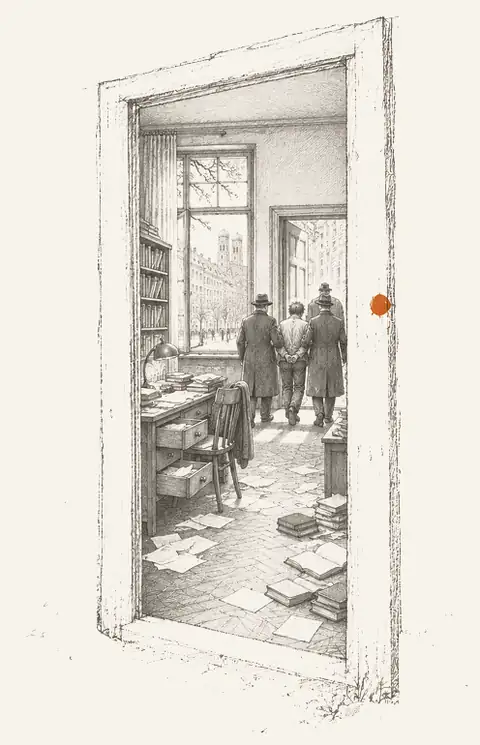
In the spring of 1938, Johannes, a writer and former soldier, has raised his voice against the deportation of a pastor to a camp. Three Gestapo men search his study for hours, then take him to a prison in Munich, where he is questioned about his opinions. After weeks of detention, an official tells him he will be sent to a concentration camp, and a train takes him via Leipzig and Halle to Weimar.
Context
The text was written in the last months of 1939, after its author's release; unable to publish it, he buried the manuscript in his garden. It appeared in 1946 in Zurich and Munich, then in 1947 in East Berlin. The title refers to Buchenwald, where Wiechert was prisoner number 7188. The author does not name himself in it: he tells in the third person the story of an intellectual whom he calls Johannes. The book was translated into French as early as 1947 by Blaise Briod, and into English the same year.
Who it is for
A short report, which the author subtitled in this way; it is closer to an indictment than to a simple account.
Prizes and reception
One of the first German accounts of the camps, translated into about ten languages.