Poetry
Ozymandias
Percy Bysshe Shelley · 1818
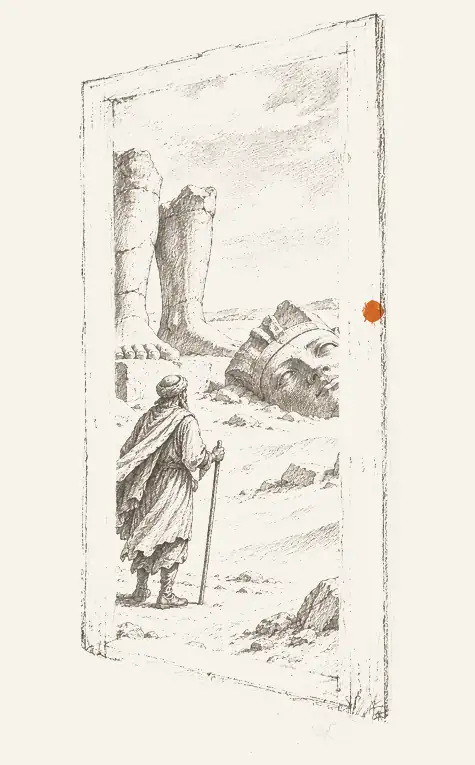
Opening lines
I met a traveller from an antique land,
Who said — "two vast and trunkless legs of stone
Stand in the desert ... near them, on the sand,
Half sunk a shattered visage lies, whose frown,
Text quoted from rpo.library.utoronto.ca
Synopsis
The poet meets a traveller who has returned from an ancient land. The traveller tells him: in the desert stand two vast legs of stone, without a trunk. Not far off, half sunk in the sand, lies a shattered head whose wrinkled lip holds a sneer of cold command; the sculptor had read these passions well, and they survive, stamped on the lifeless stone, the hand that mocked them and the heart that fed them. On the pedestal, words are engraved.
Context
The sonnet appeared on 11 January 1818 in the Examiner, the London weekly of the Hunt brothers, one of whom was the author's friend, and under a pseudonym. It came out of a friendly contest with the poet Horace Smith, whose sonnet appeared three weeks later in the same paper; that one ended by imagining a hunter of the future before the ruins of London, and it is now forgotten. Shelley had not seen the statue, which was exhibited in London only after the two sonnets were published. Their common source is a Greek historian, Diodorus of Sicily, who reported the inscription on the base, in which the king challenged anyone to surpass his works.
Who it is for
A sonnet of fourteen lines, to be read in a minute, and one of the best-known English poems.
Prizes and reception
One of the most famous sonnets in European literature, and, according to Britannica, its author's finest poem.
Sources for this page 13
The pages consulted to check this page.