Novel
Bruges-la-Morte
Bruges-la-morte
Georges Rodenbach · 1892
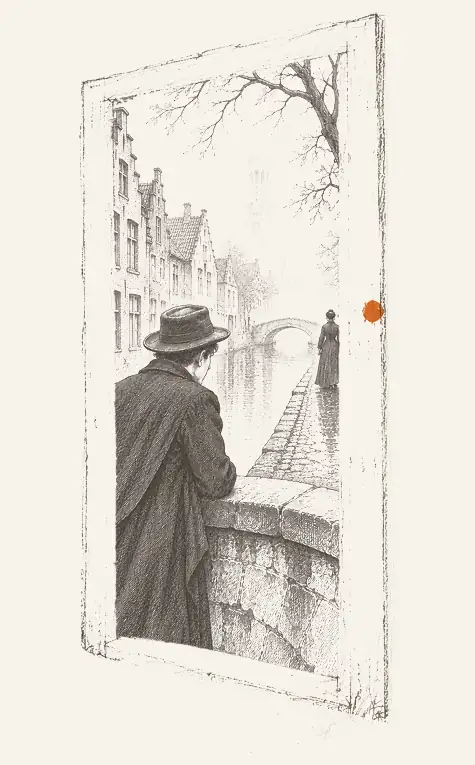
Opening lines
Le jour déclinait, assombrissant les corridors de la grande demeure silencieuse, mettant des écrans de crêpe aux vitres.
The day was waning, darkening the corridors of the great silent house, putting screens of crape over the windows.
Translation by Erostrate
Text quoted from gutenberg.org
Synopsis
A widower, Hugues Viane has withdrawn to Bruges, to a house on the Quai du Rosaire. He lives there among the relics of the dead woman, her clothes, her letters, and a braid of her hair that he keeps in a crystal case. One evening, he passes a young woman who has the other's face: Jane, an actress whom he sees again dancing in Robert le Diable. He becomes attached to her and seeks in this resemblance the return of the one he lost, at the risk of no longer knowing which of the two he loves.
Context
The novel appeared as a serial in Le Figaro in February 1892, then in volume form, expanded by two chapters, with thirty-five reproductions of photographs of the town, taken from plates by the Lévy and Neurdein studios: it is one of the first narratives illustrated in this way. The cover was by Fernand Khnopff. Its author, who had opposed the project of Bruges as a seaport, was ill regarded in the town.
Who it is for
A very short novel, best read in an edition that keeps the photographs the author wanted.
Prizes and reception
Korngold made the opera Die tote Stadt from it in 1920; it may have inspired the Boileau-Narcejac novel that Hitchcock brought to the screen.