Poetry
Изворът на Белоногата
Not translated into English
Petko Slaveykov · 1873
Opening lines
Помежду Ибинча и Харманлии на пътя има една чешма,
която ся казва „Ак балдър чешмеси“,
за нея живее в народът следующето предание:
Between Ibincha and Harmanli, on the road, there is a fountain
which is called “Ak baldır çeşmesi”,
and about it the following legend lives among the people:
Translation by Erostrate
Text quoted from chitanka.info
Synopsis
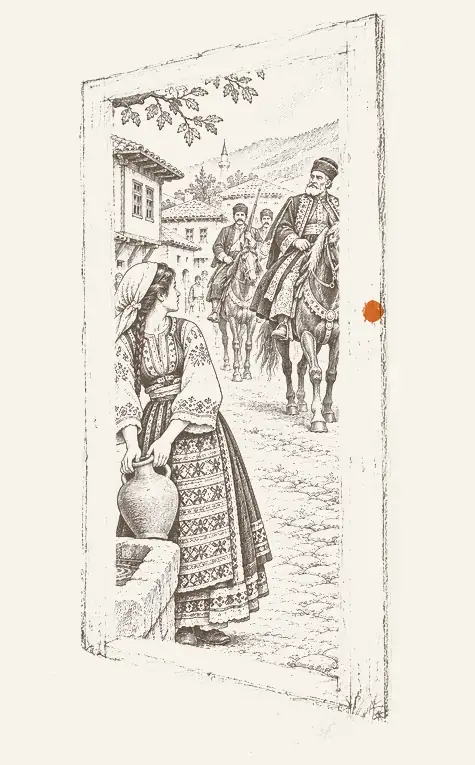
The Source of the White-Footed Girl: Gergana, a beautiful young girl from a Bulgarian village, has come to draw water at the spring when an Ottoman vizier sees her and urges her to follow him to Istanbul. She answers that she will never love anything as much as her Bulgarian land, her father's house and Nikola, the boy to whom she is promised, and the poem contrasts the young villager's fidelity with the power of the man who has fallen in love with her.
Context
The poem appeared in 1873 and is among the romantic works that the author devoted to the struggle for independence. It starts from a legend attached to a fountain near Harmanli, built by Siyavuş Pasha in the sixteenth century, and the author is said to have come to the region while looking for the tomb of King Vukašin, father of Marko Kraljević. Igor Kaliganov sees in it the popular image of beauty, honour and love of the native land; Gergana has become for critics the symbol of the Bulgarian woman.
Who it is for
A short poem, in verse close to popular song, which can be read in one sitting; no French or English translation has been found.
Prizes and reception
Regarded as one of its author's finest poems and one of the most studied works of Bulgarian literature.