Bulgaria
- works
- 47
- 33 books · 14 films
- period covered
- 1805–1988
- language of writing
- Bulgarian
The Cyrillic alphabet does not come from Cyril. The monk and his brother Methodius had devised in 863 a quite different script, Glagolitic, with round and complicated letters. Cyrillic was made a generation later by their disciples, in the literary schools of the first Bulgarian empire, at Preslav and at Ohrid, and they gave it the name of their master. The script that hundreds of millions of people read today was therefore designed here.
Read moreShow less
That priority has manufactured a lasting sensitivity. Bulgaria was the first Slavic literary centre, then five Ottoman centuries put it out of the European field of vision, and its national revival took place in the awareness of a forgetting. A monk of Mount Athos wrote in 1762 a history of the Bulgarian Slavs that would circulate for eighty years in manuscript copies, recopied by hand from monastery to monastery, before being printed. Not many founding books have lived so long without a printer, and that manual circulation explains the lasting prestige of the copyist in Bulgarian memory.
The form Bulgaria has carried furthest is the cruel self-portrait. In 1895, Aleko Konstantinov published the adventures of a Bulgarian rose merchant let loose in Europe, coarse, stingy, self-assured and ashamed at the same time. Bay Ganyo has become a common noun in the language, and a Bulgarian who calls someone that need not explain. The price was paid in cash: Konstantinov was shot dead two years later, Geo Milev disappeared in 1925 after a poem on repression and his body was found in a mass grave thirty years afterwards, Nikola Vaptsarov was executed by firing squad in 1942.
What awaits the reader is a literature that mocks itself with uncomfortable precision, and whose humour is never a consolation. The novel that opens this page takes place on the eve of the April Uprising of 1876, and its author wrote it in exile in Odessa.
A way to begin
Under the Yoke
Ivan Vazov · 1889
The first great Bulgarian historical novel, free of rights: voted the Bulgarians' favourite novel in 2009.
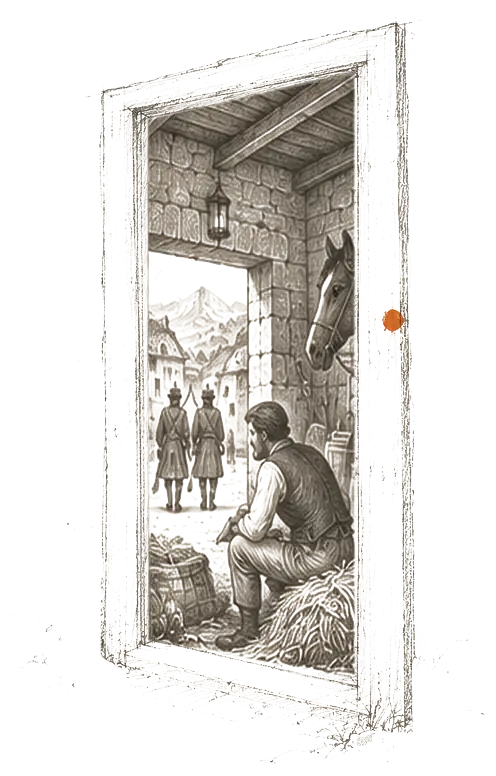
In the spring of 1875, in Byala Cherkva, a small mountain town, the supper of the notable Marko is interrupted by a fugitive hiding in his stable: Ivan Kralich, escaped from an Ottoman prison. Under a new identity, that of the schoolmaster Boycho Ognyanov, he gradually wins the inhabitants over to the cause of freedom, takes the lead of the secret committee and falls in love with Rada, a young orphaned schoolteacher.
Timeline
- 886–1396Medieval BulgariaOne of the oldest Slavic literatures, born with the alphabet and the First Empire.
- 1393–1878Five Ottoman centuriesThe lettered elite is broken. Culture survives in monasteries and exile.
- 1800–1878Bulgarian RevivalNational awakening: schools reopen, a language is rebuilt, an uprising is prepared.
- 1876The April UprisingCrushed in blood, it moves Europe and hastens independence. It haunts all the literature that follows.
- 1878–1918The new stateThe national novel, then satire of what the freed country becomes.
- 1900–1944Symbolism and modernityPoetry opens to Europe. Geo Milev pays with his life for his poem September.
- 1946–1989People's RepublicA literature under constraint, where indirection and allusion become an art.
- 1950–1990Bulgarian cinemaFrom the Sofia animation school to the dramas of Metodi Andonov and Ludmil Staikov.
Reading keys
- Names end in -ov, -ev or -ski, and the feminine form adds an a: the wife of Ivanov is Ivanova. This is not a different family name.
- The intermediate patronymic, formed on the father's first name, appears in official documents: Ivan Petrov Georgiev is Ivan, son of Petar, of the Georgiev family.
- The day of the saint whose name one bears, the imen den, is celebrated more than the birthday and one does not need an invitation to turn up.
- The godfather, kum, has a lasting role in family decisions.
- The communist period, from 1944 to 1989, and the "revival process" that forced the Turkish minority to change its names in the nineteen eighties are still difficult subjects.
- Censorship produced an allusive way of writing whose habit has survived. The grotesque and the tale served to speak of the present.
- The nod of the head is inverted: shaking the head sideways means yes, and a movement upwards means no. That inversion is legible in scenes of dialogue.
- One does not complain of one's own situation in front of a superior, but general complaint about the country is a mode of conversation.
- Orthodoxy is in the majority, with a Church that was an instrument of national survival under the Ottoman Empire and a disputed actor under communism.
- An old Muslim minority, Turkish and Pomak, is present in the south and the north-east, and its mention in a narrative is rarely neutral.
- The Julian calendar for the feasts makes certain celebrations fall on dates different from Western usage.
- The samodivi, supernatural young women of springs and clearings, and the zmey, an amorous dragon who carries off girls, belong to village belief and not to the scenery.
- Black is the colour of mourning and is worn for a long time, notably by village widows.
- The funeral ritual follows dated stages: forty days, six months, one year, with boiled wheat distributed each time.
- On 1 March, the martenitsa, a red and white cord worn until one sees a stork, opens the spring.
- The nestinari, fire-walking dancers of the south-east, and the masked koukeri of winter belong to living rites and not to reconstructions.
- Bay Ganyo, the coarse Bulgarian let loose in Europe, has become a common noun and an affectionate insult.
- The popular songs collected by Shapkarev and by the Miladinov brothers, with the samodivi and the foundation sacrifice of the bridge, are the stock shared with Macedonia.
- Krali Marko, a hero both invincible and a vassal of the sultan, runs through the whole Balkan epic stock.
- The haiduk, the outlaw avenger of the forests, is the central figure of the nineteenth-century national narrative.
- Bulgaria is not a late periphery of the Slavic world: it is its first written centre, and Cyrillic was designed there.
- The inverted nod of the head produces real misunderstandings in translated scenes of dialogue.
- The word "yoke", which gives the national novel its title, designates Ottoman domination and charges any use of the term.
- The claim to the Macedonian heritage is a live dispute with the neighbouring country, which this file documents without settling it.
Tales and mythologies 1
- PoetryБѫлгарски народни пѣсниDimitar Miladinov and Konstantin Miladinov · 1861not translated into EnglishThe great collection of folk songs published by two brothers from Macedonia on the eve of their deaths.Literature
A selection to begin with 10 / 47
- NovelBai Ganyo: Incredible Tales of a Modern BulgarianБай ГаньоAleko Konstantinov · 1895A rose merchant crosses Europe without seeing anything, then returns home to go into politics.LiteraturePublic domain
- Short storiesThe Lady with the X-Ray EyesДамата с рентгеновите очиSvetoslav Minkov · 1934Satirical stories in which technical progress promises happiness and makes it all wrong.Literature
- PoetryМоторни песниNikola Vaptsarov · 1940not translated into EnglishA worker poet expresses his faith in life, in a language close to speech.LiteraturePublic domain
- NovelThe Iron CandlestickЖелезният светилникDimitar Talev · 1952A man of the mountains comes down to a town in Macedonia, founds a household there, and his children enter a struggle over church and language.Literature
- CinemaDetourОтклонениеGrisha Ostrovski and Todor Stoyanov · 1967Former lovers meet again after years and question what separated them.Cinema
- Short filmThe Three FoolsТримата глупациDonyo Donev · 1970Three wordless companions, the first heroes of a satirical series in Bulgarian animation.Cinema
- CinemaThree ReservistsТримата от запасаZako Heskiya · 1971Three reservists go up to the front line in Hungary in 1945, with no aptitude whatever for war.Cinema
- CinemaVacation with KidsС деца на мореDimitar Petrov · 1972Two stories of a summer at the seaside, where the adult world is seen through children's eyes.Cinema
- CinemaThe Goat HornКозият рогMetodi Andonov · 1972To avenge his wife, a shepherd raises their daughter as a boy, far from everything, in the mountains.Cinema