Novel
La Terre paternelle
Not translated into English
Patrice Lacombe · 1846
Synopsis
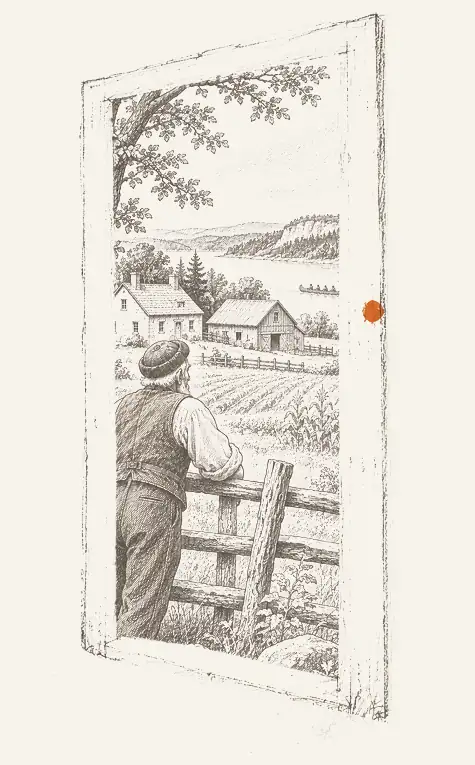
At Gros Sault, on the north shore of the island of Montreal, the Chauvins have held for several generations the land granted to their ancestor. The father lives comfortably with his wife, his sons Jean-Baptiste and Charles and his daughter Marguerite. When the younger son, Charles, leaves as a voyageur for the pays d'en haut, the father, to keep the elder, makes over the land to him by a deed of gift with heavy conditions. The gift goes badly; the father takes the land back, rents it out and opens a business in a village in the district of Montreal. Failed harvests and lost credit lead him to seizure, then to poverty in the city.
Context
The text appeared without an author's name in February 1846 in the Album littéraire et musical de la Revue canadienne, in Montreal, and was reprinted in 1848 in James Huston's Répertoire national; the first separate volume, of eighty pages, dates from 1871. Near the end, the narrator addresses the reader: “Laissons aux vieux pays, que la civilisation a gâtés, leurs romans ensanglantés”, and let us paint the child of the soil as he is. The Dictionary of Canadian Biography sees in it the prototype of the novel of the paternal land.
Who it is for
A very short text, in simple language and with an explicit moral, running to eighty pages.
Prizes and reception
Regarded as the first Quebec novel of the soil, reprinted at least eleven times up to 1972.
Sources for this page 7
The pages consulted to check this page.