Armenia
- works
- 54
- 36 books · 18 films
- period covered
- 1002–1996
- language of writing
- Armenian
On 24 April 1915, the Ottoman police arrested several hundred Armenian notables in Constantinople. Among them, almost all the writers of the capital: the poet Siamanto, the short-story writer and member of parliament Grigor Zohrab, Daniel Varoujan, Roupen Zartarian. They were deported to the interior and killed in the following weeks. In one night, a literature lost its living generation, its reviews, its circles and its reference language, Western Armenian, which has since had no country in which to be spoken daily.
Read moreShow less
That literature had fifteen centuries of writing behind it. A monk named Mesrop had invented around 405 an alphabet for a language that had none, with thirty-six letters designed for it alone, and the first sentence written in Armenian was a translated verse. The manuscripts were copied without interruption, hidden, bought back from looters, transported in pieces; the depository in Yerevan preserves thousands of them. Writing in Armenian has always been an act of conservation as much as of creation, and the word that designates the manuscript depository simply means "place of books".
Hence two parallel literatures that do not read each other easily. The eastern one, in Armenia and then in the Soviet Union, with its Soviet poets and its state cinema. The western one, in the diaspora, in Beirut, Paris, Boston, Cairo, which writes in a language without a territory. Cinema produced a limit case: an Armenian born in Tbilisi, trained in Moscow, who filmed in Ukrainian, in Georgian and in Azerbaijani, and whose 1969 film about an eighteenth-century poet is a series of almost motionless tableaux. He spent four years in a camp.
What awaits the reader is a literature of inventory and of mourning, but also a ferocious humour about notables and a very ancient mysticism. The book that opens this page was completed around the year 1000 by a monk who confesses his sins and those of all Adam's descendants, and Armenians read it at the bedside of the sick.
A way to begin
Book of Lamentations
Gregory of Narek · 1002
The book of prayers from the year 1000, the most beloved work of Armenian literature, free of rights.
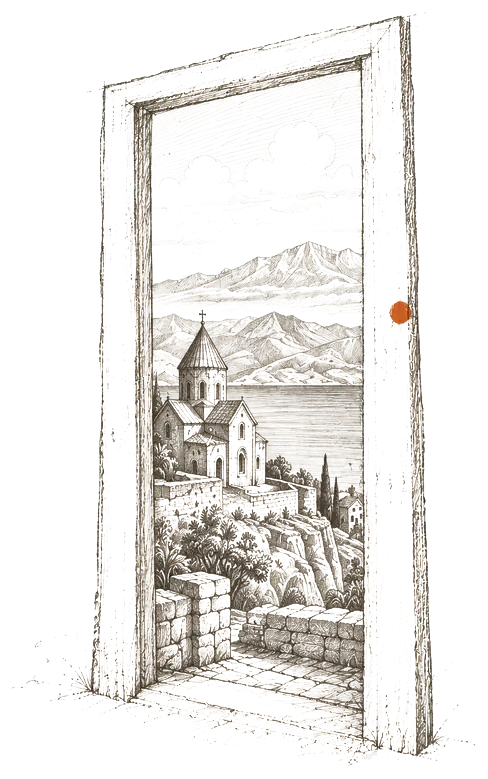
Ninety-five prayers, nearly all titled "Words addressed to God from the depths of the heart". The poet confesses his sins and those of all the descendants of Adam, measures his unworthiness before divine holiness, then entrusts himself to a grace that makes up for what he cannot merit.
Timeline
- 977–1758Mystics and ashughsNarekatsi, Kuchak, Sayat-Nova. The language is first written in prayer and song.
- 1841–1900Armenian renaissanceAbovian, Raffi, Baronian. Constantinople and Tiflis write in two forms of the language.
- 1900–1915A generation cut downSiamanto, Zohrab, Tlkatintsi. The genocide takes almost an entire literature.
- 1920–1937SovietisationCharents and Bakunts, first carried by the regime, then swept away by the Terror of 1937.
- 1965–1996Armenian cinemaMalian, Dovlatian, and Parajanov's The Colour of Pomegranates.
Reading keys
- Names almost all end in -ian or -yan, which means "of the family of". Tumanyan is "of the family of Tuman".
- Prefixes sometimes indicate the ancestor's occupation: Ter- designates a descendant of a priest, a name in -oghlu a Turkish-speaking origin.
- The transcription varies according to whether one goes through Russian, French or English: Tumanyan, Toumanian and Thoumanian are the same man.
- The distinction between Western and Eastern Armenian affects the spelling of names and signals an author's origin.
- The genocide of 1915 is the central fact, its recognition is a permanent diplomatic stake, and its denial is an offence in several countries.
- The Soviet period produced an official literature and a forbidden literature, and several authors, including Charents and Bakunts, died in detention in the nineteen thirties.
- The Nagorno-Karabakh conflict and its two wars are subjects on which every account is situated.
- Restraint is valued, and the direct expression of grief passes for a weakness.
- The Armenian Apostolic Church has been autonomous since the fifth century, and Armenia presents itself as the first state to have adopted Christianity, in 301.
- The khachkar, a stone stele carved in the shape of a cross, is a religious object and a marker of territory.
- The aralez, winged dogs who licked the wounds of warriors to resurrect them, and the vishaps, dragons of the springs, belong to the pre-Christian stock.
- The cult of saints and the pilgrimages to the mountain monasteries are a living social fact.
- Mourning includes a wake, a burial, a funeral meal, then commemorations on the seventh and the fortieth day, and one year later.
- Black is worn for a long time by widows, including in the diaspora.
- 24 April is the day of commemoration of the genocide, and it organises the civil and diasporic calendar.
- Lavash, the pomegranate and the apricot are identity markers that the texts use without explaining them.
- David of Sassoun, an epic in four branches collected from 1873, is the national heroic narrative.
- The History of the Armenians by Movses Khorenatsi, of the fifth century, preserves the pre-Christian myths including Hayk the archer and the song of the birth of Vahagn.
- The tales rewritten by Hovhannes Tumanyan, including Nazar the Brave, are the stock that every Armenian schoolchild knows.
- The khachkar, Mount Ararat and the apricot tree are constant visual references.
- Armenian is neither a Slavic nor a Turkic language: it is an isolated branch of Indo-European, with an alphabet of its own.
- There are two literary Armenians, Western and Eastern, with different spellings and grammars, and the Western one is classified as endangered.
- Ararat, the mountain that is the country's emblem, is today in Turkey, which every Armenian knows and which no text explains.
- The most famous film-maker associated with Armenia was born in Georgia and filmed mostly elsewhere: belongings in the Caucasus do not sort themselves by country.
Tales and mythologies 1
- EpicDaredevils of SassounՍասնա ծռերAnonymous · 1874An oral epic in four branches, first recorded in the Mush region and published in 1874.Literature
A selection to begin with 10 / 54
- PoetryAnushԱնուշHovhannes Tumanyan · 1892A narrative poem of 1892 in which a village love is broken against the honour code of the mountain people.LiteraturePublic domain
- PoetryԴյուցազնորենSiamanto · 1902not translated into EnglishA first collection of 1902, born of the exile that followed the Hamidian massacres, in which poetry becomes a call to arms.Literature
- PoetryՄթնշաղի անուրջներVahan Terian · 1908not translated into EnglishFirst collection, published in 1908, by a Symbolist poet who renewed Eastern Armenian lyric poetry.LiteraturePublic domain
- Short storiesVoice of ConscienceԽղճմտանքի ձայներKrikor Zohrab · 1909First collection, from 1909, by a master of the realist short story, attentive to the women and the humble of Constantinople.LiteraturePublic domain
- TheatreAncient GodsՀին աստվածներLevon Shant · 1912A drama written in 1909, in which the life of a monastery cut off by the waters falters before the return of the world and of desire.Literature
- CinemaHello, That's Me!Բարև, ես եմFrunze Dovlatyan · 1966Chronicle of an Armenian physicist, from the war to the thaw, on a screenplay partly inspired by the life of Artem Alikhanian, founder of the Yerevan physics institute.Cinema
- Short filmAvdo's CarԱվդոյի մեքենանDmitri Kesayants · 1966A retro comedy from 1966 on the struggle between the old and the new in the Yerevan of the twenties.Cinema
- CinemaTriangleԵռանկյունիHenrik Malyan · 1967Chronicle of a forge in Leninakan on the eve of the war and during the conflict, seen at a child's eye level.Cinema
- CinemaThe Colour of PomegranatesՆռան գույնըSergei Parajanov · 1969An evocation in tableaux of an eighteenth-century Armenian troubadour, which Soviet censorship had re-cut before letting it circulate.Cinema
- CinemaChaosՔաոսLaert Vagharshyan · 1974Adaptation of Alexander Shirvanzade's novel about a Baku family undone by oil money.Cinema