Ecuador
- works
- 28
- 24 books · 4 films
- period covered
- 1789–1999
- language of writing
- Spanish
It is the only country in the world named after a geographical abstraction. In 1830, on separating from Greater Colombia, the new republic chose to call itself Ecuador, from the name of the imaginary line that crosses it. The name comes from an expedition: between 1735 and 1744, French academicians had come to measure an arc of meridian in order to know what shape the Earth had, and they had spent nine years in those mountains. A country named itself after a measurement taken by foreigners who had come to verify a hypothesis of Newton's.
Read moreShow less
That baptism leaves aside what the country contains. Ecuador is made of three worlds that do not resemble each other: the tropical and mixed-race coast of Guayaquil, the Andean and Quechua-speaking sierra of Quito, and the Shuar and Achuar Amazon. It has an important Afro-Ecuadorian population in the province of Esmeraldas, descended from slaves escaped from a shipwreck in the sixteenth century and long autonomous. Each of those worlds has produced its literature, with its publishers and its journals, and they read one another little.
The dominant form is the social novel, and it exploded in 1930. A group of authors from Guayaquil published that year a collective volume of short stories about the fishermen and the day labourers of the coast, with their speech transcribed as it is and their poverty unarranged, and the scandal was considerable. Jorge Icaza wrote in 1934 the servitude of the indigenous people of the sierra in a brutal novel, then in 1958 the portrait of a mixed-race man who plays at being white and detests himself. Adalberto Ortiz had given in 1943 the first great Afro-Ecuadorian novel. Cinema arrived late, with in 1990 an adaptation of a narrative of the coast.
What awaits the reader is a literature of popular speech, transcribed without correction or glossary, and a constant attention to skin colour. The novel that opens this page takes its title from Quechua, the plot of land a hacienda granted an Indian family in exchange for its labour, and it is the most famous of the indigenist novels.
A way to begin
The Villagers
Jorge Icaza · 1934
The most famous of the indigenist novels, translated into some forty languages.
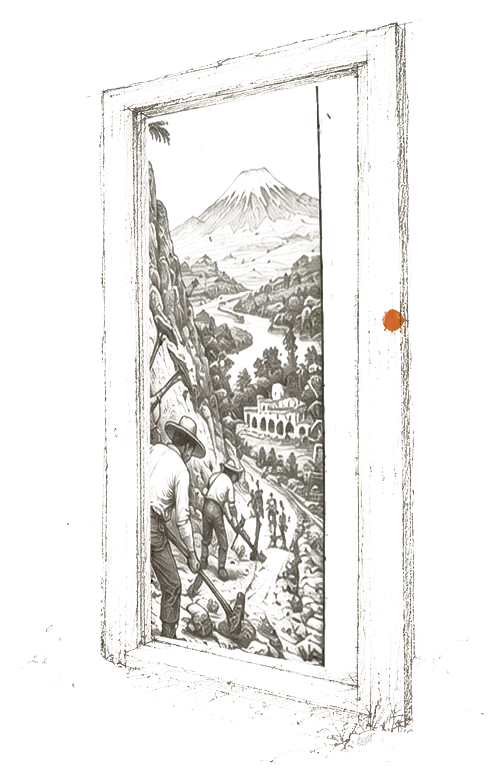
Pushed by his uncle and creditor, an indebted Quito landowner has a road opened across his hacienda, whose timber an American wants to exploit, and puts the Indians to forced labour. Andrés Chiliquinga sees the road advance over the bodies of his people, and the threat grow over the huasipungos, the plots where the families live.
Timeline
- 1877–1904FoundationJuan León Mera, Montalvo, Luis A. Martínez. From Romanticism to realism.
- 1930–1934The Guayaquil GroupGallegos Lara, Aguilera Malta, Gil Gilbert, De la Cuadra.
- 1934–1958IndigenismIcaza describes shame of oneself; the Andean novel finds its subject.
- 1969–1982The modern novelAdoum, Ubidia, Alicia Yánez Cossío, Adalberto Ortiz.
- 1949–1999Ecuadorian cinemaSantana, then Luzuriaga's La Tigra and Ratas, ratones, rateros.
Reading keys
- The Spanish usage of two surnames applies, and one classifies by the father's name.
- The Quechua names of the sierra and the Shuar names of the Amazon signal a claimed belonging, while the Afro-Ecuadorian names of Esmeraldas are Spanish.
- The word chulla designates in Quito a man without a fortune who looks after his appearance, and it gave its title to the country's great novel.
- Compadrazgo and festival charges, with their obligatory expenditure, structure the Andean communities.
- Racism and the system of colour, with its degrees named from white to black, are described with precision by the country's literature.
- Huasipungo, debt servitude that tied indigenous people to the estates until 1964, is the subject of Ecuador's best-known novel.
- The conflicts linked to oil in the Amazon and the lawsuits against the companies are a major contemporary subject.
- The rivalry between Quito and Guayaquil, between the sierra and the coast, organises political life and is expressed by detour.
- Catholicism is very much in the majority, with a spectacular colonial baroque in Quito and much-followed patron saints' festivals.
- The Andean cults survive beneath the saints, with offerings to the earth and healers, the yachak, commonly consulted.
- The Shuar and the Achuar of the Amazon have their own cosmology, with Arutam, the vision-spirit obtained through a solitary quest, and Nunkui the mother of the garden.
- The Mama Negra of Latacunga, a festival in which a man plays a black woman on horseback, mixes indigenous, African and Spanish inheritances.
- The wake and the rites of the eighth day organise the mourning, with a shared meal.
- On 2 November, colada morada is eaten with breads in the shape of a swaddled child, and one goes to the cemetery with food.
- The Inti Raymi of the sierra, in June, and the carnival of Guaranda mark the festive calendar.
- The poncho, the hat and the hairstyle indicate precisely the community of origin in the sierra, notably at Otavalo.
- Velasco's History of the Kingdom of Quito, written in 1789, preserves the pre-Inca traditions of the Cañari, including the flood and the surviving brothers.
- The Ecuadorian popular songs collected by Juan León Mera in 1892 form the Hispanic documented corpus.
- Arutam and Nunkui, with the Shuar rites, are an Amazonian knowledge that the texts do not translate.
- Cantuña, the man who tricks the devil to whom he had sold his soul in order to build a forecourt, is the best-known legend of Quito.
- Ecuador is not a small Peru: it has its own languages, its own Amazonian peoples and an important population of African descent.
- The Otavaleños, often photographed, are a prosperous trading community and not a picturesque relic.
- The word indio is an insult in the country, and the texts that use it do so in order to quote it.
- The coast and the sierra have two distinct literatures, two forms of speech and two imaginations, and confusing them erases the essential.
Tales and mythologies 1
- ChronicleHistoria del Reino de QuitoJuan de Velasco · 1789not translated into EnglishThe pre-Inca kingdom of Quito and its dynasties, recounted by a Jesuit exiled in Italy and become an account of the origins of Ecuador.Literature
Available in English 8
The books from this country that can be read in English, in the original or in translation.
- NovelCumandá: The Novel of the Ecuadorian JungleCumandá o Un drama entre salvajesJuan León Mera · 1879The love of an Amazonian Indian woman and a young white man, at a time when the missions were advancing into the forest.Literature
- NovelDon GoyoDemetrio Aguilera Malta · 1933A mangrove archipelago where woodcutters live in harmony with the trees, and where one begins to see coming what will separate them.Literature
- NovelThe VillagersHuasipungoJorge Icaza · 1934The Indians of the Andean haciendas, crushed by the road that a landowner has built across their lands.Literature
- NovelOur Daily BreadNuestro panEnrique Gil Gilbert · 1942Rice growing on the coast, seen from the point of view of those who do the work and not of the one who sells it.Literature
- NovelJuyungoAdalberto Ortiz · 1943A Black boy from the northern coast who discovers racial hatred, then what poverty has in common for everyone.Literature
- NovelWhen the Guayacans Were in BloomCuando los guayacanes florecíanNelson Estupiñán Bass · 1954A liberal revolt seen from Esmeraldas, through the voices of the Afro-Ecuadorians who wage it.Literature
- NovelBruna and Her Sisters in the Sleeping CityBruna, soroche y los tíosAlicia Yánez Cossío · 1973A girl from the sierra who discovers what her family has passed over in silence, in a city where religion governs the hours.Literature
- NovelWolves' DreamSueño de lobosAbdón Ubidia · 1986Losers from the capital planning a heist, just as the country emerges from dictatorship.Literature
A selection to begin with 10 / 28
- NovelCumandá: The Novel of the Ecuadorian JungleCumandá o Un drama entre salvajesJuan León Mera · 1879The love of an Amazonian Indian woman and a young white man, at a time when the missions were advancing into the forest.Literature
- DocumentaryLos invencibles shuaras del Alto AmazonasCarlos Crespi Croci · 1927A Salesian missionary and his camera among the Shuar of the Ecuadorian Amazon, in 1926.Cinema
- NovelLos SangurimasJosé de la Cuadra · 1934not translated into EnglishA coastal family that knows no law but that of its patriarch, in a world where legend takes the place of history.Literature
- NovelOur Daily BreadNuestro panEnrique Gil Gilbert · 1942Rice growing on the coast, seen from the point of view of those who do the work and not of the one who sells it.Literature
- NovelJuyungoAdalberto Ortiz · 1943A Black boy from the northern coast who discovers racial hatred, then what poverty has in common for everyone.Literature
- NovelWhen the Guayacans Were in BloomCuando los guayacanes florecíanNelson Estupiñán Bass · 1954A liberal revolt seen from Esmeraldas, through the voices of the Afro-Ecuadorians who wage it.Literature
- NovelBruna and Her Sisters in the Sleeping CityBruna, soroche y los tíosAlicia Yánez Cossío · 1973A girl from the sierra who discovers what her family has passed over in silence, in a city where religion governs the hours.Literature
- CinemaArcilla indócilCarlos Pérez Agusti · 1983A village notable and his young employee, a union that the whole pueblo talks about, in defiance of class barriers.Cinema
- CinemaThe TigressLa TigraCamilo Luzuriaga · 1990Three orphaned sisters rule over a farm in montubio country; a healer has tied their salvation to the youngest sister's virginity.Cinema
- CinemaRatas, ratones, raterosSebastián Cordero · 1999Two cousins in a Quito of month-ends and debts, where theft stands in for a trade and where one of the two brings with him what he is fleeing.Cinema