Brazil
- works
- 75
- 47 books · 28 films
- period covered
- 1768–1998
- language of writing
- Portuguese
In May 1928, a São Paulo review published a manifesto that ends with a date: year 374 of the swallowing of Bishop Sardinha. The bishop had been shipwrecked on the coast of the Nordeste in 1556, and the Caeté had killed and then eaten him. Oswald de Andrade thus starts the Brazilian calendar from the day America swallowed Europe, and he is two years out in his count.
Read moreShow less
Digesting what comes from elsewhere is here a method more than a provocation. Romanticism had fabricated a noble Indian, that of Alencar's Guarani in 1857, while the country was still importing slaves: the abolition of 1888 is the last in the Americas. Mário de Andrade took the opposite path and drew the hero without character of Macunaíma from the Taurepang and Arekuna myths that the German ethnographer Koch-Grünberg had noted down in the north of the Amazon. The national narrative was assembled with material collected by a foreigner, in languages that are not the state's.
What the country invents next is a writing that lets speech in: Guimarães Rosa remade Portuguese with the speech of the sertão in Diadorim, in 1956, while Graciliano Ramos went the other way, towards the bone, with Barren Lives in 1938. The price is paid everywhere. Ramos had been arrested in 1936 without charge and transported in the hold of a ship with the prisoners of the Estado Novo. Cruz e Sousa, the son of freed slaves and the country's first great symbolist, died of tuberculosis in 1898 and his body returned to Rio in a cattle wagon. Mário Peixoto shot Limite in 1931 and never shot again. Glauber Rocha, who filmed Barravento among the fishermen of Bahia in 1962, died in 1981 after ten years of exile.
What awaits the reader is a literature that states hunger, drought and the city without seeking the picturesque, and a language that accepts being spoken before being written. The story that opens this page is by a grandson of freed slaves who became the first president of the Brazilian Academy, and it tells how a doctor comes to commit a growing number of his fellow citizens in the name of science.
A way to begin
The Alienist
Joaquim Maria Machado de Assis · 1881
A doctor commits, in the name of science, a growing number of his fellow citizens: a satirical tale by Machado de Assis, free of rights.
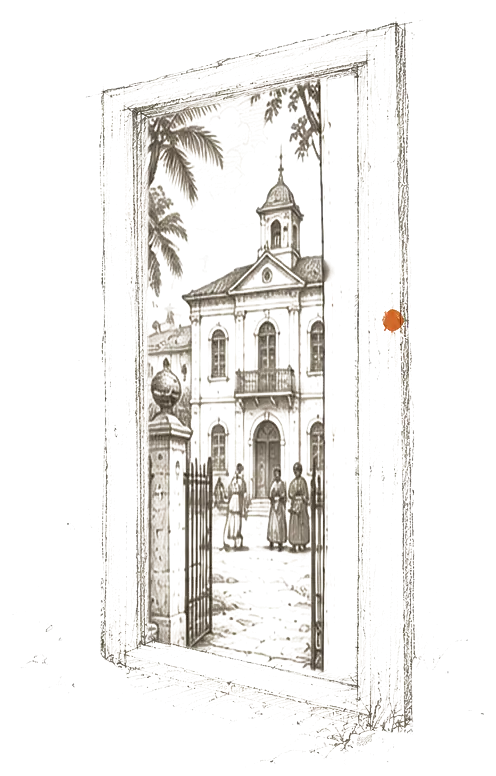
After a brilliant medical career, Simão Bacamarte returns to his home town of Itaguaí, devotes himself to the study of the mind and has an asylum built, the Green House, for the madmen of the region. Soon he sees madness everywhere and has residents committed whose only oddity is surprising. The town grows uneasy, and the barber Porfírio, who dreams of power, seizes the chance to stir it up.
Timeline
- 1500–1750ColonyJesuits, sermons, baroque poetry. Brazil first writes in Latin and European Portuguese.
- 1836–1880RomanticismThe literary Indian is invented, and the country begins to tell itself.
- 1880–1920Machado de AssisOne man alone raises the Brazilian novel to the level of the greatest.
- 1922Modern Art WeekSão Paulo launches modernism. Oswald de Andrade proclaims cultural cannibalism: devour Europe to digest it.
- 1930–1950Novel of the NordesteGraciliano Ramos, Jorge Amado. Drought, poverty, the land.
- 1955–1970Cinema NovoGlauber Rocha: a camera in hand, an idea in mind.
Reading keys
- The name is composed of the first name, the mother's surname and then the father's, and the order varies from one family to another, so that the last element is not always the transmitted name.
- People are designated by their first name or by a nickname, including in public life and in catalogue entries: Machado de Assis is Machado, Graciliano Ramos is Graciliano.
- Mário de Andrade and Oswald de Andrade are not related, and the Portuguese surnames of black families often come from the slave owners.
- Compadrio, the godparenthood that binds two families at baptism, creates lasting obligations between people of different conditions, and the text assumes it is known.
- Seu and dona before the first name mark respect without distance, and their use immediately places the relation between two characters.
- Colour is stated with a long series of terms, preto, pardo, moreno, negro, whose use depends on the speaker, the region and the period, and which do not translate term for term.
- The idea of a racial democracy, formulated in the nineteen thirties, has been contested since the nineteen sixties, and the debate on university quotas is its direct sequel.
- The dictatorship from 1964 to 1985 censored theatre, cinema and song, and the amnesty law of 1979 prevented trials, which leaves the subject open.
- Land conflicts, the landless and the demarcation of indigenous territories entail immediate political positions, including in a novel.
- Candomblé and umbanda are structured religions, with terreiros, initiation, hierarchy and calendar, and not survivals: the orixás there are acting entities, not symbols.
- The orixás come from the Yoruba and Fon stock, the same as Cuban santería and the Haitian lwa, and the correspondences with Catholic saints date from the slave period.
- Umbanda adds specifically Brazilian entities, Indian caboclos and pretos-velhos, old slaves, who speak through the mouths of the mediums.
- Kardecist spiritism has a numerous and educated following, distinct from the Afro-Brazilian cults, and the evangelical churches have modified the landscape since the nineteen eighties.
- White is required at the new year's eve and for the offerings to Iemanjá, thrown into the sea on 31 December and 2 February at Salvador.
- The carnival serves as a constant narrative hinge, with its four days that suspend ordinary relations, and it is not proper to Rio.
- The June festivals, with quadrilha, fires and maize, are the great festival of the Nordeste and a marker of working-class milieu.
- The burial follows the death very closely, the mass of the seventh day gathers the relatives, and the Círio de Nazaré, at Belém, moves a considerable crowd every year.
- The indigenous stock has passed into the common language with the Curupira, guardian of the forest with backwards feet, the Boitatá, the one-legged saci, and the Makunaima myths collected in the north.
- Sílvio Romero, in 1885, then Câmara Cascudo in the middle of the following century, established the reference collections, distinguishing the Portuguese, African and Amerindian contributions.
- Canudos, a community of the sertão destroyed in 1897 with its preacher Antônio Conselheiro, is the event to which literature returns most often.
- The cangaço and the figure of Lampião provide a repertoire of bandits, vengeances and laments that cinema took up as it stood.
- The sertão is not a desert but a populated semi-arid zone, with its economy, its towns and its cycles of drought.
- Brazilian modernism has dates of its own, the week of 1922, and does not follow the European avant-gardes: it eats them, which is not the same thing.
- The categories of colour cover neither the French nor the American ones, and the same individual may declare himself differently according to context.
- The country is not Spanish-speaking, and the Portuguese of Brazil differs from that of Portugal in pronunciation, syntax and the use of pronouns.
- The favela takes its name from a plant of the sertão growing on a hill at Canudos, which attaches the urban peripheries to that war.
Tales and mythologies 1
- TaleContos tradicionais do BrasilLuís da Câmara Cascudo · 1946not translated into EnglishA collection of one hundred popular tales heard in Brazil, arranged by families and annotated by a folklorist.Literature
A selection to begin with 10 / 75
- NovelThe GuaranyO GuaraniJosé de Alencar · 1857A novel in which an Indian warrior pledges boundless loyalty to the daughter of a Portuguese fidalgo, in a fortified house surrounded by the forest.LiteraturePublic domain
- PoetryBroquéisJoão da Cruz e Sousa · 1893not translated into EnglishA Symbolist collection in which whiteness, the melody of words and carnal desire contend for a poet in search of the absolute.LiteraturePublic domain
- NovelMacunaímaMário de Andrade · 1928A novel in which an Indian hero without character, changeable and lazy, crosses Brazil to recover a stolen amulet.LiteraturePublic domain
- CinemaLimiteMário Peixoto · 1931A silent film in which three castaways adrift relive their past in fragments of images.Cinema
- NovelBarren LivesVidas secasGraciliano Ramos · 1938A novel about a family of Nordeste peasants driven out by drought, told in thirteen almost self-contained chapters.Literature
- NovelThe Devil to Pay in the BacklandsGrande Sertão: VeredasJoão Guimarães Rosa · 1956A novel in a single unbroken block in which a former bandit of the sertão tells his life and wonders whether the devil exists.Literature
- CinemaThe Turning WindBarraventoGlauber Rocha · 1962A film about a man returned from the city who wants to tear his people away from what he regards as religious resignation.Cinema
- CinemaAll Nudity Shall Be PunishedToda nudez será castigadaArnaldo Jabor · 1973Film about a widower who has sworn never to remarry and falls in love with a prostitute.Cinema
- CinemaO homem que virou sucoJoão Batista de Andrade · 1980Film about a cordel poet who emigrated to São Paulo, mistaken for a murderer and forced into hiding.Cinema
- CinemaBye Bye BrazilBye Bye BrasilCarlos Diegues · 1980A film about a travelling fairground troupe crossing a Brazil that is converting to television.Cinema