Honduras
- works
- 32
- 30 books · 2 films
- period covered
- 1899–2000
- language of writing
- Spanish
The expression banana republic was coined for this country. An American writer, O. Henry, published in 1904 a collection of short stories set in a Central American country he calls Anchuria and which is transparently Honduras, and he used the formula to describe a state whose politics are decided in the offices of a fruit company. The word has stuck and is used today to insult any government. It designated first a precise situation: two American companies owned the land, the railways, the ports and a share of the members of parliament.
Read moreShow less
Honduran literature was built on that. Ramón Amaya Amador, a communist militant, published in 1945 the account of life in the banana plantations of the north coast, with the barracks, the illnesses, the pesticides and the strikes, and the book appeared in volume form in Mexico in 1950. The title speaks of a green prison, and the expression made its fortune. The country also has a dense and little-known poetic tradition, opened by Juan Ramón Molina at the end of the nineteenth century, continued by Clementina Suárez who ran galleries and supported several generations, and taken to its height by Roberto Sosa.
The country is also the place where the Caribbean north and the Pacific south do not resemble each other. The coast speaks Creole English and Garifuna, with villages whose memory goes back to the deportation of 1797, while the interior is Hispanic and peasant, with a Lenca stock. That double belonging appears in the narratives without being commented on. Cinema was born in 1962 with a medium-length film about a little shoeshine boy in Tegucigalpa, shot by a director trained in Italy, and it remains rare.
What awaits the reader is a precise poetry and a prose of testimony, in a country of which nobody has almost ever spoken except through a fruit. The novel that opens this page is set in the banana plantations of the north coast, and it was written by a former day labourer who had worked there as a young man.
A way to begin
Prisión verde
Ramón Amaya Amador · 1945
The banana enclave of the north coast told from within, by a former day labourer: the first banana novel of Honduras.
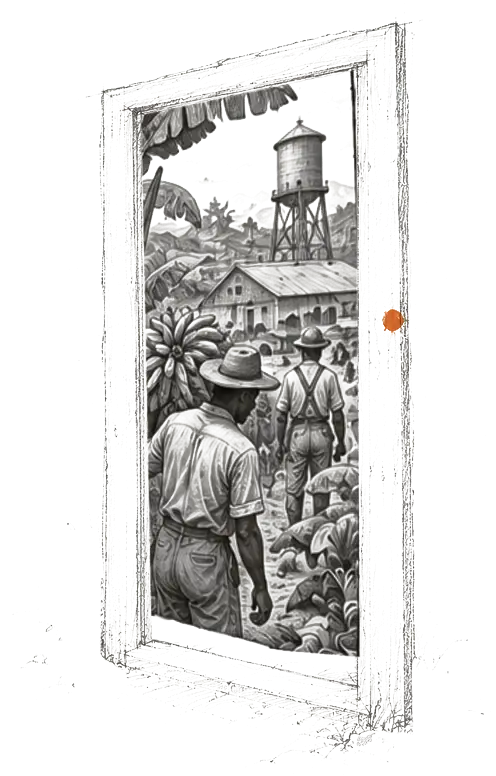
In the Bajo Aguán valley, on Honduras's north coast, cattle farmers who have sold their land to the banana company become day labourers on a plantation. Under violent foremen, the workers toil in the banana groves of the thirties and forties, and their shared suffering gradually makes the strike their weapon.
Timeline
- 1890–1920ModernismoJuan Ramón Molina, Froylán Turcios. The new verse arrives with Rubén Darío.
- 1908–1931First novelsLucila Gamero's Blanca Olmedo, and the anonymous corridos.
- 1945–1965The banana plantation novelAmaya Amador's Prisión verde: the American company enters the novel.
- 1955–1981PoetryClementina Suárez, Roberto Sosa, Óscar Acosta. A generation of magazines.
- 1962–1999A rare cinemaSami Kafati, Fosi Bendeck. A few films in a country with no industry.
Reading keys
- The Spanish usage of two surnames applies, and one classifies by the father's name.
- The Garifuna names of the coast, often French or Spanish, and the English names of the Bay Islands signal communities distinct from the Hispanic interior.
- Lenca and Miskito names survive in the regions concerned and indicate a claimed belonging.
- Emigration to the United States is massive and the money sent home represents a considerable part of the economy, which structures families.
- The control exercised by the fruit companies until the nineteen sixties and the strikes of 1954 are the base of the country's social literature.
- The coup of 2009 and the violence that followed, with one of the highest homicide rates in the world, are subjects on which writing exposes one.
- The assassination of environmental activists, including Berta Cáceres in 2016, is a documented and dangerous subject.
- Relations between the Caribbean coast and the interior are little approached head-on.
- Catholicism is in the majority, with a rapid advance of the evangelical churches.
- The Garifuna dugu, a ceremony of several days to appease the ancestors, is practised on the coast, and the drum there calls the dead.
- La Siguanaba and el Cadejo, a ghost dog, white or black, that follows nocturnal travellers, are the best-known figures of the popular stock.
- Lenca traditions, with the cult of the ancestors and the rain rites, survive in the west of the country.
- The wake and the nine days of prayers organise the mourning, with a commemoration at the end of a year.
- Black is worn in mourning, often for several months.
- The feast of the Virgin of Suyapa in February is the great national religious gathering.
- Garifuna punta and the drums of the coast mark the festivals, and 12 April commemorates the arrival of the Garifuna in Honduras.
- The narratives about the Miskitos and the coast, published in 1899 by a man raised among them, form the accessible early source.
- La Siguanaba and el Cadejo are known to all and are told to keep children at home.
- The Popol Vuh and the Maya narratives apply to the west of the country, where the site of Copán is located.
- Lempira, a Lenca chief who resisted the Spaniards in the sixteenth century, gives his name to the currency and serves as a heroic reference.
- The expression banana republic is an American literary invention applied to this country, and not a description that Hondurans would use.
- Honduras is not culturally homogeneous: the Caribbean coast is English-speaking and Garifuna, the interior Hispanic and Lenca.
- Honduran poetry is abundant and old, and reducing it to plantation literature distorts the image of the country.
- Copán is a major Maya site located in Honduras, which attaches the country to the Mesoamerican area as much as to the isthmus.
Tales and mythologies 1
- NarrativeTangweera: Life and Adventures among Gentle SavagesCharles Napier Bell · 1899A childhood among the Miskitos, told in the evening of his life by a Scot who became an engineer.Literature
Available in English 1
The books from this country that can be read in English, in the original or in translation.
- NovelThe ShipsLos barcosRoberto Quesada · 1988A young pineapple picker who dreams of writing, under the rule of an American fruit company: Roberto Quesada's first novel.Literature
A selection to begin with 10 / 32
- PoetryTierras, mares y cielosJuan Ramón Molina · 1911not translated into EnglishPoems and prose by a Honduran modernist, scattered in the press and gathered after his death.Literature
- Short storiesHumusVíctor Cáceres Lara · 1952not translated into EnglishCriollista stories from Honduras, published in the early fifties.Literature
- Short storiesSendas en el abismoMimí Díaz Lozano · 1959not translated into EnglishStories of the city and its distress, published in 1959 by a young Honduran woman, then forgotten for forty years.Literature
- EssayHistoria de las ideas contemporáneas en Centro-AméricaRafael Heliodoro Valle · 1960not translated into EnglishThe political and social thought of six Central American countries, traced in a book published a year after its author's death.Literature
- CinemaMi amigo ÁngelSami Kafati · 1962The first fiction film shot in Honduras by a filmmaker from the country, a neorealist medium-length film about the poor childhood of the capital.Cinema
- Short storiesEl rey del tangoEliseo Pérez Cadalso · 1964not translated into EnglishStories from the sixties, between the peasant vein and freer forms, haunted by the memory of a tango singer.Literature
- PoetryLos pobresRoberto Sosa · 1969not translated into EnglishA slim collection on the poor of Honduras, awarded a prize in Spain in the late sixties.Literature
- Short storiesEl cuento de la guerraEduardo Bähr · 1971not translated into EnglishThe short war of 1969 between two neighbouring countries, told by a Honduran writer two years after the fighting.Literature
- NovelThe ShipsLos barcosRoberto Quesada · 1988A young pineapple picker who dreams of writing, under the rule of an American fruit company: Roberto Quesada's first novel.Literature
- CinemaSpirit of My MotherEl espíritu de mi mamáAli Allie · 1999A Garifuna woman from Los Angeles returns to Honduras to perform the rites owed to her mother.Cinema