Belize
- works
- 11
- 11 books
- period covered
- 1920–1996
- language of writing
- English
In 1797, the British forcibly embarked more than four thousand people on ships and landed them on a deserted island off Honduras. They were the inhabitants of Saint Vincent, descendants of shipwrecked Africans and of island Caribs, who had resisted for thirty years. Half died of hunger and disease before arrival. The survivors dispersed along the coast of Central America and founded villages, several of them in Belize. They speak a Carib language with French and Spanish in it, they call themselves Garifuna, and their culture is listed as intangible heritage.
Read moreShow less
Belize is made of that kind of superimposed arrival. A former Maya territory, it became in the seventeenth century a den of English logwood cutters, the only British colony on a Spanish coast, then received African slaves, Garifuna, Maya and mestizo refugees fleeing the war in the Yucatán, German-speaking Mennonites, Chinese and Indians. The country is the only one in Central America to have English as its official language, and people there fluently speak Belizean Creole, Spanish, Garifuna, Maya and Plautdietsch.
Written literature is therefore very recent: the country has been independent only since 1981. Zee Edgell published in 1982 the first recognised Belizean novel, the story of a Creole adolescent in the nineteen fifties in a colony beginning to demand its independence. Raymond Barrow had laid the foundations with a poetry of the mangrove and the fisherman, and James Martinez published verse in Creole as early as 1920. The price is smallness: without publishing or a sufficient audience, authors publish in London or in the United States.
What awaits the reader is a literature of childhood and of the mosaic, in which one changes language while crossing a village. The novel that opens this page follows a schoolgirl in Belize City while the colony stirs around the independence movement, and it appeared a year after independence.
A way to begin
Beka Lamb
Zee Edgell · 1982
The first novel published in independent Belize: a schoolgirl in Belize City, her friend expelled from school and a colony in ferment.
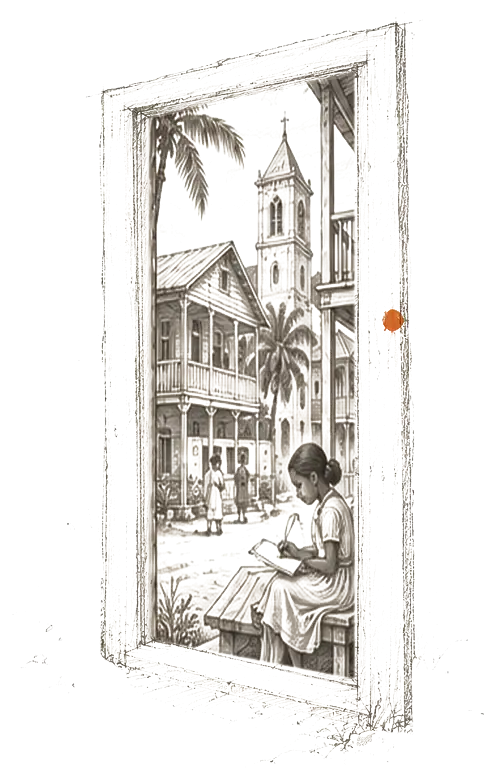
One November day, fourteen-year-old Beka Lamb wins an essay competition at St Cecilia's Academy in Belize City. While the colony stirs around the independence movement, she keeps in her mind a wake for her friend Toycie, three years older, expelled from school when she became pregnant.
Timeline
- 1922First versesJames Sullivan Martinez and his Caribbean Jingles.
- 1982Beka LambZee Edgell writes an adolescent girl and a nation, a year after independence.
- 1988The voices that followZoila Ellis, Leo Bradley, Raymond Barrow. A literature of small print runs.
Reading keys
- Creole names are British, Garifuna names often Spanish or French, Maya and mestizo names Hispanic, and Mennonite names German. The surname indicates the community precisely.
- Creole families are often matrifocal, with massive emigration to the United States and money sent home.
- The Garifuna are organised in coastal villages with a strong identity and a language of their own, transmitted by the women.
- The Mennonites live in separate communities, speak Plautdietsch and provide an important part of the country's agriculture.
- The territorial dispute with Guatemala, which claims part of the country, is a permanent subject.
- Relations between Creoles, long in the majority and holders of the administration, and Spanish speakers become the majority since the nineteen eighties, are a sensitive subject.
- The condition of the Mayas and access to the lands of the south are the object of legal proceedings.
- Belizean Creole is not the language of official writing, and using it is a decision.
- Catholicism and Protestantism share the population, with recent evangelical churches and Mennonite communities.
- The dugu, a Garifuna ceremony that gathers a family for several days to appease the ancestors, the gubida, is that community's central rite, with drums and trance.
- The Maya rituals of the Q'eqchi' and the Mopan survive in the south, with the spirits of the hills and the caves.
- The duende, a small man of the forests who punishes hunters, and the Xtabai, a woman who appears beneath a ceiba, belong to the stock shared with the Yucatán.
- The Creole wake is held for nine nights, and the Garifuna ceremony may be deferred by several years until the family gathers the means for it.
- 19 November, the day of the Garifuna arrival in 1832, is a public holiday celebrated by a re-enactment of the landing in dugout canoes.
- Punta, the Garifuna dance, and Creole brukdown are the country's two musics.
- The Garifuna drum, with its three sizes, calls the ancestors and is not played out of context.
- The Popol Vuh and the books of Chilam Balam apply to Belize, which is part of the Maya area, and the sites of Caracol and Lamanai are places of memory.
- The Garifuna narratives about the deportation of 1797 and the arrival of 1832 are that community's founding memory.
- The Xtabai, the duende and the creatures of the forest are a bestiary shared with the Yucatán and Guatemala.
- The narratives collected in 1918 by a British archaeologist among the Mayas of the south constitute the old documented corpus.
- Belize is not a Caribbean island: it is a country of continental Central America, but culturally Caribbean.
- The Garifuna are not Africans deported from Africa: they descend from Africans and island Caribs, and speak an Amerindian language.
- Belizean Creole is not bad English but a language in its own right, distinct from Jamaican.
- The country has been mostly Spanish-speaking since the nineteen eighties while its official language remains English, a gap that literature works on.
A selection to begin with 10 / 11
- PoetryCaribbean Jingles: Dialect and Other Poems of British HondurasJames Sullivan Martinez · 1920The first Belizean book to give wide space to Creole, published by a cabinetmaker of the colony.Literature
- PoetryDawn Is a FishermanRaymond Barrow · 1958A civil servant from Belize turns daybreak on the coast into a fishing scene.Literature
- NarrativeNorth Amerikkkan BluesEvan X Hyde · 1971A Belizean student returns from the United States carrying Black Power and says so in a book he publishes himself.Literature
- NovelThe Sinners' BossanovaGlenn D. Godfrey · 1987In the colony at war, a man has had the enemy supplied at sea and awaits the return of the boat that may ruin him.Literature
- Short storiesOn Heroes, Lizards and PassionZoila Ellis-Browne · 1988A lawyer from Dangriga tells, in seven short stories, of the Belize of the villages and that of the diaspora.Literature
- Short storiesThose Ridiculous YearsFelicia Hernandez · 1988A teacher from Dangriga, settled in California, tells the life of the Garifuna of her country in short stories.Literature
- PoetryBelizean FlavourLeo Bradley · 1991The first librarian of Belize brings together his poems and his stories about the country.Literature
- Short storiesPataki Full: Seven Belizean Short StoriesColville Young · 1991Belizean life in satire, by a linguist of Creole who became governor-general.Literature
- NarrativeCry Wolf: The Story of Hurricane HattieMilton Arana · 1993The testimony of a Belizean poet on the storm that devastated the colony's capital in 1961.Literature
- PoetryNaked Eye: Belizean Proverbs and PhilosophyGeorge Seymour Gabb · 1996A Belizean sculptor puts down in writing, in Creole and in English, the proverbs of his country.Literature