Solomon Islands
- works
- 5
- 5 books
- period covered
- 1924–1998
- language of writing
- English
In the lagoons of Malaita, people have manufactured their own islands. For centuries, the inhabitants of the Langa Langa and Lau lagoons carried blocks of coral by canoe to raise artificial islets above the reef, then settled on them, away from the mosquitoes and from raids from the interior. An ethnographer devoted a book to them in 1930 entitled "The Island Builders of the Pacific". The title was not a metaphor: eighty islets of that kind are still inhabited.
Read moreShow less
The whole country works on that principle of deliberate dispersal. Nearly a thousand islands, some sixty languages, and no unified power before the arrival of the British: each lineage held its stretch of coast, its ancestors and its shrines. The Solomons were moreover the theatre of the battle of Guadalcanal, which left on the ground wrecks, airstrips and a memory that contemporary narratives have not finished dealing with. The shell money made in those same lagoons still circulates to seal marriages and reparations.
Written literature there is exactly as old as independence, obtained in 1978. John Saunana published in 1980 the country's first novel: a boy sent to a colonial school learns enough there to turn that learning against his masters. The following year, Jully Makini published poems about what the same school did to girls, between the obedience they were taught and the village they no longer recognise. Two books, two positions, a single question put to the education received, and a literature that begins by asking what reading has cost.
What awaits the reader is short texts, written in a restrained English, in which the conflict is inner rather than spectacular. The novel that opens this page follows an unruly pupil in the country's only secondary school, run by the British, and its publisher presents it as the first novel from the Solomon Islands.
A way to begin
The Alternative
John Saunana · 1980
Presented by its publisher as the first novel from the Solomon Islands: a rebellious pupil in the British colonial school.
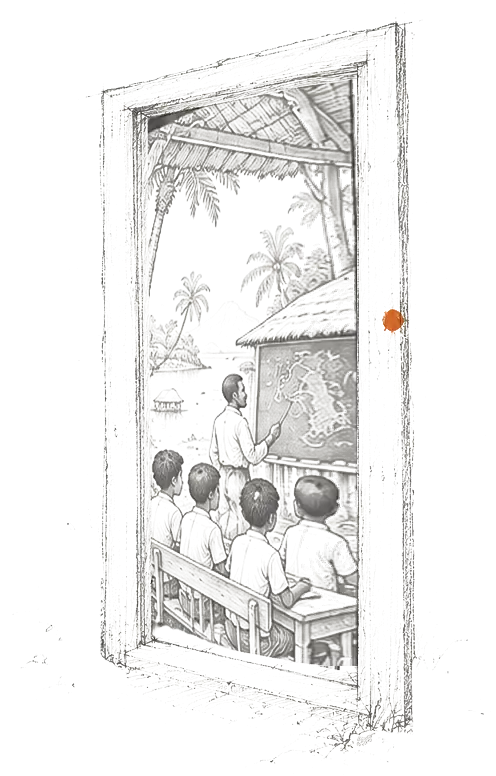
Maduru, a boy from a Solomons village, enters the British-run secondary school, the only one in the country, in the sixties. Intelligent but unruly, he refuses to wear a dress for the Christmas celebration or to apologise, and stands up to his mother and his dormitory mates. Between village life and the colonial school, he experiences the discrimination Europeans inflict on Solomon Islanders, and leads pupils against a teacher and the headmaster.
Timeline
- 1800–1900OralityNavigation tales, genealogies and chants circulate in some sixty languages.
- 1978IndependenceSchools and national radio open a space for writing in English and in pidgin.
- 1980–1990First booksPoetry and short stories appear in the Pacific reviews and with the publishers of Suva.
- 1998–2003The TensionsThe civil war and the regional mediation feed testimonies, theatre and documentaries.
Reading keys
- The name refers to the island, the lineage and the language, and that information is immediately legible for a local reader.
- Most societies are patrilineal but several are matrilineal, notably on Guadalcanal, which entirely changes who inherits and who decides.
- The big man draws his authority from his capacity to organise exchanges, not from birth. He is not a hereditary chief.
- The pidgin, called Pijin, serves as a common language and its use in a dialogue indicates an intercommunity situation.
- The civil conflict from 1998 to 2003, between people of Malaita and of Guadalcanal, is a raw subject that works approach by displacement.
- Kastom frames knowledge: certain narratives are reserved to a lineage and cannot be published.
- A direct request is impolite. One goes through an intermediary, and the narrative takes the time of that detour.
- Compensation, paid in shells, in pigs or in money, settles offences. A compensation scene is a legal scene.
- Christianity, Anglican, Catholic and evangelical, has been massively adopted, and the Church is a village institution.
- The cult of the ancestors persists beneath Christianity: skulls kept in shrines and forbidden places remain respected.
- Lineages hold food prohibitions and protective animals that identify them.
- Shell money, made in the lagoons of Malaita, has a ritual and not merely a commercial value.
- Mourning is accompanied by gifts and collective meals, and the exchange of pigs is counted publicly.
- Shell money, tafuliae, is displayed in strings whose length measures the commitment.
- 7 July, the day of independence in 1978, is the civil landmark.
- Sharing a meal cooked in an oven of heated stones seals agreements.
- The narratives collected on San Cristobal at the beginning of the twentieth century, with the spirits and the transformer heroes, constitute the main documented stock.
- The island builders of Malaita and their deified ancestors provide a strong identity reference.
- The battle of Guadalcanal belongs to collective memory, with its place names that became American.
- The figures of protective sharks and the pacts made with them circulate on several islands.
- The Solomon Islands have nothing to do with King Solomon: the name comes from a Spanish navigator who hoped to find his mines there.
- The big man is not a chief: his power is revocable and is played out again at each exchange.
- Head-hunting, abundantly described by Europeans, was a framed religious rite and not a generalised savagery.
- The English of the novels is not an impoverished English: the authors play on the gap between school English and Pijin.
Tales and mythologies 1
- NarrativeThe Threshold of the PacificCharles Elliot Fox · 1924A missionary encouraged by the anthropologist Rivers records for thirteen years the customs and tales of a Melanesian island.Literature
A selection to begin with 3 / 5
- PoetryCivilized GirlJully Makini · 1981Three years after independence, a young poet looks at what modernity does to the women of her archipelago.Literature
- NovelTwo Times ResurrectionRexford Orotaloa · 1985A young Solomon Islander between the island of the ancestors, school and the town, in the age of money.Literature
- PoetryRaindropsCelo Kulagoe · 1998Short poems by a Solomon Islands teacher, on those close to him and the life of the islands, illustrated by Frederick Butafa.Literature