Iceland
- works
- 51
- 46 books · 5 films
- period covered
- 900–1993
- language of writing
- Icelandic
On 21 April 1971, fifteen thousand people were waiting on the quayside at Reykjavík, close to one inhabitant in ten, and national television was broadcasting live for the first time in its history. A Danish navy vessel was landing two manuscripts, the Codex Regius of the Poetic Edda and the Book of Flatey, which an Icelandic bishop had given to the king of Denmark three centuries earlier. The return of the rest of the collection took twenty-six years.
Read moreShow less
Those manuscripts are not relics but title deeds. The sagas recount the settlement of the families, farm by farm, with the genealogies, the divisions and the lawsuits, and they served as land memory for a society without a king until 1262. The language has moved so little that a reader today deciphers a thirteenth-century text, the result of a Bible printed in Icelandic as early as 1584, of an early literacy through the farms and of the isolation of an island of fifty thousand inhabitants under Danish trade monopoly.
The form is a narrative without interiority: acts, brief replies, and not a word from the narrator on what to think of them. Njáls saga sets out a chain of vengeances and procedures over more than a hundred chapters without ever designating a guilty party. The price is double. The manuscripts served as dressmaking patterns and as bookbinding material, and part of the collection gathered in Copenhagen burnt in the fire of 1728. Then, in order to be published, the writers had to leave the language or the island: Jóhann Sigurjónsson wrote his plays in Danish, Gunnar Gunnarsson did the same, and Stephan G. Stephansson composed in Icelandic on a farm in Alberta.
What awaits the reader is a dry prose that keeps to the fact and leaves the emotion aside, and a poetry that still counts its alliterations. The novel that opens this page starts from a peasant forced to help the king's executioner bring down the country's old bell, and it appeared from 1943 to 1946, as Iceland was gaining independence.
A way to begin
Iceland's Bell
Halldór Laxness · 1946
An Icelandic peasant, a bell torn down and ancient manuscripts, under Danish rule: the masterwork of the Nobel laureate Halldór Laxness.
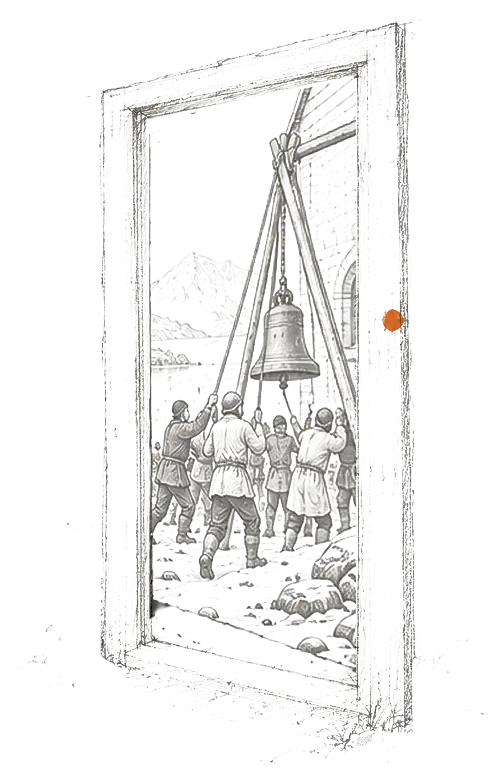
At the end of the seventeenth century, when Iceland is under Danish law, the peasant Jón Hreggviðsson, convicted of stealing a rope, must help the king's executioner tear down the country's old bell. The executioner is found dead after a drinking bout, and Jón, who remembers nothing, is sentenced to death; he flees as far as Denmark to obtain a pardon, while Snæfríður, a judge's daughter, and Arnas Arnæus, a collector of manuscripts, appear.
Timeline
- 1200–1350SagasTales of farmers, killings and lawsuits, written in a dry, modern prose.
- 1220EddaSnorri Sturluson records the Norse mythology we would not otherwise know.
- 1930–1970LaxnessA single writer carries Iceland all the way to the Nobel, in 1955.
Reading keys
- There is no family name: everyone bears their father's first name followed by son or dóttir, so that the mother, the father and the children of one household bear four different names.
- One classifies and designates by the first name, including in the telephone directory, the newspapers and bibliographies, and an author is cited by their first name.
- First names are controlled by a committee that checks their compatibility with Icelandic declension, and the use of family names is reserved for families that already had them.
- Genealogy is a national practice, supported by continuous registers, and two characters who meet often know how they are related.
- Danish dependence, the trade monopoly and the famines of the eighteenth century are the matrix of the national narrative, and the sovereignty of 1918 as well as the republic of 1944 are its outcome.
- The American military base at Keflavík, present from 1951 to 2006, divided the country and is found again in the novels of the period.
- The banking collapse of 2008 produced a literature of fault and of accounting, and the subject remains sensitive.
- Belief in the hidden people is an object of irony as much as of seriousness, and a text may play on both registers without deciding.
- Christianisation was voted at the assembly in the year one thousand, with a provisional tolerance of pagan practices, which explains the respect with which Snorri Sturluson sets out the mythology two centuries later.
- The huldufólk, hidden people who inhabit the rocks, still cause road works to be diverted, and the map of the places that belong to them is taken seriously by the administrations.
- The Lutheran Church is official, with weak practice, and a reconstituted pagan cult has been recognised since 1973.
- The revenants of the sagas and the tales are not ghosts but bodily dead who come back to claim and who must be fought physically.
- The þorrablót, in January and February, gathers people around preserved foods, sheep's head and fermented shark, and serves as a winter festival and a reminder of privations.
- 17 June, the national holiday, commemorates the birth of a nineteenth-century leader rather than the declaration of 1944.
- On the night of 23 December, the Christmas vigil begins with the distribution of books, the country publishing the bulk of its production in November and December.
- Funerals are Lutheran and sober, and the names of the dead go on circulating in the family's first names.
- The sagas of the Icelanders, written in the thirteenth and fourteenth centuries about events of the settlement period, are a stock that every text assumes has been read, with their characters named like neighbours.
- The Völuspá, the prophecy of the seeress that opens the Poetic Edda, gives the creation and the end of the world, and provides the material of the common Nordic mythology.
- Jón Árnason's collection of tales, published from 1862, holds the role of the Brothers Grimm: trolls, hidden people, spectres and outlaws.
- The outlaws who survive in the highlands, Grettir or Eyvindur, are the figure of the excluded that literature takes up until the twentieth century.
- The sagas are not epic poems but narrative prose, with dialogues, legal procedures and dry humour.
- Edda designates two different things: a collection of anonymous poems of the thirteenth century and Snorri Sturluson's manual of poetics.
- Viking is an activity, not a people: the Icelanders of the sagas are landowning farmers who litigate more often than they pillage.
- A population of that size produces an abundant literature because the state subsidises it and the readership is massive, not because the country would be naturally poetic.
- Icelandic is not a frozen archaic language: vocabulary is created by learned composition rather than borrowed, which gives the impression of continuity.
Tales and mythologies 20
- PoetryThe Prophecy of the SeeressVöluspáAnonymous · 1000A Norse cosmogony and eschatology, spoken by a seeress to the god Odin.Literature
- ChronicleFagrskinna: A Catalogue of the Kings of NorwayFagrskinnaAnonymous · 1220The history of the Norwegian kings told soberly, from one battle to the next, for the Norwegian court.Literature
- ChronicleMorkinskinna: The Earliest Icelandic Chronicle of the Norwegian Kings (1030-1157)MorkinskinnaAnonymous · 1220The court of the Norwegian sovereigns seen by Icelanders, who find their place there through speech and verse.Literature
- NovelThe Saga of Tristram and ÍsöndTristrams saga ok ÍsöndarBrother Robert · 1226The first French courtly romance to be rendered into Old Norse, at the request of a king of Norway.Literature
- NarrativeThe Saga of Erik the RedEiríks saga rauðaAnonymous · 1250The voyages of the Norse to Greenland and the lands of the West, told by the Icelanders two centuries later.LiteraturePublic domain
- ChronicleHeimskringlaSnorri Sturluson · 1230The great collection of kings' sagas, written in Iceland around 1230, in a language that was not that of the clerics of Europe.Literature
- NarrativeGisli Sursson's SagaGísla saga SúrssonarAnonymous · 1250A saga of Icelanders that takes as its subject vengeance when it destroys a family instead of drawing it closer together.Literature
- NarrativeLaxdaela SagaLaxdæla sagaAnonymous · 1245A family saga from the west of Iceland, in which a woman plays the leading role and love rekindles an old quarrel.LiteraturePublic domain
- NarrativeNjal's SagaNjáls sagaAnonymous · 1280A saga of vendetta and law in Iceland around the year one thousand, written nearly three centuries later.Literature
- EpicThe Saga of the VolsungsVölsunga sagaAnonymous · 1270The prose rendering of a heroic matter common to the Germanic world, in which one recognises the fall of a Burgundian kingdom.Literature
- EpicThe Saga of King Hrolf KrakiHrólfs saga krakaAnonymous · 1400An Icelandic legendary saga, telling of Danish kings of the fifth and sixth centuries, the very ones that Beowulf names.LiteraturePublic domain
- NarrativeGrettir's SagaGrettis saga ÁsmundarsonarAnonymous · 1320The life of an Icelandic outlaw of the eleventh century, mingling legal quarrels with trolls, berserkers and walking dead.LiteraturePublic domain
- PoetryThe Lay of HamdirHamðismálAnonymous · 900A sister's vengeance carried out by her brothers, at the court of a Gothic king: the last heroic song of the manuscript of the Eddic poems.LiteraturePublic domain
- PoetryThe Lay of AtliAtlakviðaAnonymous · 900The visit of the Burgundian kings to Atli's court, a distorted memory of the wars between Huns and Burgundians in the fifth century.LiteraturePublic domain
- EpicThe Saga of King Heidrek the WiseHeiðreks sagaAnonymous · 1250A legendary saga that brings together older materials, including the memory of the wars between Goths and Huns in the fourth century.LiteraturePublic domain
- PoetryThe Lay of SkirnirSkírnismálAnonymous · 900A god's marriage proposal to a giantess, carried out by a messenger who moves from gifts to threats.LiteraturePublic domain
- PoetryHávamálAnonymous · 1000The practical wisdom of the ancient Nordic world, put in the mouth of Odin, and the account of his winning of the runes.LiteraturePublic domain
- PoetryThe Lay of VafthrudnirVafþrúðnismálAnonymous · 950A contest of knowledge between a disguised god and a giant, in which each answer yields a fragment of Norse cosmology.LiteraturePublic domain
- PoetryBaldr's DreamsBaldrs draumarAnonymous · 950A god who goes down among the dead to question a seeress about his son's dreams.LiteraturePublic domain
- PoetryThe Greenlandic Lay of AtliAtlamálAnonymous · 1150The fall of the sons of Gjúki at Atli's court, told again in a long, dark poem that is linked to Greenland.LiteraturePublic domain
A selection to begin with 10 / 51
- PoetrySonatorrekEgill Skallagrímsson · 960A tenth-century lament, composed by a skaldic warrior and preserved in a saga written nearly three hundred years later.Literature
- PoetryAndvökurStephan G. Stephansson · 1909not translated into EnglishThe poetry of an Icelandic emigrant on the Canadian prairies, written in his native language, far from any literary life.LiteraturePublic domain
- TheatreEyvind of the HillsFjalla-EyvindurJóhann Sigurjónsson · 1911The story of a couple of outlaws of the highlands, drawn from an Icelandic folk tale.Literature
- CinemaSons of the SoilSaga BorgarættarinnarGunnar Sommerfeldt · 1920The first fictional feature film shot in Iceland, undertaken by a Danish studio from an Icelandic novel written in Danish.Cinema
- NovelThe Virgin of SkalholtSkálholtGuðmundur Kamban · 1930A drama of love and authority in episcopal Iceland in the seventeenth century, drawn from a real case.Literature
- NovelThe Good ShepherdAdventGunnar Gunnarsson · 1936An Icelandic shepherd in the winter mountains, and what the duty owed to lost animals costs.Literature
- CinemaBetween Mountain and ShoreMilli fjalls og fjöruLoftur Guðmundsson · 1949A love story thwarted by a suspicion of theft, among the farmers of a still rural Iceland.Cinema
- CinemaLand and SonsLand og synirÁgúst Guðmundsson · 1980The rural exodus of the thirties, in one of the first three feature films supported by the Icelandic film fund.Cinema
- CinemaWhen the Raven FliesHrafninn flýgurHrafn Gunnlaugsson · 1984An Icelandic-Swedish adventure film that treats the Viking age in the manner of Sergio Leone's westerns.Cinema
- CinemaChildren of NatureBörn náttúrunnarFriðrik Þór Friðriksson · 1991Two old people flee the capital's care home to find the places of their youth.Cinema