Jamaica
- works
- 26
- 18 books · 8 films
- period covered
- 1903–1999
- language of writing
- English
In 1739, the British signed a peace treaty with runaway slaves. After more than ten years of war in the mountains of the interior, the crown recognised the Maroons of Jamaica in their freedom, their lands and their right to govern themselves, in exchange for the return of future fugitives. Those communities still exist, with their chiefs and their ritual language. A woman who commanded one of those groups, Nanny, is today the country's only national heroine, and her face appears on the banknotes.
Read moreShow less
That precedent explains a culture that has never stopped fabricating its own forms. Jamaica invented Anansi the storyteller, Patois, Rastafari, ska, reggae, dub and dancehall, and it exported all of that without going through an institution. Jamaican Patois, a language in its own right issued from English and the Akan languages, was long treated as damaged English, and Louise Bennett spent forty years writing poems in it before being taken seriously: she was considered an entertainer, and her poems went out on the radio between two advertisements.
Hence a literature in which the voice counts for more than the page. Linton Kwesi Johnson recorded from 1975 poems in Patois over bass rhythms, and invented a form that would be called dub poetry. Claude McKay had published as early as 1912 poems in Patois before leaving for Harlem and becoming a voice of the black American renaissance. Cinema follows the same logic: the 1972 film about a young country singer come up to Kingston, with its soundtrack that became worldwide, is the first Jamaican feature and it did more for the language than any textbook.
What awaits the reader is a literature that is heard more than it is read, and that assumes one accepts stumbling over the first pages. The collection that opens this page dates from 1912 and it was already written in the country's language.
A way to begin
Songs of Jamaica
Claude McKay · 1912
The first book of verse written in the language of Jamaica, free of rights: the hill peasants have their say.
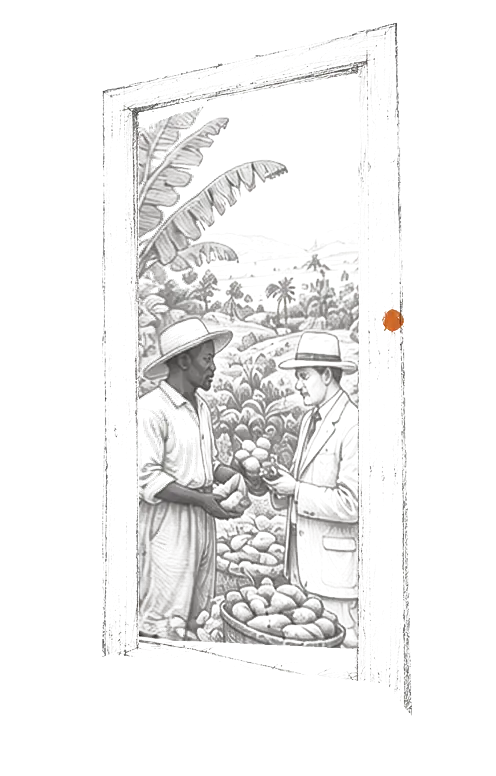
Twenty-four poems in Jamaican Creole, spoken mostly by hill peasants. The first has the Black farmer speak to the white man who buys his potatoes without knowing the toil they cost; others tell of hard times, market day, love, the homeland and faith, and in one a peasant enthusiastically reports to his cousin a lecture on evolution.
Timeline
- 1903–1912First voicesTom Redcam, then Claude McKay writing in Jamaican Creole.
- 1953–1966The independence generationRoger Mais, Sylvia Wynter, and Louise Bennett, who imposes patois.
- 1972–1982Reggae on screenThe Harder They Come, Rockers, Countryman. Cinema is born with the music.
- 1975–1991Women writers and dubGoodison, Olive Senior, Erna Brodber; Linton Kwesi Johnson in London.
Reading keys
- Family names are British, assigned by the slave owners, and indicate no European ancestry.
- Families are often matrifocal: the mother and the grandmother bring up the children, the father is intermittently present, and the children of one man may be born in several households. This is not a disorder but an old organisation.
- The grandmother who raises the grandchildren while the mother works abroad is a central figure, and one speaks of barrel children for those who receive parcels instead of their parents.
- The Maroons have their own lineage names and a chief, the colonel, recognised by the state.
- The political violence of the nineteen seventies and eighties, with its militias tied to the two parties, is a raw subject.
- Skin colour organises a fine hierarchy that literature names precisely, from brown to black, and that overlaps with social class.
- Homosexuality is repressed by law and by part of popular culture, which makes its literary treatment risky.
- Patois is not a language of official writing, and using it in a text is a position taken.
- Protestant Christianity is very much in the majority, with numerous and demonstrative revivalist churches.
- Rastafari, born in the nineteen thirties around the figure of the last emperor of Ethiopia, is not a folklore but a religious and political movement with its food prohibitions and its own vocabulary.
- Obeah, a magical practice inherited from West Africa, was forbidden by law and remains publicly disapproved of while being consulted.
- The duppy, the spirit of a dead person, comes back if the rites have not been performed, and concrete precautions are taken against it.
- The wake, the nine night, is held nine nights after the death, with singing, drumming, rum and food, so that the spirit departs.
- Black and white are worn in mourning, and the ninth day marks the separation.
- The red, yellow and green of Rastafari, borrowed from the Ethiopian flag, are immediate identity markers.
- The Jonkonnu festivals, with masks and drums, are a survival of the slave celebrations at Christmas.
- Anansi the spider, called Anancy, is the central trickster, and the collections published in 1907 and 1924 constitute the documented corpus. It is the same figure as in Ghana.
- Nanny of the Maroons, and the narratives about the war of 1739, are the founding memory.
- The duppy and the beliefs of obeah are a common knowledge that the texts do not translate.
- Rastafari and its lexicon, with the use of the pronoun I and I, are assumed known by any recent work.
- Jamaican Patois is not badly spoken English but a creole language with its grammar and its literature.
- Rastafari is not a musical aesthetic but a religion, and reggae is a vehicle of it and not the reverse.
- The Maroons are not a marginal rural population: they have a treaty, lands and recognised institutions.
- The matrifocal family is not a failing family, and reading it as such distorts every Jamaican novel.
Tales and mythologies 1
- TaleJamaica Anansi StoriesMartha Warren Beckwith · 1924The Anansi tales collected in the early twenties from the island's storytellers.Literature
A selection to begin with 10 / 26
- NovelThe Hills of HebronSylvia Wynter · 1962An Afro-Christian peasant utopia in the island's hills, undermined by a succession quarrel.Literature
- NovelThe Children of SisyphusOrlando Patterson · 1964Orlando Patterson's first novel, about the poorest people of Kingston and the Rastafarians of the Dungle.Literature
- PoetryJamaica LabrishLouise Bennett · 1966Monologue poems in Creole, written for the stage and radio by a storyteller from Kingston.Literature
- CinemaThe Harder They ComePerry Henzell · 1972A singer from the countryside who becomes an outlaw, in the Kingston of early reggae.Cinema
- PoetryDread Beat an' BloodLinton Kwesi Johnson · 1975Poems of anger in Creole, spoken over reggae by a young Jamaican in London.Literature
- CinemaChildren of BabylonLennie Little-White · 1980Five lives that cross on an estate on the island, between desire, class and colour.Cinema
- CinemaCountrymanDickie Jobson · 1982A Rastafarian fisherman comes to the aid of two hunted Americans, in a Jamaica caught up in an election campaign.Cinema
- NovelMyalErna Brodber · 1988A young woman dispossessed of her history, and the village that sets out to heal her.Literature
- CinemaThe LunaticLol Creme · 1991The farce of the madman who talks to trees, brought to the screen by an English music-video director.Cinema
- CinemaDancehall QueenRick Elgood and Don Letts · 1997A street vendor who becomes the masked queen of dance contests, in the Kingston of the sound systems.Cinema