Barbados
- works
- 6
- 6 books
- period covered
- 1925–1980
- language of writing
- English
In 1984, a Barbadian poet proposed that the word dialect be dropped. Kamau Brathwaite argued that what West Indians speak is not a degraded English but a language shaped by a precise experience, that of deportation and of the plantation, with a rhythm of its own, that of the calypso rather than of the English pentameter. He called it nation language. The expression went round the anglophone world and is used today to describe comparable situations in Africa, in India and in the Pacific, wherever a language born of a constraint has been treated as a patois.
Read moreShow less
The place of that proposal is not a matter of indifference. Barbados was nicknamed little England: a flat island, entirely planted with cane, with no mountain in which to flee, it was the most profitable and the most closely controlled sugar colony in the Caribbean, endowed with a parliament as early as 1639 and with a black population long deprived of any recourse. There were never lasting maroons in Barbados, for want of forest in which to hide. That absence of escape produced a highly hierarchised and highly schooled society, which exported teachers and civil servants throughout the region, as far as Panama and Ghana.
Hence a literature of childhood and of class consciousness. George Lamming published in 1953 the narrative of a nine-year-old boy in a Barbadian village who discovers, by degrees, the system to which he belongs, and the book became the model of the Caribbean novel of formation. Brathwaite, for his part, constructed from 1967 a trilogy in verse that follows the journey from Africa to the West Indies and back, working on typography and on the drum. The price was exile: both men wrote in London and in the United States.
What awaits the reader is an attention to social detail and an ear turned towards the rhythm of the sentence. The collection that opens this page follows the black diaspora from Africa to the plantations and then to Europe, and its title plays on rites and rights.
A way to begin
Rights of Passage
Kamau Brathwaite · 1967
A sequence of poems following the black diaspora from Africa to the Caribbean and Europe, to the rhythms of jazz and calypso.
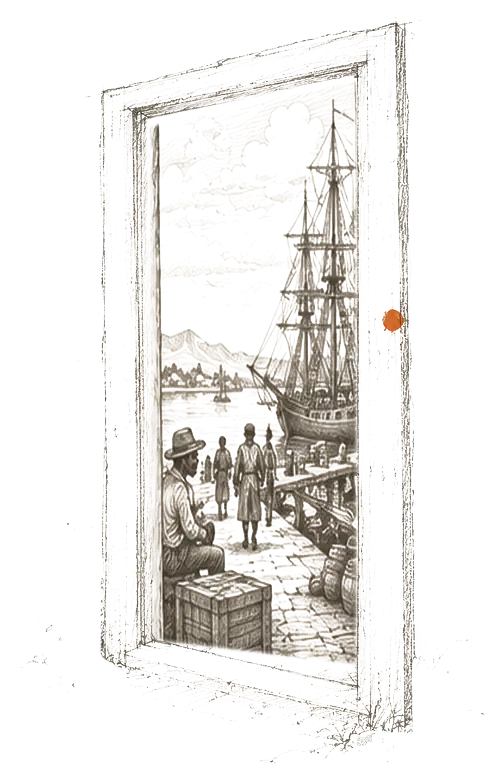
The book follows the black diaspora: departure from Africa into slavery on the plantations of the New World, emancipation, then the emigration of West Indians to Europe in the fifties. One figure, Tom, passes from ancestor to slave to prophet; work songs, spirituals, jazz, calypso and ska supply the rhythms.
Timeline
- 1627–1834PlantationSugar and slavery fix the island's society and provide the matter of all its literature.
- 1942–1955The review BimFrank Collymore's review, in Bridgetown, publishes the first work of Lamming, Brathwaite and Walcott.
- 1953In the Castle of My SkinGeorge Lamming tells the childhood of a Barbadian village and opens the anglophone Caribbean novel.
- 1966–1980BrathwaiteKamau Brathwaite seeks a prosody born of island speech and runs the Caribbean Artists Movement.
Reading keys
- Family names are British, assigned by the planters, and indicate no European ancestry.
- The hierarchy of colour, from white to black by way of brown, overlaps with class and is legible in the narratives without being named.
- Families are often matrifocal, the grandmother bringing up the children, and emigration to England and to the United States is an ordinary stage.
- The Bajans, the name Barbadians give themselves, have a distinct island identity, often mocked in the rest of the region.
- The institutional attachment to England, long claimed, is today a subject of embarrassment: the country became a republic in 2021.
- The hierarchy of colour inherited from the plantation is real and rarely named head-on.
- The absence of marronage, for want of relief, deprives the country of a narrative of armed resistance like that of Jamaica, which literature compensates for otherwise.
- Restraint is valued and open conflict is avoided, which gives texts in which resentment is buried.
- Anglicanism was the state religion until 1969, and Protestantism remains in the majority, with numerous Pentecostal churches.
- Obeah was forbidden by law until 1998, and its practice remains discreet.
- Duppies, spirits of the dead, are taken seriously, and concrete precautions are taken.
- Barbados is also the place of a small Sephardi Jewish community settled as early as 1654, whose synagogue is one of the oldest in the Americas.
- The wake and the meal that follows the burial organise the mourning, with a collection for the costs.
- Black is worn in mourning, and mourning is kept for several months.
- Crop Over, the festival of the end of the cane harvest, is the Barbadian carnival and closes the agricultural year.
- Cricket is a social institution and a language: part of the literature refers to it as to a ritual.
- The tales collected by Parsons in the nineteen thirties, with Brer Rabbit and Anansi side by side, form the documented stock.
- Bussa, leader of the revolt of 1816, has been a national hero since 1998 and serves as a reference for the memory of resistance.
- The duppy and the beliefs of obeah constitute a knowledge common to the Lesser Antilles.
- The calypso and the memory of the plantation provide the rhythm and the images that Brathwaite theorises.
- Barbados is not a little England: the nickname is colonial and the country's authors have turned it into a critique.
- Nation language is not a dialect: it is the concept that Brathwaite forged precisely against that word.
- The absence of marronage does not indicate an absence of resistance: the revolt of 1816 and the strikes of 1937 bear witness to it.
- The slenderness of the corpus in the catalogue does not measure the country's influence, which supplied the region with part of its teachers and its theorists.
Tales and mythologies 1
- TaleBarbados FolkloreElsie Clews Parsons · 1925An American anthropologist collects the tales and riddles of Barbadian storytellers.Literature
A selection to begin with 4 / 6
- NovelIn the Castle of My SkinGeorge Lamming · 1953Barbados is still a British colony, and a nationalism is born in the villages of the thirties and forties.Literature
- PoetryCollected PoemsFrank Collymore · 1959The poems of a Barbadian schoolmaster, between the ocean and the colonial society of his island.Literature
- NovelBrown Girl, BrownstonesPaule Marshall · 1959A Barbadian childhood in Brooklyn, between a mother who wants the house and a father who dreams of the island.Literature
- NarrativeGrowing Up Stupid Under the Union JackAustin Clarke · 1980A Barbadian childhood in the 1940s, shaped by a tenacious mother and an English-style school.Literature