Papua New Guinea
- works
- 7
- 5 books · 2 films
- period covered
- 1917–2000
- language of writing
- English and Tok Pisin
More than eight hundred languages are spoken in Papua New Guinea, that is to say about one eighth of all the living languages on the planet. None is in the majority. Some are spoken by a few hundred people in a valley that the neighbouring valley does not understand. Three lingua francas make it possible to speak to one another, among them Tok Pisin, born on the colonial plantations and become the language of parliament and of radio.
Read moreShow less
A national literature in an indigenous language is therefore impossible, and that fact has oriented all the creative work of the country. One writes in English and in Tok Pisin, one sings and dances in eight hundred languages, and the image proves more effective than the book for reaching an audience that shares no common writing. The country has moreover been described more than it has written: it was in the Trobriand Islands that Malinowski founded fieldwork anthropology, and Papua is one of the most studied places on the planet. The Highlands, for their part, were reached by Europeans only from the nineteen thirties, so that very old institutions were described there by living witnesses.
Hence an inversion, in this country, between film and text. The first Papuan feature film dates from 1991: a road comedy in which an old Highlands chief, now the owner of a bush taxi, takes to the road with his daughter and a young partner, and in which languages, roads and misunderstandings make the plot. Nine years later, a documentary follows, over many years, a Highlands clan preparing the cult of an ancient fertility goddess. Cinema there takes on what literature cannot do: speaking to everyone at once.
What awaits the viewer is an art of displacement and of permanent translation, in which one changes language in mid-scene and the journey replaces the plot. The film that opens this page follows a bush taxi on the Highlands road, in Tok Pisin, and it remains the cult film of Papuan cinema.
A way to begin
Tinpis Run
Pengau Nengo · 1991
Often presented as the country's first fiction feature: a bush taxi on the Highlands road, in Tok Pisin.
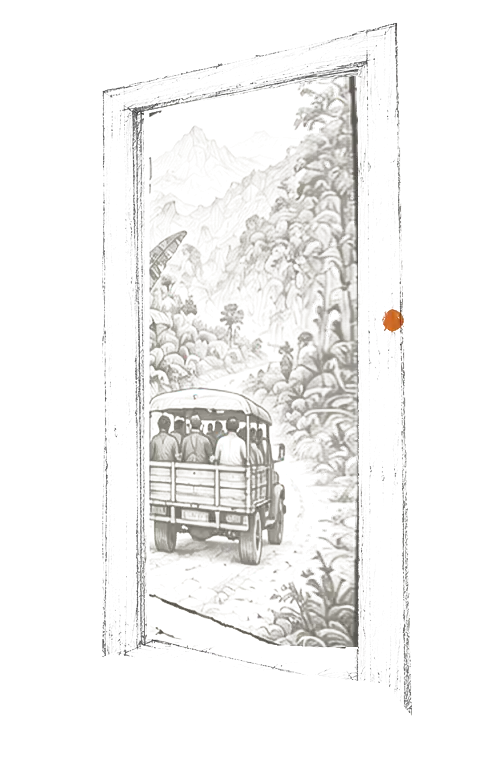
Papa, chief of a Highlands tribe, has an accident driving home drunk from a feast; his daughter Joanna and Naaki, a young man from the Sepik who was courting her, come to his aid. With the compensation, Papa buys a bush taxi, takes Naaki on as a partner and offers him his daughter, but the two young people refuse this arranged marriage. The two men open a route from Mount Hagen to Madang.
Timeline
- 1900–1960OralityMore than eight hundred languages carry myths, chants and founding narratives.
- 1968–1975Port MoresbyThe university and Ulli Beier's workshops publish the country's first written literature.
- 1975IndependenceTheatre and the novel accompany the birth of the state and the question of languages.
- 1980–2010DocumentaryEthnographic film and documentary form the country's main production of images.
Reading keys
- The name refers to the clan, the valley and the language, and it also indicates whether a character comes from the Highlands or from the coast, a major social distinction.
- Classificatory kinship extends the terms brother and sister to a wide circle, and the obligations that follow are real.
- The big man draws his authority from the exchanges he organises and not from birth. In certain regions a hereditary chief exists, which is not the rule.
- The clan name determines rights over land, and a land dispute is a genealogical dispute.
- The violence linked to compensations, to elections and to mining resources is a daily subject that works treat with caution.
- The Bougainville war, from 1988 to 1998, over a copper mine, remains sensitive.
- Certain knowledge is initiatory and is not told: a narrative may break off because what follows is reserved.
- A request goes through an intermediary, and public speech is held in a place provided for it.
- The wantok, the one who speaks the same language, creates an obligation of help that structures social life and sometimes corruption.
- Christianity has been massively adopted, in all its forms, and combines with earlier beliefs without declared conflict.
- Sorcery, sanguma, is held to be real and accusations of it have grave consequences, including murderous ones. An accusation in a narrative is not a picturesque superstition.
- The spirits of places and of ancestors inhabit the landscape, and masked spirit-men intervene during ceremonies.
- The so-called cargo movements existed here too and are to be understood as readings of the arrival of foreign wealth.
- Mourning is accompanied by gifts, by meals and sometimes by sacrifices of pigs whose value is publicly announced.
- Body paintings and feather headdresses, at the sing-sing, identify the clan and the occasion. They are not costumes but signatures.
- Compensation, bride price or death compensation, is negotiated in pigs, shells and money, and its amount makes the story.
- The oven of heated stones, the mumu, serves the collective meals that seal agreements.
- The Kiwai narratives collected in the Fly delta at the beginning of the twentieth century, almost five hundred texts with the names of the narrators, form the most extensive documented corpus.
- The Trobriand myths of origin and the kula, a network of exchange of bracelets and necklaces between islands, are references known well beyond the country.
- Transformer heroes and the spirits of the swamps provide the ordinary cast of the coastal narratives.
- Tok Pisin has produced its own repertoire of songs and formulas, known to all.
- The word "primitive", long applied to the country by colonial descriptions, in fact designates societies with a highly elaborate economic and ritual organisation.
- The Highlands were contacted only from the nineteen thirties, which means that ancient institutions were documented by living witnesses and not by archaeology.
- Tok Pisin is not a deformed English but a language in its own right, with its grammar, its literature and its press.
- The number of languages is not a handicap but an old fact of individual multilingualism, each person speaking several of them.
Tales and mythologies 1
- TaleThe Folk-Tales of the Kiwai PapuansGunnar Landtman · 1917In the marshes and islands of the Fly estuary, every Kiwai place has its story.Literature
A selection to begin with 5 / 7
- NarrativeThe Erstwhile SavageHosea Linge · 1932The life of a Methodist convert from New Ireland, told by himself in the early 1930s.Literature
- NarrativeKiki: Ten Thousand Years in a LifetimeAlbert Maori Kiki · 1968A Papuan life, from tribal initiation to politics, in the last decades of the Australian administration.Literature
- NovelThe CrocodileVincent Eri · 1970A Papuan youth under Australian administration, between sorcery, mission and the Pacific War.Literature
- NovelMaibaRussell Soaba · 1985The daughter of the last chief of a Papuan village, caught between custom and changes come from elsewhere.Literature
- CinemaBridewealth for a GoddessChris Owen · 2000In the Western Highlands, a clan celebrates the cult of a fertility goddess for the last time.Cinema