El Salvador
- works
- 4
- 4 books
- period covered
- 1933–1980
- language of writing
- Spanish
In 1935, a German ethnologist published the myths of the Pipil collected at Izalco, in the Nawat language with a translation. Three years earlier, in January 1932, the Salvadoran army had crushed a peasant uprising in that same region, killing thousands of people, mainly Pipil, and one could be executed for wearing indigenous dress or speaking the language. The survivors stopped passing it on. Leonhard Schultze-Jena's book therefore preserves the narratives of a community that had just been destroyed, and Nawat is today spoken by a few dozen people.
Read moreShow less
The country was built on that erasure. El Salvador is the smallest and the most densely populated country in continental America, entirely organised around coffee, with an oligarchy of a few families and a landless peasant population. After 1932, indigenous identity was denied and the Salvadoran was defined as mixed-race, which provided a political convenience and a cultural amputation that the country is only beginning to speak about.
Literature was made against that, and sometimes at the cost of life. Salarrué published in 1933, a year after the massacre, very brief narratives written in the speech of the peasants, with their pronunciation, their images and their humour: a monument to those who had just been killed, without one line of explicit denunciation. Roque Dalton, a communist poet, wrote an ironic and political body of work and was assassinated in 1975 by his own comrades. Manlio Argueta recounted in 1980 one day of a peasant woman whose family disappears, on the eve of a civil war that would cause seventy-five thousand deaths.
What awaits the reader is a writing close to the voice, brief, in which violence is stated through what it leaves rather than through what it shows. The collection that opens this page lets the peasants speak as they speak, the spelling following their pronunciation, and it is the most published and most read Salvadoran book.
A way to begin
Cuentos de barro
Salvador Salazar Arrué (Salarrué) · 1933
Thirty-three tales of the Salvadoran countryside, in the speech of the peasants: the most published and most read Salvadoran book.
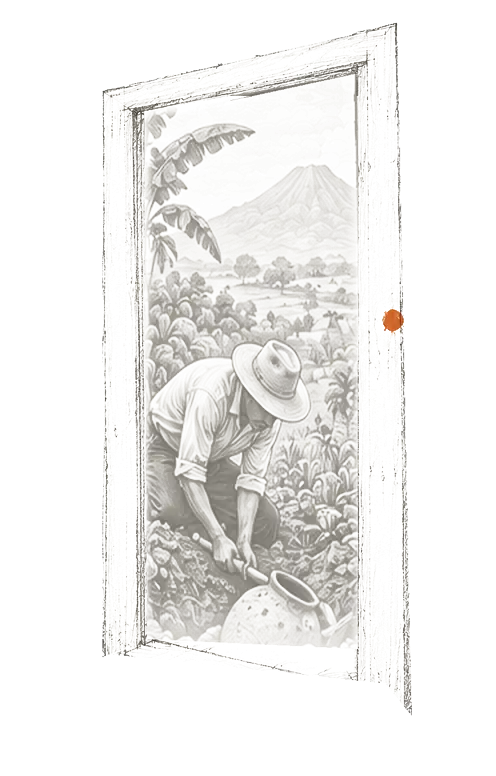
Thirty-three short tales of the Salvadoran countryside, preceded by a prelude in poetic prose, in which peasants speak as they speak, the spelling following their pronunciation. José Pashaca, a humble man, starts digging the earth in hope of finding a jar full of gold coins; other tales tell of honour, Christmas Eve or a haunted house. Nature has as much place as people.
Timeline
- 1933Cuentos de barroSalarrué writes in the speech of the peasants, two years after the massacre.
- 1969–1983Poetry and warRoque Dalton, killed by his own side; Manlio Argueta writes in exile.
Reading keys
- The Spanish usage of two surnames applies, and one classifies by the father's name.
- The fourteen families, an expression used to designate the coffee oligarchy, are a social reference that every Salvadoran understands, and certain surnames signal it.
- Nawat names have almost entirely disappeared from the civil registry after 1932, which is in itself a piece of historical information.
- Emigration to the United States concerns a considerable part of the population, and the money sent home keeps the country alive.
- The massacre of 1932 was long absent from the textbooks and remains a subject on which the figures themselves are disputed.
- The civil war from 1980 to 1992, the death squads and the assassination of Archbishop Romero in the middle of mass in 1980 are subjects on which every account is situated.
- Indigenous identity was denied by the state, and affirming it long remained dangerous and then marginal.
- The gangs, the maras born in Californian prisons and repatriated by deportations, are a difficult contemporary subject.
- Catholicism is in the majority, with a strongly growing evangelical Protestantism, and liberation theology played a major political role in the nineteen seventies.
- The cult of saints and the cofradías organise the religious life of the villages, notably at Izalco where Pipil elements survive.
- La Siguanaba, a woman with a horse's head who leads unfaithful men astray, and el Cipitío, a child with backwards feet, are the two best-known figures of the popular stock.
- The nahual, an animal double, and the healers belong to the residual Pipil stock.
- The wake and the nine days of prayers organise the mourning, with a commemoration at the end of a year.
- Black is worn in mourning, often for several months.
- The village patron saints' festivals, with processions and moros y cristianos dances, are the local event of the year.
- Holy Week, with its carpets of coloured sawdust, is the great religious moment, as in neighbouring Guatemala.
- The Pipil myths collected at Izalco and published in 1935, in Nawat and in German, are the most important documented corpus on that culture.
- La Siguanaba and el Cipitío are known to all and are told to children to keep them at home in the evening.
- The Nicaraguan Güegüence, in Nawat and in Spanish, belongs to the same linguistic area and provides a comparison.
- Monsignor Romero, assassinated in 1980 and canonised in 2018, has become a moral and literary reference.
- El Salvador is not a country without an indigenous population: the Pipil exist, and their invisibility is the direct product of the 1932 massacre.
- Salvadoran Nawat is close to Mexican Nahuatl without being confused with it, and it is today critically endangered.
- Salarrué's narratives are not peasant picturesque: written a year after the massacre, they give speech back to those who had just been killed.
- The civil war of 1980 is not the country's first conflict but the resumption, fifty years later, of the same confrontation over land.
Tales and mythologies 1
- TaleIndiana II: Mythen in der Muttersprache der PipilLeonhard Schultze-Jena · 1935not translated into EnglishThe stories were recorded in a few months at Izalco, during a journey funded by the anthropologist Franz Boas.Literature
Available in English 1
The books from this country that can be read in English, in the original or in translation.
- NovelOne Day of LifeUn día en la vidaManlio Argueta · 1980The novel appears just as the country enters civil war, and the government bans it.Literature
A selection to begin with 2 / 4
- PoetryTaberna y otros lugaresRoque Dalton · 1969not translated into EnglishThe author, in exile, was then living in Prague as correspondent for an international communist journal.Literature
- NovelOne Day of LifeUn día en la vidaManlio Argueta · 1980The novel appears just as the country enters civil war, and the government bans it.Literature