Tonga
- works
- 2
- 2 books
- period covered
- 1974–1987
- language of writing
- English
In 1953, at the coronation of Elizabeth II, a queen from the Pacific crossed London in the rain in an open carriage, and the photograph went round the world. She was Sālote Tupou III, queen of Tonga from 1918 to 1965, one of only two women then at the head of a kingdom. She had the genealogies and traditions of her country written down.
Read moreShow less
Visited by Cook, who named them the Friendly Islands, the Tonga islands were unified in the nineteenth century by King George Tupou I, who gave them a constitution in 1875. Placed under British protection from 1900 to 1970, the kingdom kept its kings. Society is hierarchical: the king, thirty-three nobles and the people, and one is born into one's rank. Sunday is made sacred by the constitution, and all trade stops on that day.
Written literature appeared at the end of the 1960s and the beginning of the 1970s, with Konai Helu Thaman and Epeli Hauʻofa. Thaman published a first collection of poems in 1974; Hauʻofa, the son of Tongan missionaries, gave in 1987 a satire in the Rabelaisian vein about a small Pacific island. The price, here, is the detour: these books are published in Suva, Auckland or Honolulu, and their authors taught in Fiji, at the University of the South Pacific.
What awaits the reader is a brief English, poems in which women speak, and an irony that spares neither healers nor experts. The collection that opens this page appeared in 1974; its title poem gives voice to a young woman facing the man her parents have chosen for her.
A way to begin
You, the Choice of My Parents
Konai Helu Thaman · 1974
The first collection of a Tongan woman poet: a woman's voice facing arranged marriage and a school come from elsewhere.
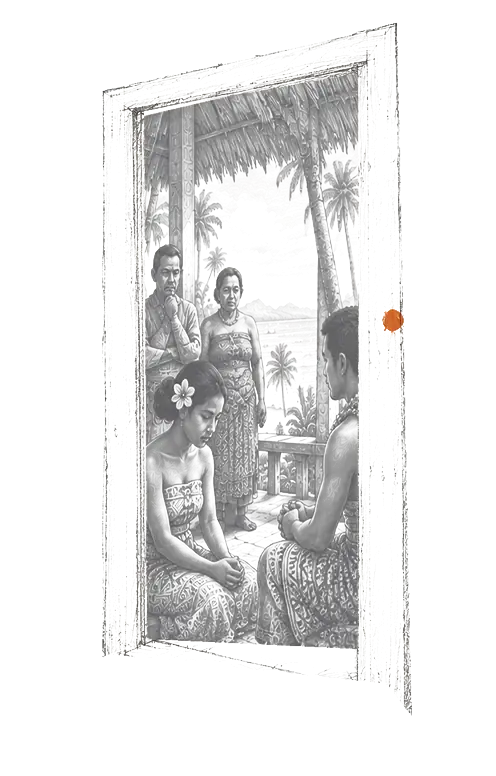
The author's first collection, it brings together poems written in English. In the poem that gives it its title, a young woman speaks to the man her parents have chosen for her and says that she has no other choice. “Island Fire” evokes “the pages of foreign textbooks” turned slowly, and touches on Western schooling and the gap between generations.
Timeline
- 1875The constitutionGeorge Tupou I, who unified the kingdom, gives it a constitution.
- 1918–1965The reign of SāloteThe queen has the genealogies and traditions gathered, and appears at the 1953 coronation.
- 1974–1987Thaman and HauʻofaA first collection of poems, then a satire in the Rabelaisian vein.
Reading keys
- The father's eldest sister, the fahu, holds the first rank in the family, and this rank passes to her children.
- A sister always ranks above her brothers close in age, and the elder above the younger.
- Rank is fixed at birth: a commoner does not become noble, even by marriage.
- The extended family binds its members to one another, so that no one in it remains without a roof or without food.
- The place of the king and the nobles, at the top of a society of ranks, is a delicate subject; in 2006, demonstrations for democracy turned into riots and left seven dead in the capital.
- The 2010 elections gave a large place to the democratic movement, which opened a debate on the institutions.
- Respect for elders is a rule of conduct, and one addresses them with deference.
- At church, men and women cover their knees and shoulders, and light clothing shocks people in the villages.
- The Methodist mission took root in 1826, after two failures, and Christianity became the religion of the kingdom.
- About half of Tongans belong to the Free Wesleyan Church, of which the king is the head.
- Sunday is consecrated by law: shops close, and even the Adventists observe their sabbath on that day.
- The king was once so sacred that no one could touch him, and only designated men handle the remains of a sovereign.
- The ta'ovala, a mat tied at the waist, is the dress of solemn occasions, and at funerals its form shows the tie to the deceased.
- Mourning is worn in black, a few days for a neighbour, up to a year for a close relative.
- Kava marks formal occasions: the men drink it, the women serve it.
- Tapa, bark cloths called ngatu, and woven mats are offered at weddings and funerals.
- Queen Sālote, her reign and her presence at the 1953 coronation are a source of national pride.
- George Tupou I and the constitution of 1875 founded the modern kingdom.
- The name “Friendly Islands”, given by Cook, recurs in travel narratives.
- Thaman and Hauʻofa are counted among the country's first published writers.
- Tonga was a British protectorate, not a colony: the kingdom kept its kings and its constitution.
- Tongans are close to Samoans in language and culture, but the two countries have distinct histories.
- Hauʻofa also appears in the catalogue under Fiji, where he lived and taught; he is here for his novel.
- The island of Hauʻofa's novel, Tipota, is imaginary.
A selection to begin with 1 / 2
- NovelKisses in the NederendsEpeli Hauʻofa · 1987A Rabelaisian satire of a small Pacific society caught between tradition and modernity.Literature