Poetry
Songs of Innocence and of Experience
William Blake · 1794
Opening lines
Piping down the valleys wild,
Piping songs of pleasant glee,
On a cloud I saw a child,
And he laughing said to me:
Text quoted from gutenberg.org
Synopsis
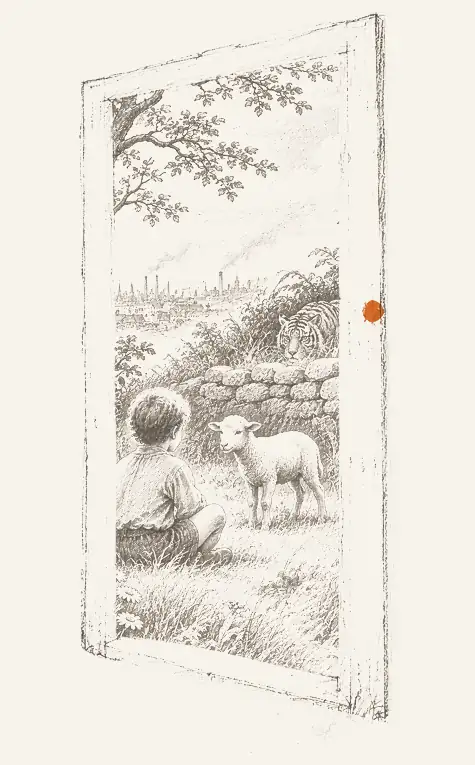
Two collections brought together in one volume, several of whose poems bear the same title. On one side, a child asks a lamb who made it; a little chimney sweeper tells of a comrade's dream, thousands of boys locked in black coffins that an angel comes to open; a nurse hears the children laughing on the hill. On the other, the same nurse, at their voices, feels the days of her youth come back; a little black thing in the snow says that his parents have gone to pray at church; and the tiger is asked whether he who made the lamb made him too.
Context
The copies printed in the author's lifetime were coloured by hand, by him and sometimes by his wife, using a relief etching process that he said he owed to his dead brother, who appeared to him in a dream: they all differ, in colours as well as in the order of the plates. The first set appeared alone in 1789; the second was joined to it in 1794, in a volume whose subtitle announces the two contrary states of the human soul. The author nevertheless went on selling the two sets separately. The first edition in ordinary typography appeared in 1839, twelve years after his death.
Who it is for
Very short poems, to be read separately; the illustrated editions reproduce the plates engraved and coloured by the author.
Prizes and reception
Rediscovered in the Victorian era by Rossetti and the biographer Gilchrist, it influenced the Pre-Raphaelites, then Yeats, Ginsberg and the counterculture of the sixties.
Sources for this page 16
The pages consulted to check this page.