Novel
Fogo morto
Not translated into English
José Lins do Rego · 1943
Synopsis
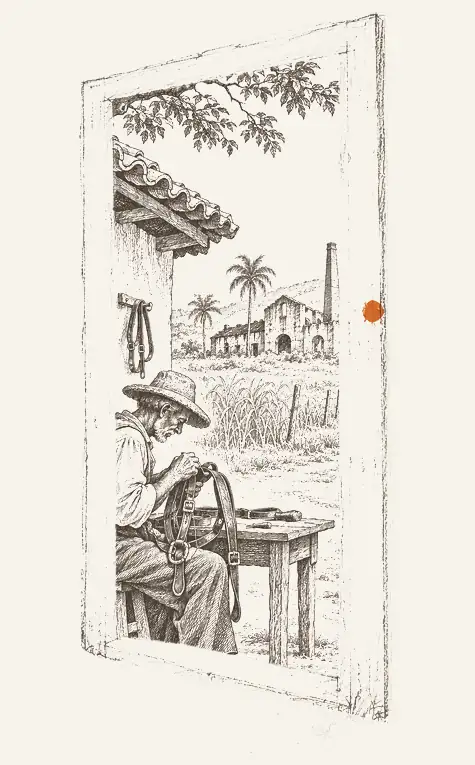
The novel follows, in three parts, three men linked to the Santa Fé sugar estate, in Paraíba. Master José Amaro, a proud and gloomy saddler who lives by the roadside, admires the cangaceiro Antônio Silvino and watches his daughter Marta lose her reason. Colonel Lula de Holanda, son-in-law of the founder, has inherited the estate and has let it decline since abolition. Captain Vitorino Carneiro da Cunha, an eccentric mocked by all, sees himself as the defender of the weak against the powerful. Around them, the sugar mill dies out.
Context
The novel appeared in 1943 and is regarded as the peak of its author's sugar cane cycle. The expression that gives it its title designates, in the Nordeste, the sugar mill that no longer grinds. One part goes back to the 1850s, to the founding of the engenho by Captain Tomás Cabral de Melo. Massaud Moisés regarded it as one of the most representative works of modernism, and Otto Maria Carpeaux saw in its author the last of the storytellers. Paula Anacaona translated it into French in 2017 under the title Crépuscules.
Who it is for
An easily accessible novel, rich in the vocabulary of sugar cane and of the Nordeste; a French translation appeared in 2017 from a small Parisian publisher.
Prizes and reception
The masterpiece of its author, regarded as one of the most representative novels of Brazilian modernism.