Novel
A moreninha
Not translated into English
Joaquim Manuel de Macedo · 1844
Opening lines
—Bravo! exclamou Fillippe, entrando, e despindo a casaca, que pendurou em um cabide velho; bravo!.... interessante scena! mas certo que deshonrosa fôra para caza de um estudante de medicina, o já do sexto anno, a não valer-lhe o adagio antigo: O hábito não faz o monge.
“Bravo!” exclaimed Filipe, coming in and taking off his tailcoat, which he hung on an old peg. “Bravo!… An interesting scene! But it would surely have been a disgrace to the lodgings of a medical student, and one already in his sixth year, were it not for the old adage: the habit does not make the monk.”
Translation by Erostrate
Text quoted from pt.wikisource.org
Synopsis
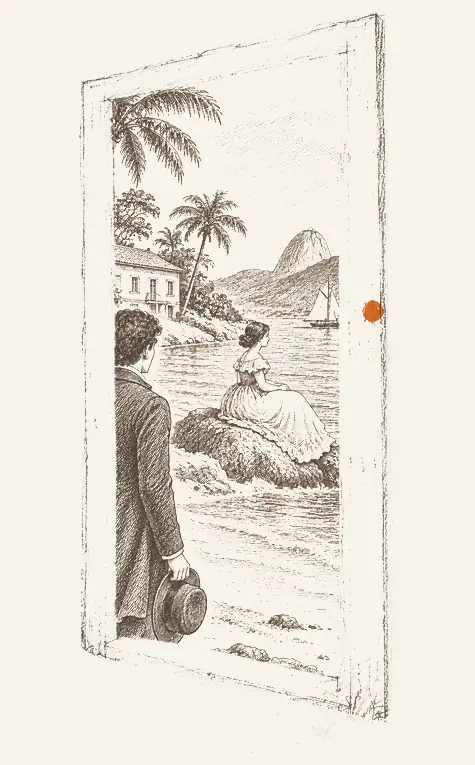
Augusto, a medical student who often changes loves, makes a bet with his friend Filipe: if he stays in love with the same girl for more than a month, he will write a novel. With two other friends, they spend a weekend of festivities on an island in Rio bay, at the home of Dona Ana, Filipe's grandmother. Once his quirks are revealed at table, the girls drift away from him, except Carolina, Filipe's mischievous sister. Augusto, for his part, keeps the memory of a nameless little girl met on a beach in his childhood.
Context
The novel appeared in 1844, first as a serial according to Toda Matéria, and made its author famous; he was then finishing his medical studies. Cultura Genial regards it as the first great Brazilian Romantic novel. The island is never named, but everything points to Paquetá, opposite the imperial capital. The book was adapted for the cinema in 1915 and in 1970 and inspired two television serials, in 1965 and in 1975.
Who it is for
A short novel in Portuguese, with no French translation: a sentimental comedy of young people, lively and without shadow.
Prizes and reception
The first great success of the Brazilian Romantic novel, reissued and adapted for cinema as well as television.
Sources for this page 4
The pages consulted to check this page.