Novel
L'Homme-dieu de Bisso
Not translated into English
Étienne Yanou · 1974
Synopsis
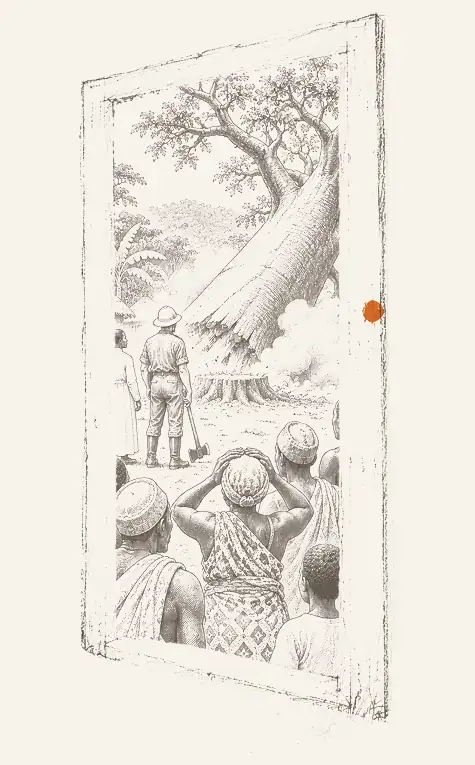
There is a new god at Bisso, a village where people live in peace, faithful to the beliefs and deities of the ancestors. This one is unlike those who came before him: young, handsome, rich and adored, he refuses to bend to what those around him expect of him, and he loves a young girl. Around him, Abbé Voulana, a local boy trained in Europe, does not believe in leopard men, and Monsieur Delange, a French forester, fells an immense baobab, the dwelling of the guardian god of the land.
Context
The novel appeared in Yaoundé from the publisher CLE in 1974, running to one hundred and fifty-five pages. It brings together three worlds: the cult of the ancestors, a priest born in the village but trained in Cartesian logic, and a forester who sees in the sacred tree only a tree and says he is bound only to the government. The latter's son reproaches him for having committed a crime. Pierre Martial Abossolo makes it an example of the encounter between the Westerner and the African, and of the place of the sacred tree in the francophone novel; the new road, which destroys other trees and sacred places, is another sign of it.
Who it is for
In French, a short volume. It helps to know that, in this village, the felled tree is the dwelling of a god, and not mere shade.
Prizes and reception
Grand Prize for literature of Black Africa in 1975, the year after publication. The book appears from 1986 in the textbook by Rouch and Clavreuil published by Bordas.