Tale
Strange Tales from a Chinese Studio
聊齋誌異
Pu Songling · 1679
Opening lines
予姊丈之祖宋公,諱燾,邑廪生。一日病臥,見吏人持牒,牽白顛馬來,雲:“請赴試。”
The grandfather of my elder sister's husband, Mr Song, personal name Tao, was a stipendiary scholar of our district. One day, as he lay ill in bed, he saw a clerk arrive holding a summons and leading a horse with a white blaze; the clerk said: “Please come to the examination.”
Translation by Erostrate
Text quoted from gutenberg.org
Synopsis
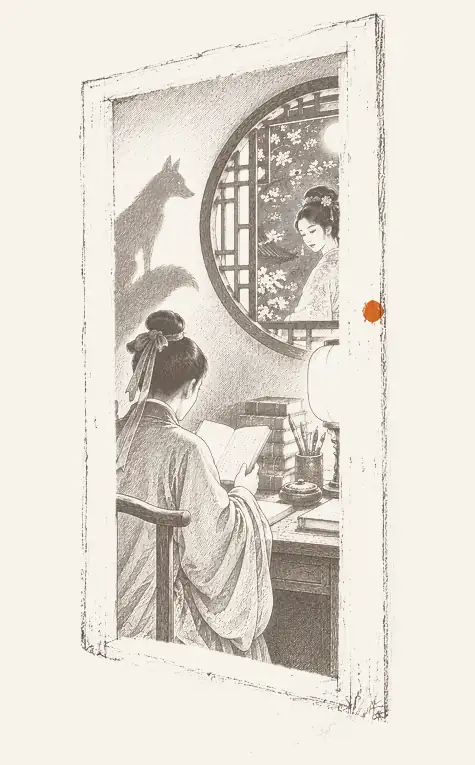
A collection of short tales in classical Chinese, nearly five hundred (four hundred and thirty-one according to Britannica), in which fox spirits, ghosts and supernatural creatures appear. These texts blend the strange with everyday life rather than seeking to frighten. They include the tale of the Painted Skin, and the one from which Hong Kong cinema drew A Chinese Ghost Story.
Context
Written in classical Chinese, and not in the vernacular language of the huaben tales, the collection takes up the forms of the marvellous tales of the Tang and the Song, according to Britannica. Pu Songling compiled it from the early 1670s to the early 1700s, most of it being completed in 1679. The book circulated in manuscript copies until its first surviving printing, at Hangzhou, in 1766. Herbert Giles published an expurgated English translation in 1880, John Minford another in 2006; André Lévy translated it into French for Philippe Picquier. Cinema has often adapted it, from King Hu to Ching Siu-tung.
Who it is for
Very short tales, to be read one or two at a time; André Lévy's French translation is complete.
Prizes and reception
According to Britannica, the book revived the short tale in classical language and prompted many imitations.