China
- works
- 126
- 72 books · 54 films
- period covered
- -450–2000
- language of writing
- Chinese
For thirteen hundred years, one became a civil servant in China by writing. The imperial examination required knowing the classics by heart, composing dissertations according to an imposed plan and producing poems in fixed forms, and it opened access to every office of the state. A gifted peasant could, in theory, become a minister. Tens of thousands of men spent their lives preparing for an examination they failed, and that mass of frustrated scholars provided literature with its authors, its readers and its most constant subject.
Read moreShow less
Hence a unique configuration: learned literature and administration merge, and the novel is born on the margins, despised, written in spoken language for an audience of merchants. The four great classical novels, from the pilgrim monkey to the reveries of a family in decline, were long held to be vulgar entertainments. One of them, left unfinished by its author, who died in 1763, has since occupied an entire university discipline devoted to it alone, with its journals and its conferences.
The rupture was brutal and deliberate. In 1917, a generation decided to write in spoken language rather than in classical language, and Lu Xun published in 1918 the diary of a man convinced that his neighbours want to eat him, a founding text of modern prose. There followed three decades of inventiveness, then forty years in which literature became a service of the state, then a reopening. Cinema followed the same curve: a golden age in Shanghai in the nineteen thirties, propaganda films, and from 1984 a generation that films the countryside in saturated colours and became known throughout the world.
What awaits the reader is a literature in which reference to the past is constant and in which material detail counts for more than psychology. The narrative that opens this page consists of thirteen fragments in the spoken language, preceded by a foreword in classical Chinese, and it is often regarded as the first modern story in the vernacular.
A way to begin
Diary of a Madman
Lu Xun · 1918
The text often regarded as the founding work of modern Chinese fiction: a man believes himself surrounded by eaters of men. Free of rights.
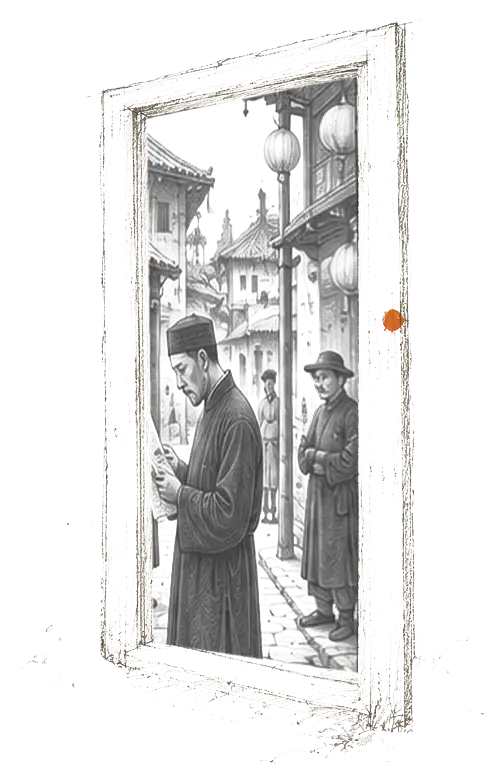
A short note in classical language introduces the diary of a man who has been ill. Thirteen fragments follow: the diarist notices that the Zhaos' dog is staring at him, that the villagers whisper, that his elder brother has sent for a doctor. He rereads a history book and sees, between the words "virtue and morality", two others that recur everywhere: eat people.
Timeline
- 701–770Tang poetryLi Bai, Du Fu. The unsurpassed summit of Chinese poetry.
- 1350–1791The great novelsThree Kingdoms, Water Margin, Dream of the Red Chamber.
- 1917–1927May Fourth MovementThe classical language is dropped for the spoken one. Lu Xun leads the way.
- 1930–1949ShanghaiA flourishing literary modernity and cinema, broken by the war.
- 1949–1976MaoismArt is put at the service of the state. The Cultural Revolution closes almost everything.
- 1984–1995Fifth GenerationZhang Yimou, Chen Kaige. Chinese cinema reappears, and hits hard.
Reading keys
- The family name precedes the first name and most often has a single syllable: Lu Xun's family name is Lu.
- First names are composed of characters chosen for their meaning, and brothers and sisters sometimes share a common character.
- Kinship distinguishes the paternal and maternal sides by different words: there is not one word for uncle but five, according to the side and the age.
- One addresses strangers by a kinship term according to age, and one calls an elder big brother or big sister with no blood link at all.
- The Cultural Revolution, the Great Leap Forward and the events of 1989 are framed subjects, and several major authors publish outside the country or are banned.
- Censorship functions through publishers' self-censorship more than through published prohibition, which makes the map of subjects a shifting one.
- Losing face is an operative social category: a character humiliated in public suffers a real damage that the narrative treats as such.
- Direct refusal is impolite, and one answers with a difficulty, a delay or a silence.
- Three teachings coexist without exclusivity: Confucianism as social order, Taoism as a relation to the world, Buddhism as salvation. The same character resorts to all three according to circumstances.
- The cult of the ancestors is central: incense and paper money are burnt for them, and the absence of male descent is a catastrophe.
- The ghosts of the dead without burial come back to claim their due, and an apparition is not fantasy but a problem of an unperformed ritual.
- Feng shui, the orientation of tombs and houses, and the choice of dates are serious operations in the narratives.
- White is the colour of mourning, red that of marriage and of luck. A bride in white in an old narrative would be a misreading.
- The number four is pronounced like death and is avoided, eight announces prosperity.
- Mourning imposes garments of coarse cloth and a duration that varies according to the degree of kinship, codified since antiquity.
- The festival of the dead in spring, when the tombs are cleaned, and the lunar new year organise the narrative calendar.
- The Three Kingdoms, Water Margin, Journey to the West and Dream of the Red Chamber are the four novels that everyone knows, including through theatre, comics and television serials.
- Pu Songling's Strange Tales, nearly five hundred narratives of ghosts and fox spirits, are a reserve of stories constantly taken up.
- The Classic of Mountains and Seas provides the fabulous bestiary, and the Huainanzi the narratives of Nüwa repairing the sky.
- The poems of Li Bai and Du Fu are learnt by heart at school and quoted in conversation.
- White is the colour of mourning and not of innocence, an inversion that distorts the reading of many scenes.
- Confucianism is not a religion but a social and moral order, and one may be Confucian and Buddhist.
- The novel was long a despised genre in China, which explains why its authors are sometimes anonymous or uncertain.
- Classical language and spoken language are two distinct written languages, and the passage from one to the other in 1917 is a revolution comparable to a change of alphabet.
Tales and mythologies 2
- TaleStrange Tales from a Chinese Studio聊齋誌異Pu Songling · 1679A collection of fantastic tales in classical language, for the most part completed in 1679 and printed in 1766.Literature
- ChronicleThe Classic of Mountains and Seas山海經Anonymous · -200An inventory of the mountains, seas and beings of the known world, compiled from the Warring States to the Han.Literature
A selection to begin with 10 / 126
- NovelJourney to the West西遊記Wu Cheng'en · 1592A comic novel of 1592 that turns into fiction the pilgrimage of a Tang Buddhist monk to India.Literature
- NovelDream of the Red Chamber紅樓夢Cao Xueqin · 1750Eighteenth-century novel about a great Beijing family and its love affairs, left unfinished by its author.Literature
- NovelThe Scholars儒林外史Wu Jingzi · 1750Satirical novel of the eighteenth century about scholars and the imperial examinations, with no central plot and no hero.Literature
- NovelRickshaw Boy駱駝祥子Lao She · 1937Novel published in 1937, about a Beijing rickshaw puller who saves up to own his own rickshaw.Literature
- NovelTales of Hulan River呼蘭河傳Xiao Hong · 1940A town in Manchuria and its people, seen through a child's eyes, in a partly autobiographical novel.Literature
- CinemaBoat People投奔怒海Ann Hui · 1982A Japanese photographer in post-war Vietnam, caught between an official visit and hidden misery.Cinema
- CinemaOne and Eight一個和八個Zhang Junzhao · 1983A Communist cadre falsely suspected, a prisoner among eight criminals, in the time of the Japanese occupation.Cinema
- CinemaYellow Earth黃土地Chen Kaige · 1984A collector of songs for the Communist army among poor peasants in Shaanxi, in 1939.Cinema
- CinemaLong Arm of the Law省港旗兵Johnny Mak · 1984Robbers from mainland China, hunted through the streets of Kowloon.Cinema
- CinemaRed Sorghum紅高粱Zhang Yimou · 1987A young woman married against her will who takes over a sorghum distillery, based on Mo Yan.Cinema