Antigua and Barbuda
- works
- 5
- 5 books
- period covered
- 1934–1989
- language of writing
- English
In 1988, a novelist published eighty pages against her native island. Jamaica Kincaid takes the reader to task in them, accuses him of being a tourist, describes the corruption of her government, the library damaged by an earthquake and never repaired, the school that teaches nothing, and refuses all consolation. The text made her unwelcome at home for years. She had been born Elaine Potter Richardson and had left at seventeen to work as an au pair in the United States, where she took another name to write, because her family disapproved of her doing so.
Read moreShow less
That violence has a precise object, and it is not only political. Antigua was a sugar island entirely cleared, where the black population remained without land after the abolition of 1834 and with no employment other than the plantation, then, once cane had become unprofitable, with no employment other than tourism. Barbuda, the second island, belonged for two centuries to a single English family that raised cattle there, and its inhabitants today hold the land collectively, a situation unique in the region and disputed by developers.
The country's written literature is therefore recent, slender and dominated by one body of work. Kincaid published in 1985 the narrative of an adolescent who violently detaches herself from her mother, in a limpid and cold prose, and the rest of her work works the same material. Veronica Evanson Bernard published in 1989 poems in local speech. The country's first feature film came out in 2000, a sentimental comedy shot on the island with local actors and a tiny budget. The price is that of a very small market: without publishing or a sufficient audience, the author who succeeds leaves and writes elsewhere.
What awaits the reader is a tightly controlled anger and a prose without one sentence too many. The novel that opens this page follows a girl who adored her mother and cannot understand the day her mother asks her to leave childhood behind.
A way to begin
Annie John
Jamaica Kincaid · 1985
A childhood in Antigua, from adoration of the mother to revolt, by Jamaica Kincaid.
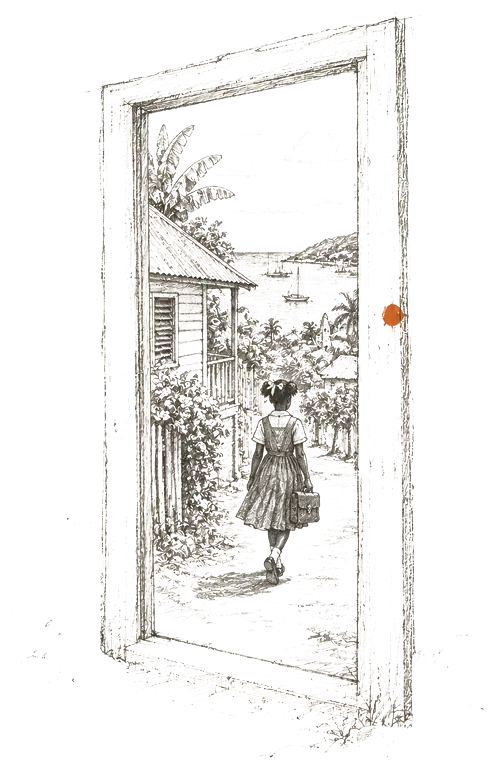
Annie grows up adoring her mother, from whom she is never apart. At about twelve, her mother suddenly asks her to leave childhood behind, and the child cannot understand this reversal. Then come the school where she shines, a passionate friendship with Gwen, a long illness of languor, and revolt against what is expected of her.
Timeline
- 1985Annie JohnJamaica Kincaid writes the island as a place one must break away from.
- 1989–2000AfterVeronica Evanson Bernard in verse; The Sweetest Mango, the country's first film.
Reading keys
- Family names are British, inherited from the planters, and indicate no European ancestry.
- Families are often matrifocal, and the mother-daughter relation is the knot of the country's literature.
- Emigration to the United States, Canada and England is an ordinary stage of the journey, and the money sent home supports whole families.
- Barbudans distinguish themselves from Antiguans and claim an identity and a land right of their own.
- Political corruption and dependence on tourism are the subjects that Kincaid named head-on, which cost her her access to the country.
- The land status of Barbuda, collective property contested by tourist projects, is a raw dispute.
- The absence of land for the freed slaves after 1834 is the economic key to the country and remains a subject of resentment.
- Social restraint is valued, and Kincaid's frankness is precisely what shocked locally.
- Protestant Christianity is very much in the majority, Anglican and Methodist, with recent evangelical churches.
- Obeah, long forbidden, is consulted discreetly, and mentioning it remains charged.
- The jumbie, the spirit of a dead person, comes back if the rites have been neglected, and precautions are taken.
- A Rastafari community is present, with its prohibitions and its vocabulary.
- The wake and the meal that follows the burial organise the mourning, with a public collection for the costs.
- Black is worn in mourning, often for several months.
- The August carnival, which commemorates the abolition of 1834, is the national event and not a Lenten one.
- 1 November, the day of independence in 1981, is the civil landmark.
- Anansi, called locally Anansi or Nancy, is the trickster of the tales, and the opening formula calls for a response from the audience.
- The tales collected by Parsons in the nineteen thirties cover Antigua and form the documented corpus.
- The jumbie, La Diablesse and the creatures of the Lesser Antilles constitute the common bestiary.
- The memory of the abolition of 1834 and of the carnival that commemorates it is a shared reference.
- The country is made of two islands with distinct histories, and Barbuda has a collective land regime without regional equivalent.
- The Antiguan carnival commemorates the abolition and is held in August, unlike that of Trinidad which precedes Lent.
- Kincaid is claimed as the country's great writer and her work is in part a trial of that country: both are true.
- The tourist beauty of the island is exactly the object of the 1988 pamphlet, and citing it as a quality is to miss the text.
Tales and mythologies 1
- TaleFolk-Lore of the Antilles, French and EnglishElsie Clews Parsons · 1936In the Lesser Antilles, the same tales pass from one island to another, from French to English Creole.Literature
A selection to begin with 3 / 5
- PoetryTomorrow's BlossomsRoy H. S. Dublin · 1934One of the first collections of poetry printed in Antigua, composed for an anniversary of the colony.Literature
- TheatreThe OfferingGus Edwards · 1977In New York in the seventies, a Black company opens its stage to authors from the Caribbean.Literature
- PoetryPineapple RhymesVeronica Evanson Bernard · 1989A few years after the independence of 1981, a woman from Antigua puts into writing the language of her childhood.Literature