Belgium
- works
- 78
- 51 books · 27 films
- period covered
- 1519–1999
- language of writing
- French and Dutch
There exists in Belgium a town built to settle a linguistic dispute. In 1968, the Flemish students of Leuven demanded the departure of the French-speaking section of their university; the government fell, the law of 1970 created two distinct universities, the first stone of a new town was laid in 1971 in Walloon Brabant, and the 1972 academic year began on a building site. Louvain-la-Neuve exists because two languages could no longer fit into the same lecture hall.
Read moreShow less
The country was founded in 1830 with French as its only official language, while the majority of its inhabitants spoke Flemish dialects. A century of laws reversed the relation: equality of languages in 1898, linguistic border fixed in 1963, federal state from 1970. The result is two literatures that each have their prizes, their textbooks and their institutions, and almost no common history, except one founding book: the one that opens this page was written in French to recount a Flemish revolt.
The Belgian form is the fantastic and the grotesque, a way of derailing the real without leaving it. Michel de Ghelderode writes a theatre of masks, Jean Ray installs a haunted house in a setting of brick, and Chantal Akerman films domestic time until it becomes disquieting. The price is double. In order to exist, one had to go through Paris: Simenon, Yourcenar and Michaux, all catalogued here, made their work elsewhere. And the Congo, the king's personal colony and then a state colony, appears in this catalogue only through colonial documentaries, whereas the most widely cited estimate attributes some ten million deaths to the period of the Free State: Belgian literature took a century to take hold of it.
What awaits the reader is a domestic unease, brick towns and a humour that gives no warning. The book that opens this page, published in 1867, tells in an archaic French forged in the tradition of Rabelais the revolt of Flanders against Spain; ignored on publication, it was recognised only some twenty years later.
A way to begin
The Legend of the Glorious Adventures of Tyl Ulenspiegel
Charles de Coster · 1867
The prose epic of Flanders in revolt against Spain, free of rights: a prankster turned rebel.
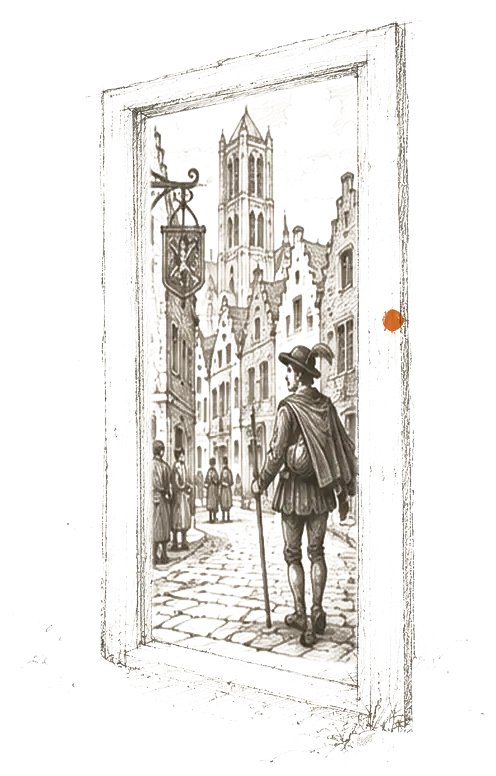
Flanders, in the sixteenth century. Thyl Ulenspiegel, born in Damme, is a prankster whom persecution turns into a rebel: when his father Claes, declared a heretic, is burned, he carries his ashes on his breast and sets out to fight Spanish oppression. Lamme Goedzak, fat and fond of good living, goes with him in search of his lost wife.
Timeline
- 1867UlenspiegelDe Coster gives thirty-year-old Belgium a founding novel.
- 1880–1914SymbolismMaeterlinck, Belgium's first Nobel, Verhaeren, Rodenbach. Brussels shines.
- 1929–1980ComicsHergé, Franquin, Peyo. Belgium invents an industry and an art.
Reading keys
- Flemish names often carry an agglutinated particle, Van de Woestijne, De Coster, which is in no way noble, and alphabetical order varies according to whether one classifies under the particle or under the name.
- One and the same place has two official names, Louvain and Leuven, Mons and Bergen, and the choice of one or the other in a text is a political indication.
- French first names in a Flemish family, or the reverse, often signal a history of social advancement in the nineteenth century.
- Kinship through the commune, the parish and the sports club structures the narratives, more than the extended family.
- The language question is the permanent subject, and the vocabulary used to name the regions, the communes with language facilities or Brussels situates a text before any argument.
- The colonisation of the Congo, Rwanda and Burundi, the mutilations of the period of the Free State and the restitution of objects are a recent and raw debate.
- Collaboration during the two wars, different in the north and in the south, and the royal question of 1945 still divide memories.
- The judicial affairs of the nineteen nineties installed a mistrust of the state that crime fiction constantly exploits.
- Catholicism structured education, the unions and the parties, and the divide between Catholics and secularists long counted as much as the linguistic divide.
- Processions and the giants of the parades, ducasses and carnivals, are communal institutions with brotherhoods and calendars.
- The Flemish fantastic, with its village devils and its dead who come back, comes from a well-documented stock of legends and not from a literary invention.
- Religious practice collapsed in one generation, which makes the persisting rites all the more visible in contemporary texts.
- The carnival of Binche, with its Gilles who throw oranges, and that of Aalst obey precise rules that the inhabitants enforce.
- Village fairs, abbey beer and chips served at a stall are social markers more than folkloric ones.
- The national 21 July is little invested, while the Flemish 11 July and the Walloon 27 September are militant dates.
- Funerals are brief, cremation in the majority, and the meal that follows is the real social moment.
- The 1867 book about Ulenspiegel, a drinker and a rebel, is the only founding text recognised by both communities.
- Conscience's Lion of Flanders, in 1838, gave the Flemish movement its narrative of origin, and the battle of 1302 its date.
- Comics, Tintin, Spirou, Suske en Wiske, are a shared reference more solid than literature, and authors refer to them.
- The beguinages, the canals of Bruges and the miners' rows of the industrial belt are the settings that every text assumes are legible.
- There is not one Belgian literature but two, Dutch-speaking and French-speaking, and the catalogue places them under one country for administrative convenience.
- Flemish is not a language distinct from Dutch: it is the Dutch of Belgium, with its variants, and calling it a patois is a political fault.
- Simenon, Yourcenar, Michaux and Maeterlinck are Belgian by birth and Parisian by career: national belonging here is an open question.
- Brussels is officially bilingual and mostly French-speaking within a Flemish region, a situation that explains a great part of the tensions.
- The catalogue mixes colonial films shot in the Congo with Belgian works: that presence is an archival fact to be read as such.
Tales and mythologies 1
- TaleUlenspieghelAnonymous · 1519not translated into EnglishThe pranks of a vagabond who obeys too well, in a popular book printed in Antwerp.Literature
A selection to begin with 10 / 78
- NovelBruges-la-MorteBruges-la-morteGeorges Rodenbach · 1892Bruges at the end of the nineteenth century: a widower chooses the city of canals in which to shut away his mourning.LiteraturePublic domain
- TheatreThe Blue BirdL'Oiseau bleuMaurice Maeterlinck · 1908On a Christmas Eve, two woodcutter's children set out to find the bird of happiness through enchanted lands.LiteraturePublic domain
- TheatreLa Balade du Grand MacabreMichel de Ghelderode · 1934not translated into EnglishA strange visitor claims to have come to carry off the world, in an imaginary country of fairs and drinkers.Literature
- NovelMalpertuisJean Ray · 1943Heirs must live together in a sinister house in order to receive their share, and they disappear one by one.Literature
- NovelThe Snow Was DirtyLa neige était saleGeorges Simenon · 1948A young man in an occupied town commits gratuitous crimes, as if to see how far he can go.Literature
- NovelMemoirs of HadrianMémoires d'HadrienMarguerite Yourcenar · 1951A Roman emperor at the end of his life recounts his reign and his loves in a letter to his young successor.Literature
- CinemaIf the Wind Frightens YouSi le vent te fait peurÉmile Degelin · 1960Two children of the same family camp in the dunes and gauge how ambiguous their closeness is.Cinema
- CinemaFrom the Branches Drops the Withered BlossomDéjà s'envole la fleur maigrePaul Meyer · 1960An Italian family arrives in the mining basin just as a former underground worker is preparing to leave.Cinema
- CinemaHotel MontereyHôtel MontereyChantal Akerman · 1972A night in a New York welfare hotel, seen in long, fixed, silent shots.Cinema
- CinemaMalpertuisHarry Kümel · 1972A sailor finds himself shut up in his family's house, around an uncle and an inheritance.Cinema