Burundi
- works
- 5
- 3 books · 2 films
- period covered
- 1970–1992
- language of writing
- Kirundi and French
In Burundi, the drum was not an instrument but a person. The karyenda, sacred drum of the royalty, embodied the power of the mwami to the point that it was not beaten to make music: it had its hereditary guardians, its fields, its shrine, and a sacrifice was needed in order to approach it. The drummers formed a caste, passed their rhythms down within the family, and played standing, carrying the instrument on the head. The monarchy was abolished in 1966. The drums remained, become a national emblem and a show, without the king they were.
Read moreShow less
That loss of the frame is the central fact of contemporary Burundian culture. The country has a single language, Kirundi, spoken by everyone, a considerable oral literature, with its cattle poems, its riddles and its narratives, and almost no old written tradition. Belgian colonisation lasted forty years, and printed literary production is almost entirely later than 1970. A country of a single language therefore had no written literature in that language until yesterday.
It developed under the constraint of violence. The massacres of 1972, the civil war from 1993 to 2005 and the subsequent crises produced a literature of testimony and of exile, published in Paris and in Brussels more than in Bujumbura. Cinema opened in 1992 with the first Burundian feature film, the story of a young graduate returned from France and unable to find his place again, a bitter comedy that was seen throughout Africa. The price is a country where almost all authors write from elsewhere, and where the local reader has access only to what European publishers are willing to send.
What awaits the reader is a writing attentive to the proverb and to restrained speech, in a French worked by Kirundi. The film that opens this page is a comedy of return: a student back from Paris, who expected to become a minister, meets the country as it is.
A way to begin
Gito the Ungrateful
Léonce Ngabo · 1992
The first fiction feature by a Burundian filmmaker: a comedy of the return home.
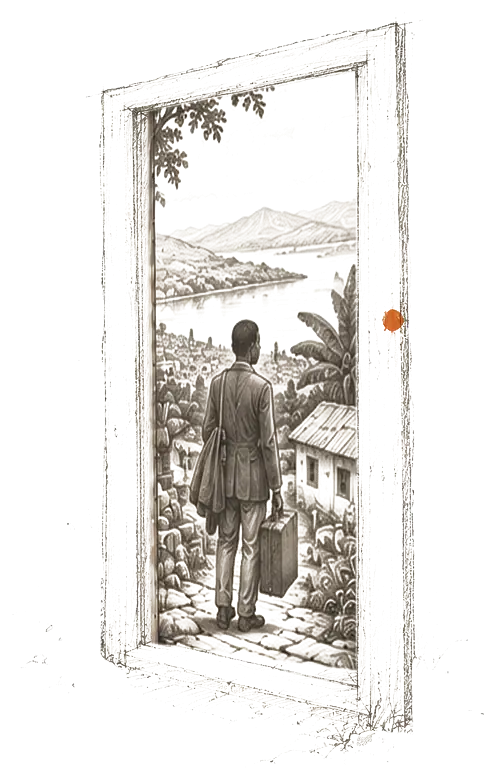
Gito, a Burundian student in Paris, goes home promising his Parisian partner to bring her over as soon as he becomes a minister. The reality of the country catches up with him: he gives up his ambition, finds his childhood love again and has to juggle the two women in his life.
Timeline
- 1976–1989First textsSéraphin Sese, Ambroise Niyonsaba. A literature very little circulated.
- 1980–1992First filmsNi-Ni, then Gito the Ungrateful, the first Burundian feature.
Reading keys
- Burundian names are sentences in Kirundi and are not passed from father to son: each child receives his own, often linked to the circumstances of his birth.
- There is therefore no family name in the European sense, which is disconcerting when reading genealogies in a novel.
- The Hutu, Tutsi and Twa categories designate an old social hierarchy, in a country of a single language and a single majority religion.
- The cow and its exchange, ubugabire, created bonds of clientship that organised society.
- The massacres of 1972 and the civil war of 1993 are raw subjects, and their designation is a political stake.
- The ethnic categories have been officially framed by quotas since 2005, which makes their literary evocation delicate.
- Criticism of power is dangerous, and most critical voices write from exile.
- Restraint is valued, and one does not express disagreement directly: the proverb serves to say what the sentence does not.
- Catholicism is very much in the majority, with an old implantation and an important place in schooling.
- Imana is the creator god, present in names, and the possession cult of kubandwa, whose spirit is here called Kiranga, offered an open space to subordinates and to women.
- The spirits of the ancestors, abazimu, receive offerings and intervene in family affairs.
- The diviner, umupfumu, is consulted for important decisions and for illnesses.
- Mourning includes a wake, a burial and a ceremony of lifting of mourning, with prohibitions for the widow.
- The royal drums, played standing and carried on the head, are listed as intangible heritage and their use is today regulated by the state.
- Woven baskets and patterned basketry serve as ceremonial gifts.
- The calendar mixes Catholic feasts and national commemorations of the massacres.
- The Kirundi proverbs, the imigani, are used as arguments and are quoted in ordinary conversation.
- The cattle poems, celebrating a herd and its owner, form a recognised literary genre.
- Ryangombe, called Kiranga here, and the kubandwa cult are shared with Rwanda.
- The drums and their names are an identity reference that any text assumes is known.
- Hutu and Tutsi are not two peoples with two languages: it is a social hierarchy fixed by the colonial administration.
- The drums are not a tourist folklore: they were a royal institution and their use is today framed by law.
- Burundian names do not function as surnames, and two brothers bear unrelated names.
- Burundi and Rwanda share a close language and a comparable social structure, without being the same country or having the same history.
Tales and mythologies 1
- TaleAnthologie rundiFirmin Rodegem · 1973not translated into EnglishThe collection appears at a time when, according to its introduction, the richness of the oral tradition risks sinking into oblivion.Literature
A selection to begin with 3 / 5
- EssayEntre deux mondesMichel Kayoya · 1970not translated into EnglishA priest and educator, the author writes for young people caught between the heritage of their fathers and modernization.Literature
- NovelL'Homme de ma collineJoseph Cimpaye · 1971not translated into EnglishThe author, a former head of government, wrote the novel in prison, where an accusation of endangering state security had led him.Literature
- Short filmNi-NiJean-Michel Hussi Nyamusimba · 1980The film predates Léonce Ngabo's first fiction, Gito, l'ingrat, by about ten years.Cinema