Rwanda
- works
- 3
- 2 books · 1 film
- period covered
- 1952–1986
- language of writing
- Kinyarwanda and French
In 1998, ten African writers came to live in Rwanda for two months. Four years after the genocide, a project invited them to stay in the country, to talk with survivors, then to write what they could. Senegalese, Ivorians, a Chadian, a Guinean, a Djiboutian: none was Rwandan, and that was the principle. From it came about ten books, novels, narratives, essays, and a way of putting a question that had no answer, that of who has the right to write a massacre.
Read moreShow less
That question has a prehistory. Rwanda had an extremely elaborate court literature: dynastic poems, pastoral poems to the glory of cows, a secret ritual code of the royalty, all of it transmitted by specialists who had hereditary charge of it. Alexis Kagame, a priest and poet, spent his life collecting that corpus and publishing it, while himself composing a Christian epic in Kinyarwanda. He set down in writing what was transmitted by word of mouth, and he did so in a language that almost nobody outside the country reads. The paradox is complete: a corpus saved and made inaccessible by the same gesture.
The dominant form after 1994 is testimony and inquiry, often written outside the country and often in French. The price was double: Rwandan literature from before the genocide is almost unknown, and the literature that came after was first written by foreigners or exiles. The country has since chosen English as the language of teaching, which shifts the question again, and a generation born after 1994 now publishes in both languages without passing through Kinyarwanda.
What awaits the reader is a literature in which form is a moral problem before being an aesthetic choice. The poem that opens this page is the first vigil of a Christian epic composed in Kinyarwanda by a priest, who cast sacred history in the forms of his country's pastoral poetry.
A way to begin
La Divine Pastorale
Alexis Kagame · 1952
The first of the eighteen vigils of a Christian epic composed in Kinyarwanda, translated by its author.
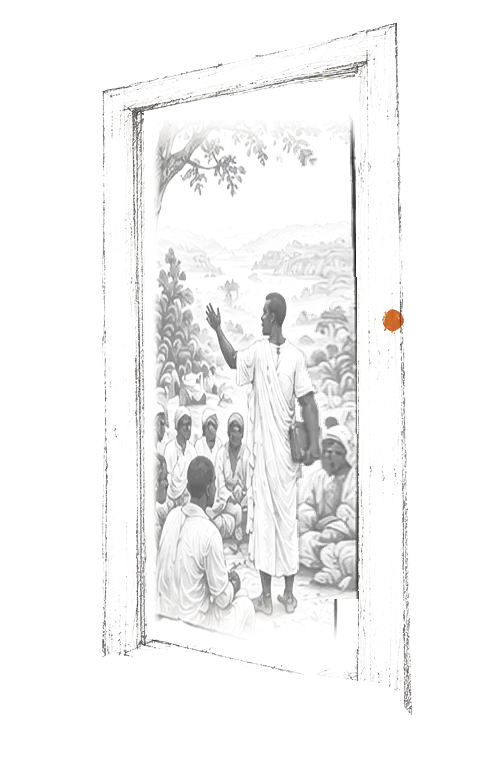
The first of the eighteen vigils of a Christian epic composed in Kinyarwanda, which the author himself translated into French. The epic adapts the pastoral genre of Rwandan poetry and tells the history of the world according to the Christian faith, drawing it close to the traditions of ancient Rwanda. It seeks to win its listeners to Christianity while turning them away from imitating Europeans.
Timeline
- 1952–1954First writingsAlexis Kagame in Kinyarwanda, Naigiziki in French.
- 1986ManirafashwaGaspard Habiyambere makes one of the rare Rwandan films from before 1994.
Reading keys
- Rwandan names are sentences in Kinyarwanda: Habyarimana means "it is God who begets", Mukamana "daughter of a king". They are not passed from father to son, each child receiving his own.
- There is therefore no family name in the European sense, and members of the same family bear different names.
- The Hutu, Tutsi and Twa categories are not ethnic groups in the linguistic sense: one language, one religion, the same territory, and a hierarchy hardened by colonisation.
- The cow is at the centre of kinship: the exchange of cattle created bonds of clientship, ubuhake, that structured society.
- The genocide of 1994 is framed by a law that forbids denial and punishes divisionism, which bounds what a text may say.
- The Hutu and Tutsi categories are no longer officially used, and mentioning them in a narrative is a delicate act.
- The role of France, of the Church and of the regional powers is the object of competing accounts.
- Restraint is valued: ubwenge, social intelligence, consists in not saying everything one knows, and a direct character is a naïve character.
- Christianity, above all Catholic, has been massively implanted since the beginning of the twentieth century and played a role in the construction of the social categories.
- Imana is the creator god, present in personal names, and Gihanga the mythical founder of the royalty.
- Ryangombe and the possession cult of kubandwa formed a parallel religion open to all, including women and subordinates, which made it a counterweight.
- The royal rites, the ubwiiru, were a secret code transmitted by distinct holders, and their loss is a major documentary loss.
- Mourning includes a wake, a burial and a lifting of mourning, and the kwita izina, the giving of a name to a child, takes place at a family ceremony.
- The annual commemoration of the genocide, in April, structures the national calendar and imposes a dress and a behaviour.
- The woven agaseke baskets and the patterned basketry are objects of gift and of reconciliation.
- The cattle poems, amazina y'inka, were recited to celebrate a herd and are a recognised literary genre.
- The dynastic poems and court narratives collected and published by Alexis Kagame are the learned corpus of reference.
- Gihanga, mythical founder of the royalty, and the narratives of clan origins are a common reference.
- Ryangombe and kubandwa are shared with Burundi, where the spirit is called Kiranga.
- The tales in Kinyarwanda, the imigani, are used as arguments and quoted in conversation.
- Hutu and Tutsi are not two peoples with two languages: it is an old social hierarchy, racialised and fixed by the colonial administration.
- Rwandan names do not function as surnames: two brothers bear different names, which is disconcerting when reading a family novel.
- The literature from before 1994 exists and is not only missionary: court poetry was a learned art with its schools.
- Writing about the genocide from outside was an avowed and debated choice, not an editorial accident.
A selection to begin with 2 / 3
- TheatreL'OptimisteSaverio Naigiziki · 1954not translated into EnglishThe play was written by an editor at a research institute, and was performed as soon as it was published.Literature
- CinemaThe Rwandan ChildManirafashwaGaspard Habiyambere · 1986Before 1994, the films shot in Rwanda that reference works record are foreign productions.Cinema