Comoros
- works
- 8
- 7 books · 1 film
- period covered
- 1980–1997
- language of writing
- French
The chronicles of the Comorian sultanates relate that the founders of the dynasties arrived by sea from Shiraz, in Persia. The same narrative is found at Kilwa, at Mombasa, at Lamu, all along the Swahili coast: everywhere Persian princes landing on African shores to found cities there. Historians see in it less a migration than a claim, that of Muslim merchant families equipping themselves with a prestigious ancestry. In the Comoros, that genealogy still serves as a title.
Read moreShow less
The archipelago is made of such superpositions. Shikomori is a Bantu language close to Swahili, written in Arabic characters long before being written in the Latin alphabet, and the learned vocabulary comes from Arabic, the domestic vocabulary from Bantu, part of the narrative stock from Madagascar. The Comoros were a relay of the Indian Ocean trade, a stopover between Africa, Arabia and India, and Arabic manuscripts were read and copied there for centuries. To which is added a political singularity: three islands took their independence in 1975, the fourth became a French department, and that division runs through families.
Modern writing therefore arrived late and through protest. Mohamed Toihiri published in 1985 the first Comorian novel, a ferocious satire of the revolutionary regime that mercenaries overthrew in 1978, whose title designates adolescents in power. Nassur Attoumani wrote in 1989 a play on polygamy that caused a scandal. The great marriage, the anda, a central institution that consecrates a man's status at the cost of considerable expenditure, is the subject that Comorian literature never stops examining.
What awaits the reader is a satirical and frontal writing, often theatrical, which takes its own society as a target rather than the coloniser. The novel that opens this page transposes under invented names the revolutionary regime of 1975 to 1978, and it is the first novel written by a Comorian.
A way to begin
La République des imberbes
Mohamed Toihiri · 1985
The first novel written by a Comorian: a satire of a revolutionary regime adrift, under invented names.
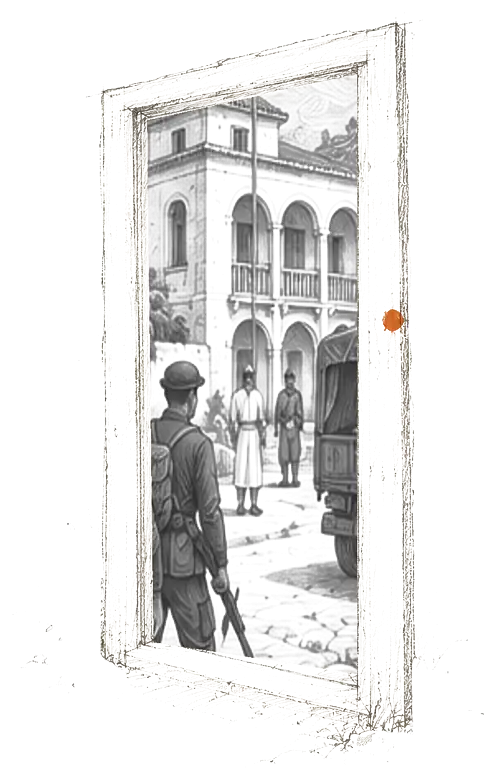
Mercenaries led by one John Ménard put to sea to seize President Guigoz, whom they find drunk in his residence. The novel then goes back over his life: the schoolboy who extorted the younger children, the politician who plays the factions off against each other to absolute power, the leader who abolishes the administration and its archives, hunts sorcerers while consulting his own and surrounds himself with very young people.
Timeline
- 1985–1989First novelsMohamed Toihiri opens Comorian fiction; Nassur Attoumani follows.
- 1997BacoMamadali makes the archipelago's first film.
Reading keys
- Names combine Arabic and Bantu, and the founding particle may refer to a claimed sharifian or Shirazi ancestry.
- Society is matrilocal: the husband moves into the house that the wife's family has built for her. The house belongs to the women, which reverses what a reader expects of a Muslim society.
- The great marriage, anda, confers on a man the status of a notable and opens public speech to him. A man who has not accomplished it remains a social junior whatever his age.
- The mfaume, a notable who has accomplished the anda, forms the governing class of the villages.
- The question of Mayotte, which remained French in 1975, divides families and is rarely spoken of head-on in the texts.
- The repeated coups and the role of foreign mercenaries in the years 1975 to 1995 are approached through satire.
- The cost of the anda, which puts whole families into debt and pushes people to emigrate, is criticised in literature and defended socially.
- The clandestine crossings towards Mayotte, which are lethal, are a recent and burning subject.
- Shafii Sunni Islam is practised by nearly the whole population and structures the day, the year and family law.
- The Sufi brotherhoods, among them the Shadhuliya, organise ceremonies, songs and visits to the tombs of saints.
- The jinn and the spirits of possession, called patros or trumba according to the island, belong to a stock shared with Madagascar and the Swahili coast. A trance scene is not a scene of madness.
- The majilis, a recitation assembly, mixes Quranic reading and collective song.
- Muslim mourning is brief, burial takes place on the same day, and condolences last three days.
- The great marriage unfolds over several days with processions, gifts of gold, songs and codified dances. Its description in a narrative is an inventory of debts and alliances.
- The women's shawl and shiromani veil, with their coloured patterns, indicate the island and the status.
- The lunar calendar moves Ramadan and the Eids, and the month of fasting reverses the rhythm of the days.
- The Shirazi legend, with the Persian princes founding the sultanates, is the narrative of origin that everyone knows.
- The tales of the archipelago, with their jinn and their ogres, belong to the Swahili and Malagasy stock.
- The narratives of Sufi saints and their visited tombs provide a repertoire of examples.
- The great marriage and its vocabulary are a social reference that any Comorian text assumes is known.
- The Comoros are not an Arab country: the language is Bantu and the population African, Arabic being the language of learning and of religion.
- Matrilocality, where the house belongs to the woman, contradicts the common image of a patriarchal Muslim society without for all that cancelling it.
- The great marriage is not a party: it is a status institution that organises access to public speech.
- Mayotte is part of the archipelago from the Comorian point of view, and mentioning it in a text is a political act.
Tales and mythologies 1
- TaleContes comoriensMarie-Françoise Rombi and Mohamed Ahmed-Chamanga · 1980not translated into EnglishIn 1980, the Comoros have been independent for five years, while Mayotte has remained under French administration.Literature
A selection to begin with 6 / 8
- TheatreLa Fille du polygameNassur Attoumani · 1989not translated into EnglishIn the Mayotte of the eighties, local law of Muslim origin still allows a man to marry several women.Literature
- NovelBrûlante est ma terreAbdou Salam Baco · 1991not translated into EnglishA childhood in Mayotte in the 1970s, between farming rites and political struggles, the first Mahorais novel in French.Literature
- NovelUn coin de voile sur les ComoresHamza Soilhaboud · 1994not translated into EnglishThe first novel of a Comorian writer, published in Paris in the mid-1990s.Literature
- TaleContes de ma grand-mèreSalim Hatubou · 1994not translated into EnglishA Comorian grandmother's tales, set down in writing by her grandson, the first book of a Marseille storyteller.Literature
- TaleContes des îles de la luneAbdallah Saïd · 1995not translated into EnglishComorian tales translated from Swahili, in which initiation passes through the ordeal of death and faithfulness to one's promise.Literature
- CinemaBacoOuméma Mamadali and Kabire Fidaali · 1997In the Comoros, there has been no working cinema since the eighties, nor any film industry.Cinema