Costa Rica
- works
- 30
- 28 books · 2 films
- period covered
- 1888–1999
- language of writing
- Spanish
On 1 December 1948, a head of government took a sledgehammer and broke a wall of the barracks. José Figueres had just won a six-week civil war, and he announced the abolition of the army, whose budget was transferred to education and health. The measure was written into the Constitution the following year. The country has had no armed forces since, it has the highest literacy rate in the region, and that decision has become the national narrative that Costa Ricans claim.
Read moreShow less
That choice has a prehistory. Costa Rica had little gold, little indigenous labour after the conquest, and an economy of small coffee proprietors rather than of great plantations: a less unequal society than its neighbours, more schooled, with a rural middle class. Literature was built on that peaceful self-representation and on its critique, often by the same authors. Carmen Lyra published in 1920 the tales of her aunt Panchita, in which the rabbit Tío Conejo triumphs over all the strong, and became the reference for all the children of the country before being stripped of her post and exiled for communism, and dying abroad.
The contradiction appears on the Caribbean coast. Carlos Luis Fallas published in 1941 the account of his work in the banana plantations of the south, with the black Jamaican workers and the Bribri Indians, and the book tears up the image of a country without conflict. Quince Duncan, regarded as the country's first Afro-Caribbean writer to write in Spanish, published in 1973 a novel about a black man from Limón who loses his reflection, and wrote a population that is English-speaking, Protestant and long deprived of citizenship, come from Jamaica to build the railway and forbidden to leave the province.
What awaits the reader is a literature calm on the surface and run through with fractures that it names without emphasis, those of colour, of language and of land. The collection that opens this page is a book of tales for children, the one that opened children's literature in Costa Rica, with the tricks of Uncle Rabbit in the country's own speech.
A way to begin
Cuentos de mi tía Panchita
Carmen Lyra · 1920
The book that opened children's literature in Costa Rica, free of rights: fairy tales and the tricks of Uncle Rabbit.
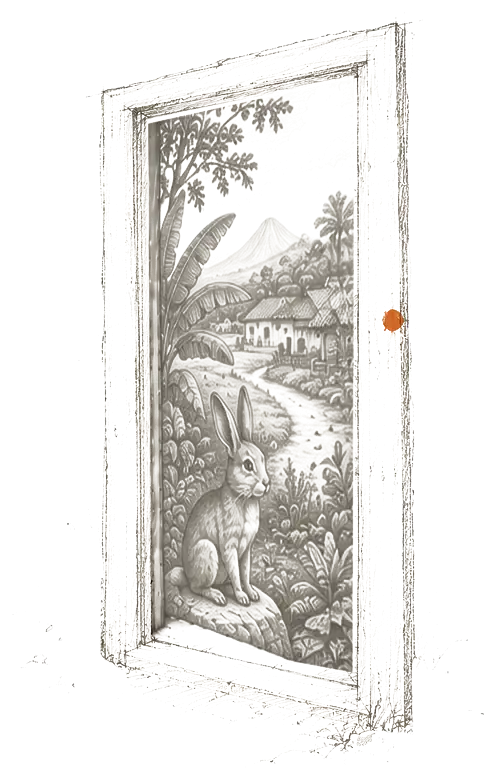
Two families of tales. The first are fairy tales: the olive flower, the Cucarachita Mandinga, the Ratón Pérez. The second follow tío Conejo, Uncle Rabbit, who plays truant, buys himself a horse, goes after the cheeses or gets engaged, and always gets out of trouble by trickery, in the speech of Costa Rica.
Timeline
- 1899–1920FoundationGarcía Monge, Aquileo Echeverría, Carmen Lyra. The country tells itself in tales.
- 1940–1947The 1940s generationFallas and Mamita Yunai, Fabián Dobles, Joaquín Gutiérrez. The social novel.
- 1955First feature filmAlfonso Patiño Gómez's Elvira opens a cinema that will stay rare.
- 1961–1970New voicesCarmen Naranjo, Julieta Pinto, and Quince Duncan, the first Afro-Costa Rican author.
- 1974–1983ContemporariesLaureano Albán, Rafael Ángel Herra. Poetry and the essay take over.
Reading keys
- The Spanish usage of two surnames applies, and one classifies by the father's name.
- The English names of the province of Limón, Duncan, Brown, McDonald, belong to the Afro-Costa Rican population come from Jamaica at the end of the nineteenth century.
- Bribri, Cabécar and Boruca names signal the indigenous peoples of the south, whose societies are matrilineal.
- Costa Ricans call themselves ticos, from the diminutive they use constantly, and that feature of speech is an identity marker.
- The image of a country without conflict, the Switzerland of Central America, is a national narrative that literature has contested since 1940.
- The Afro-Costa Rican population obtained full citizenship and the right to travel outside Limón only after 1949, a fact long absent from the textbooks.
- The situation of the indigenous peoples and access to the lands of the south are subjects little treated.
- Nicaraguan immigration, large and indispensable to the economy, is the object of prejudices that recent texts address.
- Catholicism is the state religion, with the Virgin of the Angels as patroness and a mass pilgrimage in August.
- The Caribbean coast is Protestant, Anglican and Baptist, with obeah practices inherited from Jamaica.
- The Bribri and the Cabécar have their own cosmology, with Sibö the creator and the awá, ritual specialists, and their narratives were collected as early as the nineteenth century.
- La Segua, a woman with a horse's face, and La Llorona are the best-known figures of the popular stock.
- The wake and the nine days of prayers organise the mourning, with a mass at the end of a year.
- Black is worn in mourning.
- The pilgrimage to Cartago, on 2 August, gathers hundreds of thousands of people sometimes walking for several days.
- Limón calypso and the Limón carnival in October mark the country's Caribbean culture.
- Tío Conejo, the cunning rabbit who gets the better of the coyote and the tiger, is the national trickster, fixed by the tales of 1920 and known to all the children.
- The Bribri and Cabécar narratives about Sibö and the creation, collected since the nineteenth century, form the documented indigenous corpus.
- The tico narratives published in 1901 and translated into English as early as 1905 are the accessible early source.
- La Segua and La Llorona belong to the common stock of the isthmus.
- The abolition of the army in 1948 is a real fact, but it did not abolish inequality, and the country's literature makes a point of recalling that.
- Costa Rica is not a country without a black or an indigenous population: Limón is Afro-Caribbean and English-speaking, the south is Bribri and Cabécar.
- Tío Conejo is not an import of the American Brer Rabbit: it is the same figure come from Africa by both routes.
- Bribri societies are matrilineal, which changes the reading of family relations in the narratives of the south.
Tales and mythologies 2
- TaleCuentos de mi tía PanchitaCarmen Lyra · 1920not translated into EnglishWonder tales and the tricks of tío Conejo, rewritten for children in everyday language.Literature
- TaleCuentos viejosMaría Leal de Noguera · 1923not translated into EnglishTales collected by a schoolteacher from the peasants of Guanacaste, between marvels from afar and the tricks of Uncle Rabbit.Literature
Available in English 3
The books from this country that can be read in English, in the original or in translation.
- Short storiesCosta Rican Short Stories of Anguish and LandscapesCuentos de angustias y paisajesCarlos Salazar Herrera · 1947Short dramas of the Costa Rican countryside, written and engraved by the same artist.Literature
- PoetryAutumn's LegacyHerencia del otoñoLaureano Albán · 1980A Costa Rican poet discovers autumn in Spain and makes it the symbol of a meditation on being, nature and time.Literature
- NovelAssault on ParadiseAsalto al paraísoTatiana Lobo · 1992A fugitive from the Inquisition in colonial Costa Rica, witness to an indigenous revolt: Tatiana Lobo's best-known novel.Literature
A selection to begin with 10 / 30
- Feature filmEl retornoA. F. Bertoni · 1930A student torn between the coffee-growing countryside and the capital, in the Costa Rica of 1930.Cinema
- NovelMamita YunaiCarlos Luis Fallas · 1941not translated into EnglishAn electoral mission in the heart of the banana zone on the Atlantic coast, under the sway of an American company.Literature
- NovelCocoríJoaquín Gutiérrez · 1947not translated into EnglishA little boy from the Caribbean coast tries to understand why beautiful things pass so quickly.Literature
- Short storiesCosta Rican Short Stories of Anguish and LandscapesCuentos de angustias y paisajesCarlos Salazar Herrera · 1947Short dramas of the Costa Rican countryside, written and engraved by the same artist.Literature
- NovelEl sitio de las abrasFabián Dobles · 1950not translated into EnglishThe struggle of the small settlers of the mountains against a large estate, from the 1870s into the twentieth century.Literature
- Short filmElviraAlfonso Patiño Gómez · 1955An educated servant and his employers' daughter, in San José in the middle of the twentieth century.Cinema
- NarrativeEl poeta, el niño y el ríoJosé León Sánchez · 1963not translated into EnglishA childhood narrative written in prison by a man sentenced to life, who had just learned to write there.Literature
- NovelLos cuatro espejosQuince Duncan · 1973not translated into EnglishA Black man from Limón, married into the white high society of San José, loses his reflection and sets out to find who he is.Literature
- PoetryAutumn's LegacyHerencia del otoñoLaureano Albán · 1980A Costa Rican poet discovers autumn in Spain and makes it the symbol of a meditation on being, nature and time.Literature
- NovelAssault on ParadiseAsalto al paraísoTatiana Lobo · 1992A fugitive from the Inquisition in colonial Costa Rica, witness to an indigenous revolt: Tatiana Lobo's best-known novel.Literature