Gabon
- works
- 24
- 15 books · 9 films
- period covered
- 1963–2000
- language of writing
- French
To recite the Mvett, one must be dead. The Fang epic, which tells of the war between the immortal men of Engong and the mortals of Oku, can be sung only by an initiate who has passed through a ritual death and come back from it, and its performance lasts a whole night, sometimes several, accompanied by a stringed instrument of the same name. The reciter alternates song, speech and dance, and the audience answers. In 1970, Tsira Ndong Ndoutoume fixed a written version of it.
Read moreShow less
That relation to speech dominates everything. Gabon is a thinly populated forest country, where societies were organised in dispersed lineages rather than in kingdoms, and where transmission passed through initiation and not through school. Bwiti, a cult that uses iboga to provoke visions and to meet the ancestors, still structures the religious life of part of the country, including among practising Catholics. What is known has to be earned, and a good part of what is told is not meant for everyone. That economy of secrecy is the key to most Gabonese texts: they indicate that there is something else without delivering it.
Hence a late written literature and an early cinema. The country produced films from the end of the nineteen sixties, with state funding, before it had novelists, and the first Gabonese novel appeared in 1971. Angèle Rawiri published in 1980 the first novel written by a woman in Gabon, about a young mixed-race teacher who returns to his mother's country, where witchcraft weighs on people's fates. The price of that late entry into writing is a slender corpus, and the price of the oil windfall is a culture long financed by the state and therefore little inclined to criticism.
What awaits the reader is a writing that keeps the rhythm of recited speech, with repetitions, direct addresses and silences. The book that opens this page transcribes the sung epic of the Fang, and its author, a master of the instrument, said he had received from the Ancestors the exceptional permission to set this sacred art down in writing.
A way to begin
Le Mvett
Tsira Ndong Ndoutoume · 1970
The sung epic of the Fang, transcribed into French by a master of the instrument that gives it its name.
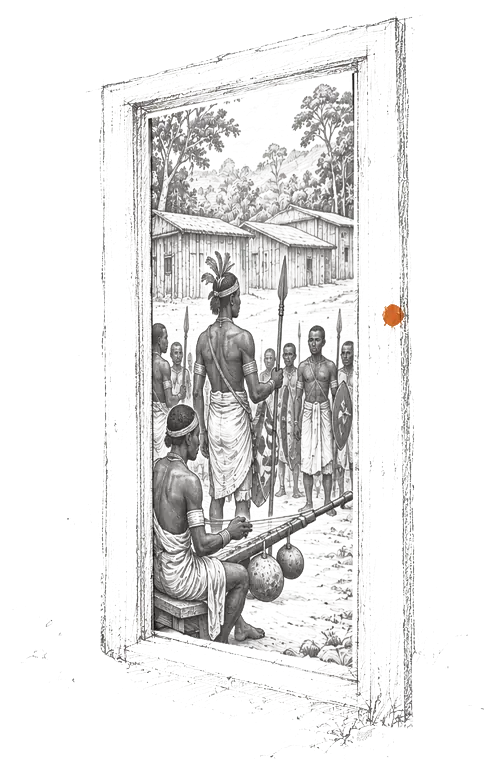
The tales of the mvett, the sung epic of the Fang people, transcribed into French: the boundless exploits of great warriors, the Ekang first of all. They unfold in a mythical world where the quest for immortality is played out, and each tale, originally accompanied by the instrument of the same name, pits Fang heroes against one another in their battles.
Timeline
- 1960–1971First textsRaponda-Walker collects the tales; poetry begins with Walker-Deemin.
- 1962–1975First filmsRobert Darne, Philippe Mory, Pierre-Marie Dong. A state cinema in the making.
- 1977The MvettNdong Ndoutoume writes down the Fang epic, until then only sung.
- 1978–1990The Gabonese novelAngèle Rawiri, the country's first woman novelist, Owondo, Okoumba-Nkoghé.
- 1986–2000New cinemaKoumba Bididi, Imunga Ivanga. Gabon returns to the screen.
Reading keys
- Names indicate the group and the region: Fang in the north, Myènè on the coast, Punu and Nzebi in the south.
- Fang societies are patrilineal and segmentary, with no central chief: authority is negotiated at each generation.
- Several societies of the south are matrilineal, so that inheritance passes through the maternal uncle. Confusing the two systems makes a family narrative unreadable.
- Initiation, and not age, makes the adult. An uninitiated man remains a junior whatever his social status.
- Initiatory knowledge is not spoken of outside the circle. A narrative may stop dead, and that interruption is a piece of information.
- The oil rent and the longevity of power from 1967 to 2009 form a subject little approached head-on in works published in the country.
- Sorcery and ritual crime are real accusations with judicial consequences. They are not fantastical motifs.
- The palabre, a discussion meeting under the village shelter, takes the time it takes and the narrative respects that duration.
- Catholicism is in the majority and coexists with Bwiti, an initiatory cult that uses iboga, a hallucinogenic root, to provoke the encounter with the ancestors. Many characters practise both.
- Nzame or Nzambe is the creator, and the ancestors, the bekong, are everyday interlocutors.
- The byeri, a chest containing the skulls of the ancestors surmounted by a statuette, is the central religious object of the Fang. The statues that European museums exhibit come from it.
- The forest is inhabited: spirits of the trees, the rivers and the crossroads, and one does not move through it without precaution.
- Funerals take place in two stages, the burial then the lifting of mourning, and the second ceremony is expensive and long prepared.
- White, obtained with kaolin, marks contact with the ancestors and is worn painted on the face during rites.
- Widowhood imposes on the woman prohibitions of dress, of speech and of movement for several months.
- The calendar mixes Christian feasts and initiatory ceremonies whose dates are not public.
- The Mvett, the Fang epic of the war between immortals and mortals, is the national literary reference.
- The Gabonese tales collected by Father Raponda-Walker, the first Gabonese priest and a scholar of his country, form the reference corpus.
- The Fang and Mpongwe narratives about origins and forest spirits are a stock shared with Equatorial Guinea and the south of Cameroon.
- Bwiti and its vocabulary constitute a common knowledge that the texts do not translate.
- The Fang and Punu statues in European museums are not works of art in the Western sense: they are guardians of reliquaries torn from their function.
- Iboga is not a recreational drug but the support of a framed rite of initiation.
- The small size of the written corpus does not measure the richness of a tradition that rested on initiatory orality.
- Gabon is not a Sahelian or savanna country: it is a country of dense forest, and the landscape commands the narratives.
Tales and mythologies 3
- TaleContes gabonaisAndré Raponda-Walker · 1967not translated into EnglishThe Gabonese oral tradition, recorded by the first priest of the country, who spoke the languages of those he listened to.Literature
- EpicLe MvettTsira Ndong Ndoutoume · 1970not translated into EnglishThe great sung epic of the Fang, transcribed into French by a master of the instrument that gives it its name.Literature
- TaleFables, proverbes et devinettes du Haut-OgoouéJean-Jérôme Adam · 1977not translated into EnglishFables, proverbs and riddles from south-eastern Gabon, collected by an Alsatian missionary who became archbishop of Libreville.Literature
Available in English 1
The books from this country that can be read in English, in the original or in translation.
- NovelAwu's StoryHistoire d'AwuJustine Mintsa · 2000The life of a village seamstress, the second wife of a schoolteacher, caught between the custom of northern Gabon and the school.Literature
A selection to begin with 10 / 24
- Feature filmThe Tam Tams Are SilentLes tam-tams se sont tusPhilippe Mory · 1971A sculptor attached to custom, a coveted young wife and the city that draws people in, in the early seventies.Cinema
- DocumentaryIl était une fois LibrevilleSimon Augé · 1972A documentary on the birth of Libreville and the treaty that opened colonisation, shot a dozen years after independence.Cinema
- Feature filmIdentitéPierre-Marie Dong · 1972A young artist back from Europe looks for his place in his country.Cinema
- Feature filmIlombéCharles Mensah · 1978A young peasant whose hut has burned down believes himself punished by the invisible powers.Cinema
- NovelElongaAngèle Rawiri · 1980not translated into EnglishThe return of a young mixed-race teacher to a country where witchcraft weighs on people's destinies.Literature
- Feature filmEquatorÉquateurSerge Gainsbourg · 1983An unemployed Frenchman in colonial Libreville, caught between a hotel owner and a murder the whites cover up.Cinema
- NovelAu bout du silenceLaurent Owondo · 1985not translated into EnglishA bereavement tears an adolescent from his coastal village and throws him into the poor districts of Libreville.Literature
- Short filmRaphiaPaul Mouketa · 1986A Gabonese short film awarded a prize at Carthage, whose subject has not been described anywhere.Cinema
- NovelAwu's StoryHistoire d'AwuJustine Mintsa · 2000The life of a village seamstress, the second wife of a schoolteacher, caught between the custom of northern Gabon and the school.Literature
- Feature filmDjogoLes Couilles de l'éléphantHenri-Joseph Koumba Bididi · 2000An election campaign in an imaginary African town, where a deputy's impotence becomes a public matter.Cinema