Georgia
- works
- 63
- 30 books · 33 films
- period covered
- 1150–1998
- language of writing
- Georgian
For centuries, a young Georgian woman took a copy of the same book with her in her dowry. The Knight in the Panther's Skin, written around 1200 by Shota Rustaveli at the court of Queen Tamar, recounts the friendship of two princes who cross India and Arabia to find an abducted woman. It was learnt by heart, stanzas of it were quoted in toasts, it was given at weddings. A poem of one thousand six hundred quatrains has held the role of national book in a country that has changed empire a dozen times.
Read moreShow less
Georgia has for that an alphabet of its own, one of the rare ones in the world to have been designed entirely for a single language, with three successive forms and thirty-three letters without capitals. The country has been Christian since the fourth century, wedged between the Ottoman Empire, Persia and Russia, and it has developed a culture of the table in which the meal is presided over by a master of ceremonies who gives codified toasts that may last for hours. Drinking is here a form of discourse, and refusing a toast is a political answer.
The dominant form in the twentieth century came from cinema, and it has a recognisable flavour. Under the Soviet regime the Georgians produced films so allusive, so funny and so unconforming that Moscow tolerated them as a folkloric exception: parables in which a man spends his days doing nothing, tales in which a tree grants wishes, tableaux without dialogue. Otar Iosseliani filmed in 1970 an orchestra timpanist who has only a few bars to play and fills the rest of his life with nothing. Tengiz Abuladze shot allegories that the censors were unable to read, and the Tbilisi studio produced more films per inhabitant than Moscow.
What awaits the viewer is a slow humour, a politeness that masks irony, and a trust in detail rather than in plot. The poem that opens this page was composed around 1200, and it was still part of a bride's dowry at the beginning of the twentieth century.
A way to begin
The Knight in the Panther's Skin
Shota Rustaveli · 1200
The masterpiece of medieval Georgian letters, free of rights: two knights bound by an oath, translated into more than fifty languages.
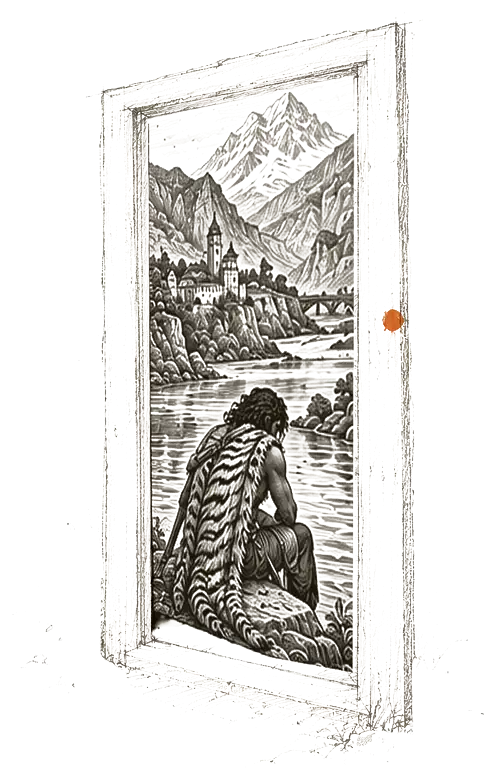
Rostevan, king of Arabia, has no son and has his daughter Tinatin crowned. During a hunt, the king and his general Avtandil glimpse a knight clad in an animal skin weeping by a river, who then vanishes. Tinatin asks Avtandil to find him within three years, promising him her hand; he discovers Tariel, an Indian prince mourning his lost beloved, and swears to help him find her.
Timeline
- 1150–1220Medieval golden ageRustaveli and The Knight in the Panther's Skin found the literary language.
- 1820–1900Romantics and realistsBaratashvili, Ilia Chavchavadze. Georgia under the Russian Empire tells itself.
- 1915–1930The Blue HornsTitsian Tabidze, Paolo Iashvili. The Terror will take them both.
- 1923–1940Birth of cinemaPerestiani, Mikaberidze, Shengelaia: an inventive Georgian silent cinema.
- 1956–1985Georgian New WaveAbuladze, Iosseliani, Parajanov. The freest cinema in the USSR.
Reading keys
- The endings of names indicate the region: -dze and -shvili, both meaning "son of", come from the west and the east; -iani from the Svan mountains; -ava and -ia from Mingrelia.
- Georgian has no grammatical gender and its nouns do not decline according to sex, so that a name alone does not say whether it belongs to a man or a woman.
- Godparenthood and sworn brotherhood create binding kinships.
- The tamada, master of ceremonies of the meal, directs the toasts and his role is a real social charge.
- The Soviet period is judged in contrasting ways, and the role of Stalin, born in Georgia, remains an uncomfortable subject.
- The wars in Abkhazia and South Ossetia, and the war of 2008, are subjects on which every account is situated.
- The nationalism of the nineteen nineties and the treatment of minorities are little approached head-on.
- Hospitality is an absolute duty: refusing a toast or leaving the table before the end offends lastingly.
- The Georgian Orthodox Church is autonomous and its social place is considerable, including among the non-observant.
- The high valleys of Khevsureti and Pshavi preserved until the twentieth century a pantheon of local divinities, the khati, with their sanctuaries and their attendants, distinct from Christianity.
- Amirani, a hero chained in the Caucasus with an eagle devouring his liver, is the Georgian Prometheus, and folklorists date the myth to the iron age.
- The spirits of the springs and the passes have their prohibitions, and the mountain is never a setting.
- Mourning includes a wake, a burial and a funeral meal, with calendar commemorations.
- The supra, a banquet presided over by a tamada, is the central social institution, with an order of toasts that begins with peace and ends with the dead.
- Wine, whose invention Georgia claims with buried vats eight thousand years old, has a ritual value.
- Three-voice polyphonic singing, listed as intangible heritage, accompanies meals and funerals.
- The Knight in the Panther's Skin is the text that all Georgians have learnt and quote, notably in toasts.
- Amiran-Darejaniani, a twelfth-century cycle, and the myth of Amirani form the heroic layer.
- The Georgian tales, translated into English as early as 1894 and published by the national library, constitute the documented corpus.
- Queen Tamar, a twelfth-century sovereign, is the most frequently summoned historical reference.
- Georgian belongs to no known family: it is neither a Slavic, nor an Indo-European, nor a Turkic language.
- The supra is not a drinking bout: it is a regulated form of speech-taking, with an order and a master of ceremonies.
- Georgia is not a Muslim country: it has been Christian since the fourth century, with old Muslim minorities in Adjara.
- Soviet Georgian cinema was not conforming: it was tolerated because Moscow took it for harmless folklore.
Tales and mythologies 1
- EpicThe Myth of AmiraniამირანიAnonymous · 1890A hero chained in the Caucasus for having defied God, a dog that wears down the chain and smiths who remake it: the Georgian myth that Hellenists compare to Prometheus.Literature
A selection to begin with 10 / 63
- TaleA Book of Wisdom and Liesსიბრძნე სიცრუისაSulkhan-Saba Orbeliani · 1695Fables and tales embedded in the disputes of a royal court, in the manner of the great books of Oriental tales.Literature
- Poetryსტუმარ-მასპინძელიVazha-Pshavela · 1893not translated into EnglishA highlander receives in his home a man from the enemy clan, and two equally sacred duties command contrary things of him.LiteraturePublic domain
- NovelKvachiკვაჭი კვაჭანტირაძეMikheil Javakhishvili · 1924A Georgian swindler who rises from Tiflis to the tsar's entourage, in an empire on the eve of collapse.Literature
- NovelThe Hand of a Great Masterდიდოსტატის მარჯვენაKonstantine Gamsakhurdia · 1939A novel of 1939: a cathedral building site in the kingdom of Georgia, when the crown, the Church and the clans of the highlands contend for the country.Literature
- NovelI See the Sunმე ვხედავ მზესNodar Dumbadze · 1962A story from 1962: a Georgian village in the rear during the war, seen by a teenager left alone by the arrests of 1937.Literature
- CinemaფიროსმანიGiorgi Shengelaia · 1969A life of the painter Niko Pirosmani, filmed in fixed, frontal shots that reproduce the composition of his canvases, in which the title role is played by a painter and not by an actor.Cinema
- Cinemaარ იდარდო!Georgiy Daneliya · 1969A young doctor returned from Russia to a Georgian town of bygone days, amid banquets, debts and neighbours who were not expecting him.Cinema
- CinemaThere Was a Singing Blackbirdიყო შაშვი მგალობელიOtar Iosseliani · 1970A musician who spends his evenings out and always comes back just in time, in a film that refuses to make a plot out of his life.Cinema
- Short filmფეოლაBaadur Tsuladze · 1970Twenty minutes taken from an almanac of three sports stories, in which a neighbourhood employee finds himself coaching a team of kids he does not want.Cinema
- CinemaRepentanceმონანიებაTengiz Abuladze · 1984A provincial tyrant is buried and his corpse returns every night; the woman who digs him up is put on trial, and her trial reopens thirty years that the town had decided to forget.Cinema