Ukraine
- works
- 67
- 49 books · 18 films
- period covered
- 1187–1990
- language of writing
- Ukrainian
In May 1847, Nicholas I added in his own hand, to the order sending Taras Shevchenko to serve as a private soldier at the far end of the empire, that he would be kept under the closest surveillance and that he was forbidden to write and to draw. Shevchenko had been born a serf and had been bought out nine years earlier thanks to a lottery organised around a painting. He spent ten years in garrison, hiding small notebooks, and he died under police surveillance.
Read moreShow less
The ban was not a personal matter. In 1863, a circular from the minister Valuyev declares that the Ukrainian language does not exist and has never existed, and forbids the printing of religious and school works; the Ems decree, in 1876, extends the ban to almost all print and to the importing of books. Publishing then moves to Lviv, under Austrian administration, where one may publish. On the same territory a Russian literature, a Yiddish literature and a Polish literature are also written, and the Tale of Igor's Campaign, around 1187, is claimed by Kyiv, by Moscow and by Minsk.
The Ukrainian form is a lyricism that passes into prose and into the image: Paradjanov filmed in 1965 a Carpathian village in sung tableaux, and the prose of the nineteen twenties invents an urban modernity with Pidmohylny. The price has a name, the executed renaissance. Hryhorii Kosynka was shot in 1934, Mykola Kulish in 1937, Pidmohylny the same year, and Mykola Khvylovy took his own life in 1933, at the moment of the famine that Ukraine calls Holodomor and describes as a genocide, a description that Russia contradicts. Isaac Babel, born in Odessa and writing in Russian, was shot in 1940. Lina Kostenko published no book from 1961 to 1977.
What awaits the reader is a literature in which song, the steppe and the violence of history hold together, and a poetry that served as a political language for want of another platform. The collection that opens this page held only eight poems in 1840, written in a language the Empire regarded as a peasant dialect, and it earned its author the nickname Kobzar.
A way to begin
Kobzar
Taras Shevchenko · 1840
Taras Shevchenko's first collection, eight poems in Ukrainian that earned their author the name Kobzar. Free of rights.
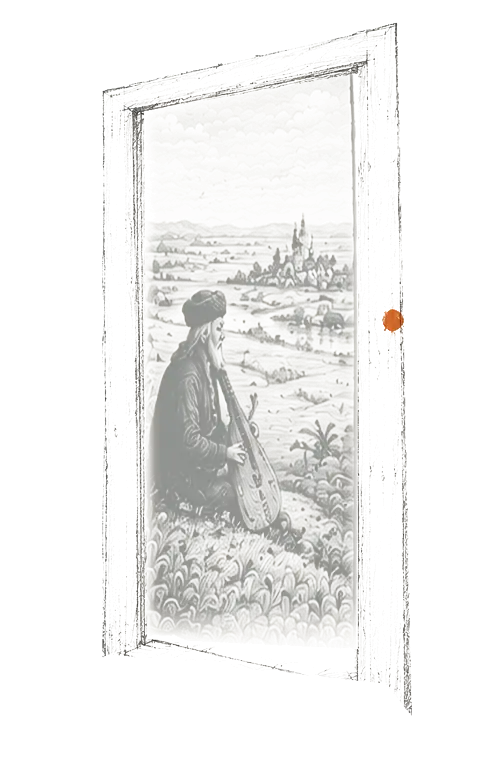
Eight poems in the first edition. The poet addresses his own thoughts; an old blind kobzar sings to himself alone in the steppe; a girl seduced by a Russian soldier gone to war against the Turks is driven from the village with her child. Then come ballads steeped in folk song, Cossacks setting out on an expedition against the Turks, and a singer who recalls the Cossacks' struggle against Polish rule.
Timeline
- 1840ShevchenkoA former serf founds modern Ukrainian literature, and pays for his language with exile.
- 1920–1933The executed renaissanceA whole generation of writers, painters and directors is exterminated by Stalin.
- 1930DovzhenkoEarth, one of the summits of silent cinema, shot in Ukraine and censored at once.
- 1960–1972The SixtiersA new generation raises its head, and ends up in the camps.
- 1991IndependenceUkrainian literature begins again to be written freely.
Reading keys
- Names in -enko, -chuk and -yuk are the most widespread, and many were transcribed into Russian in the imperial and Soviet periods: Shevchenko and its Russified form, Kyiv and Kiev, the spelling retained is a position.
- The patronymic in -ovych is used as in Russia, but the everyday use of the first name alone is more frequent, and diminutives are numerous.
- Female family names do not systematically decline, unlike in Russian, which distinguishes the two usages.
- Many families are bilingual and change language according to the interlocutor, without that indicating a political belonging.
- The famine of 1932 and 1933, called Holodomor and recognised as a genocide by Ukraine and by many states, is contested in that description by Russia: the choice of words situates a text, and the file uses the Ukrainian term while signalling the disagreement.
- The collaboration of certain nationalist movements with Germany during the war, and their present commemoration, divide inside as well as outside the country.
- The massacre of the Jews of Ukraine, including Babi Yar in 1941, and the participation of local auxiliaries were long erased from Soviet accounts.
- The war begun in 2014 and the invasion of 2022 run through all current production, and Russian as a literary language has become there a subject of internal debate.
- The country has several competing Orthodox Churches, one of which became autocephalous in 2019, another long attached to Moscow, plus a Greek Catholic Church in the majority in the west, suppressed in 1946 and restored in 1989.
- The pre-Christian stock is alive in the songs and the rites: Dazhboh and Perun in the old texts, the rusalki of the waters, the mavky of the forests.
- Kupala night, the Christmas songs and the spring games are complete ritual sequences that literature takes up as they stand.
- Judaism marked towns and small towns for centuries, with Hasidism born in those regions, and its absence in post-war texts is an effect of the extermination.
- The shirt embroideries, with their patterns and colours proper to each region, are a system of signs that a text uses to place a character.
- The koliadky of Christmas, sung from house to house with a star, and the spring songs are dated rites, and the Julian calendar remains in use in part of the country.
- The commemorative meal at a fixed date after a death, with sweetened boiled wheat, and the visits to the graves after Easter structure the relation to the dead.
- The bread and salt offered at the entrance, the bride's wreath and the wife's headscarf are coded gestures, immediately legible.
- The Kobzar of 1840 is the absolute founding text, learnt at school and quoted from memory, and its author is a quasi-religious figure.
- The Tale of Igor's Campaign, around 1185, is claimed by Ukraine, Russia and Belarus, which make of it three different inheritances.
- The first great collection of Ukrainian tales, published by Rudchenko in 1869, appeared under a title imposed by the censors, who forbade the word Ukrainian.
- The Zaporozhian Cossacks, Bohdan Khmelnytsky and the blind kobzar who sings history are the repertoire of figures that every text assumes is known.
- Ukrainian is not a dialect of Russian: it is a distinct East Slavic language, whose printing was banned in 1863 and 1876 precisely because it existed.
- Part of the literature of this territory is written in Russian, in Yiddish or in Polish, and the catalogue shows it: literary nationality is not confused with language.
- Gogol was born in Ukraine and wrote in Russian, which makes him an object of claim on both sides, and the reader gains by knowing both arguments rather than by choosing.
- The country is not a late periphery: Kyiv is older than Moscow, which is precisely what is at stake in the competing readings of the East Slavic Middle Ages.
- The catalogue stops essentially in 1989, which reflects the state of French translations and not Ukrainian literature of the last thirty years.
Tales and mythologies 2
- PoetryThe Tale of Igor's CampaignСлово о полку ІгоревімAnonymous · 1187A poem from the end of the twelfth century about an expedition of princes against those of the steppe, known from a single copy, which burned.LiteraturePublic domain
- TaleНародні південноруські казкиIvan Rudchenko · 1869not translated into EnglishA collection of folk tales in two volumes, published in 1869 and 1870 under a Russian title, the texts being printed in the language of the storytellers.Literature
A selection to begin with 10 / 67
- NarrativeIn the GrainfieldsВ житахHryhoriy Kosynka · 1926An impressionistic tale of the civil war, in which a deserter hiding in the middle of the wheat fields rediscovers the will to live.LiteraturePublic domain
- Short storiesRed CavalryКонарміяIsaac Babel · 1926A collection of 1926 drawn from the campaign of 1920, which its author followed on horseback in the Red cavalry as a correspondent, under a false name.Literature
- NovelВальдшнепиMykola Khvylovy · 1927Unfinished novel of 1927, made up of debates of ideas on revolution and nation, the second part of which was destroyed.LiteraturePublic domain
- NovelThe CityМістоValerian Pidmohylny · 1928A novel of 1928 about a village boy who comes to Kyiv and becomes a writer at the price of what he once was.Literature
- TheatreMyna MazailoМина МазайлоMykola Kulish · 1929A comedy of 1929, written in the time of Ukrainisation, on the family name and the choice between two languages.LiteraturePublic domain
- CinemaShadows of Forgotten AncestorsТіні забутих предківSergei Parajanov · 1965A film from 1965 shot among the Hutsuls of the Carpathians after a story by Kotsiubynsky, which proceeds by tableaux, colours and songs rather than by plot.Cinema
- CinemaFaithfulnessВірністьPetro Todorovsky · 1965The first film by its director, in 1965, about the few months separating a military school from the rear of the front.Cinema
- CinemaWar and PeaceВійна і мирSergei Bondarchuk · 1967A four-part adaptation of Tolstoy's novel, filmed over more than five years with the resources of a state.Cinema
- CinemaThe Stone CrossКамінний хрестLeonid Osyka · 1968A film of 1968 based on two short stories by Stefanyk, about an old peasant who leaves his hill and about a village night.Cinema
- NovelMarusia ChuraiМаруся ЧурайLina Kostenko · 1979A verse novel of 1979 about the trial of a songwriter in seventeenth-century Poltava.Literature