Guatemala
- works
- 22
- 18 books · 4 films
- period covered
- 1550–1994
- language of writing
- Spanish
It was in Paris, in French, that a young Guatemalan discovered the sacred book of his country. Miguel Ángel Asturias, a student at the Sorbonne in the nineteen twenties, attended the courses of a professor who had just translated the Popol Vuh, the narrative of the creation of the world according to the K'iche', and he retranslated it into Spanish from that French version. The original alphabetic manuscript, copied around 1701 by a Dominican of Chichicastenango in K'iche' and in Spanish, had slept for two centuries in libraries. A Maya text therefore went round Europe before coming home.
Read moreShow less
That detour throws light on a singular colonial situation. Guatemala is the country in America where the Maya population is proportionally the largest, with some twenty languages still spoken, and where official culture was long exclusively Hispanic. The great colonial texts, the Popol Vuh, the Annals of the Cakchiquels, the Rabinal Achí preserved and performed since the fifteenth century, were written by Mayas in Latin characters to save what could be saved, then forgotten by those who governed.
From that crossing a recognisable form was born. Asturias published in 1946 a novel about a dictator whom he does not name, written in a prose in which Maya rhythms and images work on Spanish, and he won the Nobel in 1967. Augusto Monterroso pushed brevity to the extreme with fables of one page and a short story of seven words. The price was terrible: the civil war from 1960 to 1996 caused two hundred thousand deaths, the majority of them Maya, and a commission described those facts as genocide. A 1994 film recounts the year 1954 as seen by a child.
What awaits the reader is a Spanish inhabited by other languages and a literature that has never separated the political from the marvellous. The novel that opens this page describes without naming it a dictatorship in which the master hardly appears, and it remained unpublished for thirteen years before appearing in Mexico.
A way to begin
The President
Miguel Ángel Asturias · 1946
The founding novel of the dictator novel, by Guatemala's Nobel laureate: the terror of a dictatorship in the language of nightmare.
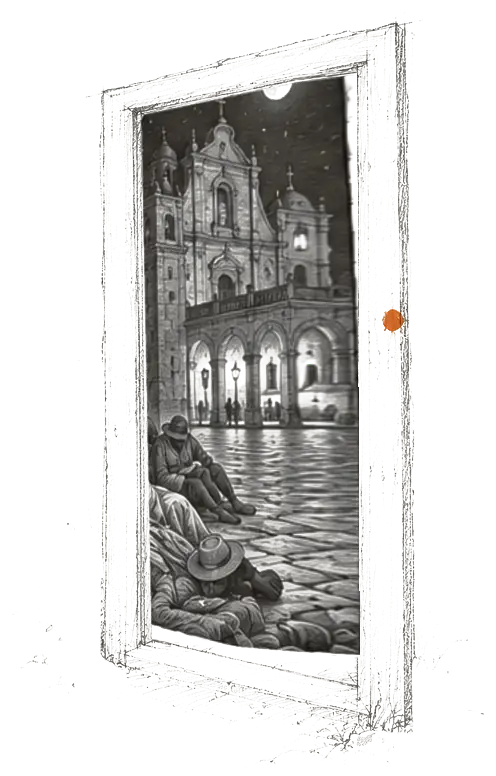
One night, under the Portal of the Lord where the beggars sleep, the Pelele, a simpleton driven mad by mockery, kills a colonel, one of the President's henchmen. The dictator uses the crime to destroy his enemies, and charges his favourite, Angel Face, with pushing General Canales to flee so that he can be shot on the way. But Angel Face falls in love with Camila, the general's daughter.
Timeline
- 1550Popol VuhThe council book of the Maya Quiché, transcribed after the conquest.
- 1830–1890FoundationBatres Montúfar, Milla y Vidaurre, María Cruz. Creole Romanticism.
- 1912–1927ModernismoArévalo Martínez, Gómez Carrillo, Cardoza y Aragón. Cinema arrives in 1912.
- 1946The PresidentAsturias invents the dictator novel. Nobel in 1967.
- 1969–1994AfterMonterroso and his brief fables; El Norte and El silencio de Neto on screen.
Reading keys
- The Spanish usage of two surnames applies, and one classifies by the father's name.
- Maya names, in K'iche', Kaqchikel, Mam or Q'eqchi', signal belonging and sometimes the region, and their public use is a claim.
- Compadrazgo binds families beyond blood and structures village communities.
- The cofradías, brotherhoods that manage a village's saints, constitute a parallel political organisation in Maya communities.
- The genocide of the Maya populations during the civil war, described as such by a truth commission in 1999, is a judicially and politically burning subject.
- The coup of 1954, organised from abroad against an elected government, is the starting point of every narrative of the conflict.
- Racism towards the Mayas is structural and rarely named head-on by the country's Hispanic literature.
- The question of who may write about the Maya world, and from what position, is an explicit literary debate.
- Catholicism and a deeply implanted evangelical Protestantism coexist with Maya religion, whose day and calendar rituals are practised by spiritual guides, the aj q'ij.
- The calendar of two hundred and sixty days, the cholq'ij, assigns to each birth a day bearing a character, and a guide is consulted to know it.
- The nawal, an animal double attached to each person, and the spirits of places belong to the living stock.
- Maximón or Rilaj Mam, an ambivalent figure venerated in the highlands with tobacco and alcohol, is neither a Catholic saint nor a Maya god but both.
- The wake and the meal that follows organise the mourning, with commemorations on the ninth day and at the end of a year.
- The colours and patterns of the huipil, a blouse woven by the women, identify the village of origin precisely. A huipil is an address.
- Holy Week, with its carpets of coloured sawdust in the streets of Antigua, is the great religious moment.
- The Day of the Dead, with giant kites flown above the cemeteries at Sumpango, is a rite proper to the country.
- The Popol Vuh, with the twins Hunahpu and Ixbalanque who go down to defeat the lords of the underworld, is the founding text, taught and quoted.
- The Annals of the Cakchiquels recount the same history from another people, and the Rabinal Achí, a danced drama of the fifteenth century, is still performed every year.
- El Sombrerón, a small man with a big hat who plaits horses' manes and seduces young girls, is the best-known figure of the popular stock.
- The nawal and the calendar of two hundred and sixty days are a common knowledge in the highlands.
- The Mayas are not a vanished people: they form a considerable part of the Guatemalan population and speak some twenty languages.
- The Popol Vuh is not a pre-Hispanic codex but a text written in Latin characters in the sixteenth century by Mayas, to preserve what was going to be lost.
- The Maya calendar did not predict the end of the world in 2012: that reading is a Western invention.
- The civil war was not a symmetrical confrontation: ninety-three per cent of the violence was attributed to state forces.
Tales and mythologies 2
- EpicPopol VuhAnonymous · 1550The book of creation and of the hero twins of the K'iche' Maya, written down in the Latin alphabet after the conquest.Literature
- TheatreRabinal AchiRabinal AchíAnonymous · 1850A Maya drama that the community of Rabinal still dances, in which two enemy warriors speak to each other before the sentence.Literature
Available in English 4
The books from this country that can be read in English, in the original or in translation.
- NovelThe PresidentEl señor PresidenteMiguel Ángel Asturias · 1946The terror of a Central American dictatorship, told in the language of nightmare.Literature
- PoetryLet's Go!Vámonos patria a caminarOtto René Castillo · 1965A Guatemalan collection that unites love song and the call to the homeland, around a poem awarded a prize in 1956.Literature
- TaleThe Black Sheep and Other FablesLa oveja negra y demás fábulasAugusto Monterroso · 1969Very short fables in which animals act out the failings of people of letters and of power.Literature
- NovelTime Commences in XibalbáEl tiempo principia en XibalbáLuis de Lión · 1985A Maya novel of circular time, published after the death of its Kaqchikel author.Literature
A selection to begin with 10 / 22
- TaleEl hombre que parecía un caballoRafael Arévalo Martínez · 1915not translated into EnglishA tale in which each character reveals the animal that dwells within, written on the margins of a friendship between two poets.Literature
- NovelEl evangelio del amorEnrique Gómez Carrillo · 1922not translated into EnglishA Byzantine novel on carnal love as a path to God, written in Paris by a Guatemalan chronicler.LiteraturePublic domain
- PoetryMaelströmLuis Cardoza y Aragón · 1926not translated into EnglishAn avant-garde book written in Paris by a young Guatemalan, combining prose, verse and montage.Literature
- CinemaCuatro vidasJosé Giaccardi · 1949A melodrama of romantic rivalries, filmed in Guatemala with two stars of Mexican cinema.Cinema
- CinemaEl SombrerónGuillermo Andreu and Eduardo Fleischmann · 1950The country's most famous legend, brought to the screen by a radio man from Guatemala City.Cinema
- PoetryLet's Go!Vámonos patria a caminarOtto René Castillo · 1965A Guatemalan collection that unites love song and the call to the homeland, around a poem awarded a prize in 1956.Literature
- TaleThe Black Sheep and Other FablesLa oveja negra y demás fábulasAugusto Monterroso · 1969Very short fables in which animals act out the failings of people of letters and of power.Literature
- CinemaEl NorteGregory Nava · 1983The flight of two young Maya people to the United States, filmed with Guatemalan refugees.Cinema
- NovelTime Commences in XibalbáEl tiempo principia en XibalbáLuis de Lión · 1985A Maya novel of circular time, published after the death of its Kaqchikel author.Literature
- CinemaEl silencio de NetoLuis Argueta · 1994A childhood during the overthrow of Árbenz, in a house in the capital where people keep silent.Cinema