Iraq
- works
- 25
- 24 books · 1 film
- period covered
- -2300–1991
- language of writing
- Arabic
The first identified author in history is a woman, and she lived here. Around 2300 before our era, a priestess of Ur named Enheduanna, daughter of King Sargon, composed hymns that she signed with her name, speaking in them of herself, of her exile and of her anger. We know her name centuries before that of any other poet, and her texts were still being copied five hundred years after her death. It is also in this country that writing was invented, around 3300 before our era, to count sacks of grain and head of cattle, long before it served to recount Gilgamesh.
Read moreShow less
Four thousand years later, Iraq has remained a country where poetry has a public status. Abbasid Baghdad produced a court literature of extreme refinement, with Abu Nuwas and his wine poems, and al-Mutanabbi whose verses are still recited. The regional saying had it that Iraq read what Lebanon printed, and a street in Baghdad bears the name of al-Mutanabbi: it is a book market, destroyed by an attack in 2007 and then reopened.
The dominant form in the twentieth century came from a technical rupture. In 1947, two Iraqi poets published almost simultaneously texts that abandoned the classical Arabic metre for free verse, and that decision, taken in Iraq, changed the whole of Arabic poetry. One was called Badr Shakir al-Sayyab, the other was a woman, Nazik al-Malaika, whose poem on cholera remained a manifesto. The price was paid under the successive regimes, with the exile of almost an entire generation, and in 2003 the national library burned, with its Ottoman archives, while the museum was looted.
What awaits the reader is a poetry in which the river, the palm grove and the city return as obligatory motifs, and a prose that counts its dead without raising its voice. The collection that opens this page dates from 1960, its title means the song of the rain, and it brought the myths of Babylon into modern Arabic poetry.
A way to begin
أنشودة المطر
Badr Shakir al-Sayyab · 1960
The collection that brought the myths of Babylon into modern Arabic poetry, one of the great events of contemporary Arabic poetry.
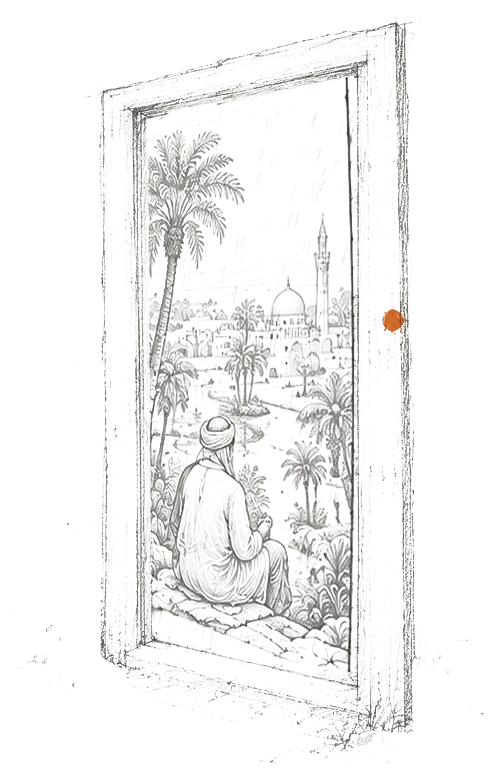
In the song that gives the collection its title, the rain on the palm trees brings back the memory of the dead mother and the observation that there is no year without hunger in Iraq. Other poems bring Tammuz and Ishtar, or Christ after the crucifixion, back to life, and voice nostalgia for the native village in the face of Baghdad.
Timeline
- 908Ibn al-Mu'tazzKitab al-Badi' fixes Arabic poetic rhetoric in Baghdad.
- 1920–1928Iraqi NahdaAl-Rusafi, al-Zahawi, al-Jawahiri. Classical poetry turns political.
- 1947The birth of free verseNazik al-Mala'ika and al-Sayyab publish in the same year, and everything changes.
- 1950–1980Novel and exileDhu al-Nun Ayyub, al-Takarli, Saadi Youssef. Many write from outside.
- 1961–1990Other voicesIbrahim Ahmad writes in Kurdish; Alia Mamdouh publishes Layla and the Wolf.
Reading keys
- The name reads as a genealogy, with bin, and the last element designates the family, the tribe or the town of origin.
- The name often makes it possible to place the confession and the region, between Sunnis of the centre and the north, Shias of the south, Kurds of the north-east, Christians of Mosul and of the Nineveh plain.
- The tribe remains an active social and political structure, and the tribal name commits real solidarities.
- The kunya, "father of" followed by the name of the eldest child, is the ordinary respectful form of address.
- The successive regimes since 1958, the war against Iran, the embargo of the nineteen nineties, the invasion of 2003 and the violence that followed form a history in which every account is situated.
- The genocide of the Kurds, with Halabja in 1988, and the repression of the Shias in 1991 are subjects whose treatment commits one politically.
- The destruction of the heritage, the national library burned and the museum looted in 2003, sites destroyed afterwards, is a documented cultural wound.
- Restraint is valued, and poetry serves to say what conversation does not say.
- Islam is in the majority, divided between Sunnis and Shias, with Najaf and Karbala as holy places of world Shiism.
- The Kurds of the north are mostly Sunni, with Yazidi and Kaka'i minorities, and the Yazidis have a religion of their own, very ancient, severely persecuted.
- Christian communities of several rites, some of them with liturgies in Aramaic, have been present since the first centuries, and the Mandaeans of the south constitute a gnostic religion unique in the world.
- The Mesopotamian stock, with Gilgamesh, the descent of Ishtar and the flood, is claimed as national depth.
- Muslim mourning is brief, with burial on the same day and three days of condolences, extended to the fortieth.
- Black dominates Shia mourning, and Ashura gives rise to processions and to collective lamentations that are a literary genre in their own right.
- Ramadan and the Eids order the calendar, and the Kurdish New Year, Newroz, on 21 March, is a major landmark in the north.
- The palm grove and the river organise the seasons and the scenes, and their destruction is a recurring motif.
- The epic of Gilgamesh, the Enuma Elish and the descent of Ishtar to the underworld are claimed as national heritage and quoted by modern poets.
- The Thousand and One Nights, whose central cycle takes place in Abbasid Baghdad, are a common material constantly reworked.
- Abu Nuwas, al-Mutanabbi and Abbasid poetry are a learned reference that every Iraqi knows.
- Al-Mutanabbi Street in Baghdad, a book market, has become a symbolic place of intellectual life.
- Iraq is not a homogeneous Arab country: the Kurds form a nation with its language and its literature, and several religious minorities there are older than Islam.
- Arabic free verse was invented in Iraq in 1947, in part by a woman, which literary histories often forget.
- Ancient Mesopotamia is not a tourist setting: it is claimed as depth by contemporary authors.
- The successive wars do not sum up a literature that is among the oldest in the world.
Tales and mythologies 3
- TaleOne Thousand and One Nightsألف ليلة وليلةAnonymous · 1400Nested tales from Persia, India and the Arab world, which a female storyteller sets against death.Literature
- EpicThe Sumerian Poems of GilgameshBilgameshAnonymous · -2100The oldest tales about Gilgamesh, in Sumerian, well before the Akkadian version that took up several of their episodes.Literature
- EpicThe Epic of Gilgameshša naqba īmuruAnonymous · -1200A tyrannical king, a lost friend and the quest for eternal life, in the Babylonian version in twelve tablets.Literature
Available in English 8
The books from this country that can be read in English, in the original or in translation.
- PoetryThe Exaltation of InannaNin-me-šaraEnheduanna · -2300A Sumerian hymn to the goddess Inanna, in which a high priestess of Ur, deprived of her office, asks for redress.Literature
- NarrativeThe Book of Misersكتاب البخلاءal-Jahiz · 850Letters and anecdotes about misers, gathered in the ninth century by the great prose writer of Basra.LiteraturePublic domain
- NarrativeImposturesمقامات الحريريal-Hariri · 1110Fifty tales in rhymed prose about the tricks of an eloquent swindler, composed at the turn of the twelfth century.Literature
- NarrativeMemoirs of a Babylonian PrincessMaria Theresa Asmar · 1844The Ottoman Orient told by a Chaldean woman from Baghdad, on her way to Europe.Literature
- NovelThe Long Way Backالرجع البعيدFuad al-Takarli · 1980A Baghdad family on the eve of the 1963 coup, told by those who make it up.Literature
- NovelSaddam Cityأنا الذي رأىMahmoud Saeed · 1981An ordinary man crushed by the prisons of Baathist Iraq, without ever learning his crime.Literature
- NovelNaphtaleneحبات النفتالينAlia Mamdouh · 1986A girl's childhood in the Baghdad of the fifties, between a sick mother and a violent father.Literature
- PoetryButterfly Valleyدەربەندی پەپوولە (Derbendî Pepûle)Sherko Bekas · 1991A long poem of mourning written in exile by a great Kurdish poet, in response to the massacres of 1988.Literature
A selection to begin with 10 / 25
- NarrativeThe Book of Misersكتاب البخلاءal-Jahiz · 850Letters and anecdotes about misers, gathered in the ninth century by the great prose writer of Basra.LiteraturePublic domain
- Essayكتاب البديعIbn al-Mu'tazz · 887not translated into EnglishThe ornaments of Arabic poetry, classified by a learned prince to defend the modern poets of his time.Literature
- NarrativeImposturesمقامات الحريريal-Hariri · 1110Fifty tales in rhymed prose about the tricks of an eloquent swindler, composed at the turn of the twelfth century.Literature
- NarrativeMemoirs of a Babylonian PrincessMaria Theresa Asmar · 1844The Ottoman Orient told by a Chaldean woman from Baghdad, on her way to Europe.Literature
- Poetryشظايا ورمادNazik al-Malaika · 1949not translated into EnglishThe manifesto of a new metre and its first poems, written in the aftermath of an epidemic.Literature
- Cinemaفتنة وحسنHaidar Al-Omar · 1955Two cousins in love against a stepmother and custom, in the Iraqi countryside of the fifties.Cinema
- NovelThe Long Way Backالرجع البعيدFuad al-Takarli · 1980A Baghdad family on the eve of the 1963 coup, told by those who make it up.Literature
- NovelSaddam Cityأنا الذي رأىMahmoud Saeed · 1981An ordinary man crushed by the prisons of Baathist Iraq, without ever learning his crime.Literature
- NovelNaphtaleneحبات النفتالينAlia Mamdouh · 1986A girl's childhood in the Baghdad of the fifties, between a sick mother and a violent father.Literature
- PoetryButterfly Valleyدەربەندی پەپوولە (Derbendî Pepûle)Sherko Bekas · 1991A long poem of mourning written in exile by a great Kurdish poet, in response to the massacres of 1988.Literature