Kuwait
- works
- 3
- 2 books · 1 film
- period covered
- 1970–1985
- language of writing
- Arabic
In the nineteen thirties, the trade that supported the Gulf disappeared in a decade. Japanese cultured pearls flooded the market, the world crisis closed the outlets, and pearl diving stopped. Whole towns lost their reason for being. Oil would arrive only after the war, and between the two there were years of destitution which the country's literature remembers.
Read moreShow less
Before that, Kuwait was a port. Its dhows went as far as Zanzibar, Bombay and Basra, and the ships of the Gulf were built there. On board, a professional singer, the nahham, gave the rhythm to the men hauling up the ropes, and his repertoire regulated the collective effort. The town lived by the rhythm of the diving season, the ghaws, which lasted four months and from which some did not return. It is a culture of the sea, not of the desert, and that distinguishes Kuwait from its neighbours. The country had schools, a press and literary circles early on, because a port needs literate men for its accounts and its contracts.
Forty years after the collapse, in 1972, Khalid Al-Siddiq shot the country's first feature film. A young man dives ever deeper in the hope of a pearl that would let him marry. The film is called The Cruel Sea, and it came out at the moment when the town was covering itself with towers and the memory of diving was becoming a museum object. Making a film about what has just disappeared, at the instant when oil money is erasing the traces, is the founding gesture of Kuwaiti cinema. The narrative does not seek to move the audience: it shows a system in which the diver falls into debt to the captain and works to repay him.
What awaits the viewer is an art turned towards loss rather than towards opulence, and attentive to trades, to gestures, to work songs. The film that opens this page follows a diver's son in the poor Kuwait of the years before oil, and it won a prize at Venice in 1972.
A way to begin
The Cruel Sea
Khalid Al-Siddiq · 1972
Kuwait's first fiction feature, awarded at Venice in 1972: a diver's son and pearl fishing before oil.
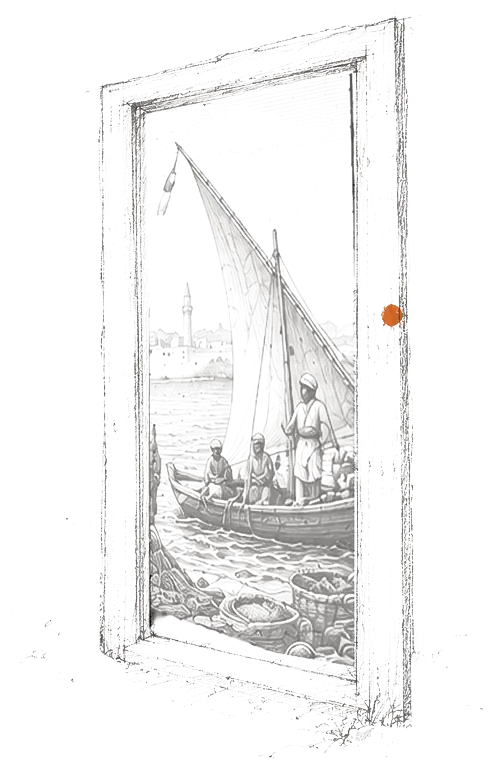
Before oil, in a still poor Kuwait, Mussaed is the son of a diver crippled by the sea. His father forbids him to dive, but the young man needs money to marry Noura, promised to a richer suitor. The father gives in and lends him his gear: Mussaed sails on a dhow for the season, hoping for a pearl that would change his fate.
Timeline
- 1930–1950ReviewsThe reviews of Kuwait City take in the country's first poets and short story writers.
- 1961IndependenceOil money funds schools, publishing and theatre, making the country a cultural centre of the Gulf.
- 1970–1985Theatre and televisionKuwaiti companies and television series are watched across the peninsula.
- 1990–1991InvasionThe Iraqi occupation and the liberation become the matter of stories, testimonies and films.
Reading keys
- The name reads as a genealogy, with ibn or bint to indicate filiation, and a last element designating the family or the tribe.
- The kunya, "father of" followed by the name of the eldest son, serves as a respectful form of address.
- The merchant families of the old town form an aristocracy recognisable from the name alone, which a foreign reader does not perceive.
- The distinction between citizens and Bidoun, residents without nationality, runs through society and appears in contemporary narratives.
- The Iraqi invasion of 1990 and the occupation remain a central and painful subject, often treated by ellipsis.
- The condition of migrant workers, the majority in the country, is a sensitive subject that works approach obliquely.
- The diwaniya, the male reception room where one receives in the evening, is the place of political and social speech. A diwaniya scene is a public scene.
- Refusing an invitation requires a negotiation, and the host's insistence is not a pressure but a politeness.
- Sunni Islam dominates, with an old Shia minority influential in trade. The distinction appears in the names and the neighbourhoods.
- The sea has its spirits and its prohibitions, and the folklore of diving is peopled with creatures, among them Bu Darya, the man of the sea who lures sailors.
- The jinn belong to Quranic cosmology and not to fancy.
- The lunar calendar moves Ramadan through the seasons, which changes the rhythm of the days in the narratives.
- Muslim mourning is brief, burial takes place on the same day and condolences are received for three days, separately for men and women.
- Ramadan and then the two Eids order the year. The month of fasting is also a season of night visits.
- The return of the pearling fleet, in former times, gave rise to a festival for the whole town, which several narratives reconstruct.
- Green and white, the colours of the sea and the sail, dominate traditional maritime imagery.
- The sea songs, the fjiri and the repertoire of the nahham, are known to all and cited as a heritage.
- Bu Darya, a sea creature who climbs aboard at night, belongs to the stock of the Gulf and is found again in Bahrain and the Emirates.
- The narratives of pearl diving, with the tawwash buyer and the nakhoda captain, form a common vocabulary.
- The pre-Islamic stock of the peninsula and the Mu'allaqat serve as a learned reference shared with Arabia.
- Oil wealth is recent and the country's literature speaks above all of what came before it. Reading Kuwait through its towers means missing its subject.
- Pearl diving was not a picturesque craft but a lethal labour organised by the divers' indebtedness to the captains.
- The word "tribe" designates a social structure active in contemporary politics, not a relic.
- Kuwait had the first press and the first literary circles of the Gulf, which contradicts the image of a country without a written tradition.
Tales and mythologies 1
- Taleالحكايات الشعبية الكويتية: دراسة مقارنةSafwat Kamal · 1985not translated into EnglishBefore oil, Kuwaiti society lived from the sea, fishing and pearls, and its tales say so.Literature
A selection to begin with 1 / 3
- Novelكانت السماء زرقاءIsmail Fahd Ismail · 1970not translated into EnglishAfter the Iraqi coups of the sixties, opponents try to flee through the south of the country.Literature