Lebanon
- works
- 33
- 19 books · 14 films
- period covered
- 120–1999
- language of writing
- Arabic
The first printing press of the Arab world was installed in 1610 in a monastery of the Lebanese mountains. It printed in Syriac characters, the liturgical language of the Maronites, and produced psalters for the monks. Three centuries later, a saying summed up the division of intellectual labour in the region: Egypt writes, Lebanon prints, Iraq reads. Beirut became the city where what was forbidden elsewhere was published, with its printers, its newspapers and its publishing houses.
Read moreShow less
That function of refuge has a counterpart: the country was built on a confessional distribution that organises the state and makes everything fragile. Eighteen recognised communities, a Maronite president, a Sunni prime minister, a Shia speaker of parliament, and a fifteen-year war, from 1975 to 1990, which destroyed the centre of Beirut and scattered half the population. Lebanon has more emigrants than inhabitants, and its literature is written as much in Paris, in São Paulo and in Detroit as in Beirut. Three languages are currently practised there, Arabic, French and English, and many authors move from one to another.
The dominant form is that of shattered testimony. During the war, novelists abandoned continuous plot for texts in fragments, in which the city is read in pieces and the narrator dominates nothing. Etel Adnan wrote in 1978 a short narrative about the abduction of a woman by a militia, Hoda Barakat in 1990 a novel about a man who refuses to choose a camp, Elias Khoury constructs books that contradict themselves from one chapter to the next. The price was exile and, for Gibran, the paradox of being the best-selling Arab author in the world having written in English from New York.
What awaits the reader is a literature that refuses synthesis and mistrusts national narratives, including its own. The book that opens this page gathers a prophet's farewells in twenty-six meditations written in English by an emigrant, and it has been translated into several dozen languages.
A way to begin
The Prophet
Kahlil Gibran · 1923
A prophet's farewell to the city where he lived, in twenty-six meditations written in English: Gibran's book, free of rights.
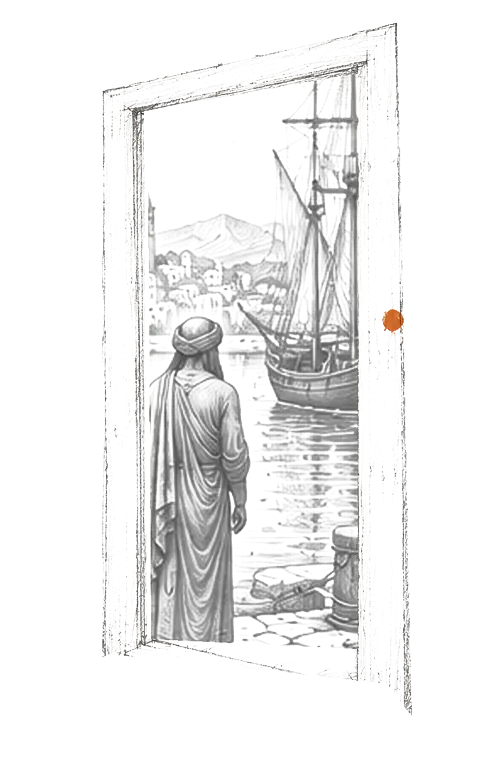
For twelve years Almustafa has lived in the city of Orphalese, waiting for the ship that is to take him home. When the ship at last appears, Almitra, the seeress who first believed in him, asks him to say, before he leaves, what he knows of life. He answers in poetic prose on love, marriage, children, work, joy and sorrow, freedom, friendship, religion and death.
Timeline
- 1855–1923NahdaShidyaq, Zaydan, then Gibran from New York. The Arab renaissance is Lebanese.
- 1930–1959First filmsPidutti, Bustany, Georges Nasser. A cinema before the studios.
- 1939–1970The modern novelAwwad, Emily Nasrallah, Hanan al-Shaykh. The village and the city.
- 1975–1986Civil warElias Khoury, Etel Adnan, Bagdadi, Alaouié. Writing and filming under the bombs.
- 1986–1990After the warMaalouf in Paris, Hoda Barakat, Beydoun. The war becomes material.
Reading keys
- The name very often indicates the confession: Boutros, Elias, Georges, Maroun signal a Christian; Mohammed, Hussein, Zeinab a Muslim, Sunni or Shia according to the first name.
- The surname may place the village of origin, and village belonging remains determining in political life.
- The great political families, called zaim, pass their influence from father to son, and the word designates a notable on whom one depends.
- The kunya, "father of" followed by the name of the eldest child, is used between adults.
- The war of 1975 to 1990 was never followed by a common account: an amnesty law of 1991 erased responsibilities, and each community keeps its version.
- The massacres committed by each camp are recounted according to the author's belonging, and there is no national history textbook for that period.
- The Palestinian question and the presence of the camps are an old subject of internal fracture.
- Confessionalism is criticised by almost every writer and remains the principle of the state.
- Eighteen communities are officially recognised, including the Maronites, the Greek Orthodox, the Greek Catholics, the Sunnis, the Shias and the Druze, each with its own family law.
- There is no civil marriage in Lebanon, which obliges mixed couples to marry in Cyprus, a frequent narrative motif.
- The cult of saints, Christian as well as Muslim, with shrines visited by both confessions, is a common social fact.
- The Druze have an esoteric doctrine to which access is reserved, and their belief in reincarnation appears in the narratives.
- Christian mourning includes a wake, a mass and a commemoration on the fortieth day; Muslim mourning is brief, with three days of condolences.
- Black is worn for a long time by bereaved women, including among Christians.
- Ramadan, Christmas, Easter and Shia Ashura follow one another, and neighbours pay visits at each other's festivals.
- Death notices posted in the street and condolence tents are a visible usage that organises mourning in public.
- The cycle of Adonis and Astarte, located at Byblos and at the source of Afqa, belongs to the ancient stock of the country and is found again in the poets.
- The fragments of Phoenician history, transmitted by a Christian apologist, are the only access to the cosmogony of the coast.
- The Thousand and One Nights and classical Arabic poetry form the common learned stock.
- The mountain, the cedar and emigration constitute a reserve of images that every Lebanese text mobilises.
- Lebanon is neither a Christian country nor a Muslim one: no community is in the majority there, and the last census dates from 1932.
- Gibran wrote in English for an American audience, and his success in the West precedes his Arab reception.
- The civil war is not a conflict between two camps but a succession of shifting alliances, which the novels render better than summaries do.
- French in Lebanon is not residual: it is the language of schooling for a substantial part of the population.
Tales and mythologies 1
- ChronicleThe Phoenician HistoryΦοινικικὴ ἱστορίαPhilo of Byblos · 120A Phoenician cosmogony that has come down to us only through the quotations of an adversary.Literature
Available in English 12
The books from this country that can be read in English, in the original or in translation.
- NovelLeg over Legالساق على الساقFaris al-Shidyaq · 1855The journey of a double of the author through the East and Europe, a pretext for satire and for praise of the learned language.Literature
- NovelThe Caliph's Sisterالعباسة أخت الرشيدJurji Zaydan · 1906The fall from favour of a family of viziers under Harun al-Rashid, told through the secret love of the caliph's sister and his vizier.LiteraturePublic domain
- PoetryThe ProphetKahlil Gibran · 1923A prophet's farewell to the city where he has lived, in twenty-six meditations written in English.Literature
- NovelLittle Mountainالجبل الصغيرElias Khoury · 1977Five accounts of the Lebanese war, from the hill of Achrafieh to the mountain and on to exile in Paris.Literature
- NovelSitt Marie RoseEtel Adnan · 1978The novel of a real abduction in 1976, written shortly afterwards by a woman who had known the victim.Literature
- PoetryLebanon: Twenty Poems for One LoveLiban : vingt poèmes pour un amourNadia Tueni · 1979Twenty poems that make Lebanon at war the object of a love: Nadia Tueni's song for her country.Literature
- NovelThe Story of Zahraحكاية زهرةHanan al-Shaykh · 1980A young woman crushed by her own family lives through the war in Beirut and finds there a freedom that peacetime denied her.Literature
- NovelThe House of Mathildeبناية ماتيلدHassan Daoud · 1983A building emptied of its inhabitants as the civil war goes on: Hassan Daoud's first novel.Literature
- NovelLeo AfricanusLéon l'AfricainAmin Maalouf · 1986The imaginary autobiography of a sixteenth-century traveller, from lost Andalusia to Renaissance Rome.Literature
- NovelThe Stone of Laughterحجر الضحكHoda Barakat · 1990Beirut in flames, seen by a young man for whom nothing has prepared him to fight.Literature
- NovelDear Mr Kawabataعزيزي السيد كواباتاRashid al-Daif · 1995A letter to a dead Japanese writer to understand the Lebanese war: a novel often studied as a major text on the civil war.Literature
- NarrativeThe School of WarL'École de la guerreAlexandre Najjar · 1999A Beirut childhood during the civil war, told between gravity and irony by the one who lived it.Literature
A selection to begin with 10 / 33
- NovelLeg over Legالساق على الساقFaris al-Shidyaq · 1855The journey of a double of the author through the East and Europe, a pretext for satire and for praise of the learned language.Literature
- CinemaA Hundred Faces for a Single Dayمئة وجه ليوم واحدChristian Ghazi · 1972Sixty-four minutes in black and white, with no continuous plot, in which those who own and those who fight are shown in the same movement.Cinema
- CinemaBeirut Oh Beirutبيروت يا بيروتMaroun Bagdadi · 1975Four young people and a city, filmed just before everything tipped over.Cinema
- NovelSitt Marie RoseEtel Adnan · 1978The novel of a real abduction in 1976, written shortly afterwards by a woman who had known the victim.Literature
- NovelThe Story of Zahraحكاية زهرةHanan al-Shaykh · 1980A young woman crushed by her own family lives through the war in Beirut and finds there a freedom that peacetime denied her.Literature
- CinemaBeirut the Encounterبيروت اللقاءBorhane Alaouié · 1981Two friends separated by the demarcation line try to speak to each other through cassette tapes.Cinema
- NovelThe House of Mathildeبناية ماتيلدHassan Daoud · 1983A building emptied of its inhabitants as the civil war goes on: Hassan Daoud's first novel.Literature
- CinemaLeila and the Wolvesليلى والذئابHeiny Srour · 1984A century of the Levant retold from the side of women, to whom the archives gave no voice.Cinema
- CinemaA Suspended Lifeغزل البناتJocelyne Saab · 1985A teenage girl born in war and a painter who expects nothing more meet in Beirut.Cinema
- NovelThe Stone of Laughterحجر الضحكHoda Barakat · 1990Beirut in flames, seen by a young man for whom nothing has prepared him to fight.Literature