Latvia
- works
- 40
- 35 books · 5 films
- period covered
- 1856–1988
- language of writing
- Latvian
Latvian national memory is contained in a cabinet. Krišjānis Barons had it built in 1880 to his own design, seventy drawers divided into compartments, in order to file the songs that the whole country sent him by post, one text per slip of three centimetres by eleven. He classified more than two hundred thousand of them and published eight volumes between 1894 and 1915. The piece of furniture is today inscribed in the register of the memory of the world.
Read moreShow less
Such an oral corpus set against a late written literature is the country's disproportion. The German barons held the land for seven centuries, serfdom lasted until 1817, Riga was a German and then a Russian city, and Latvian had its first writers only in the middle of the nineteenth century. The popular song, four lines without rhyme, without author and without narrative, therefore held the role of archive, of customary law and of theology, and poetry remains the genre in which this country is most sure of itself.
The Latvian form comes from that: a brief stanza, a concrete image, no explanation. Rainis and Aspazija made a symbolic theatre of it, and they spent part of their lives outside the country, he deported to Pskov after 1897, both of them in Switzerland after 1905. The price grew heavier afterwards. The deportations of 1941 and of 1949 emptied whole villages, and a great part of the writers left after 1944: Linards Tauns and Gunars Saliņš wrote a Latvian poetry in New York. Those who stayed composed under surveillance, like Vizma Belševica, of whom a 1969 poem in the margin of a medieval chronicle was enough for her to stop being published for years.
What awaits the reader is a dense poetry, often brief, in which the landscape and the mother are powers, and a documentary cinema that filmed people without commentary, up to that 1986 inquiry into a youth that expected nothing any more. The epic that opens this page appeared in 1888, during the Latvian song festival, and it borrows from tales of the strong man born of an animal without taking up folk songs.
A way to begin
Bearslayer
Andrejs Pumpurs · 1888
Latvia's national epic, free of rights: the Bearslayer against the German knights of the crusades.
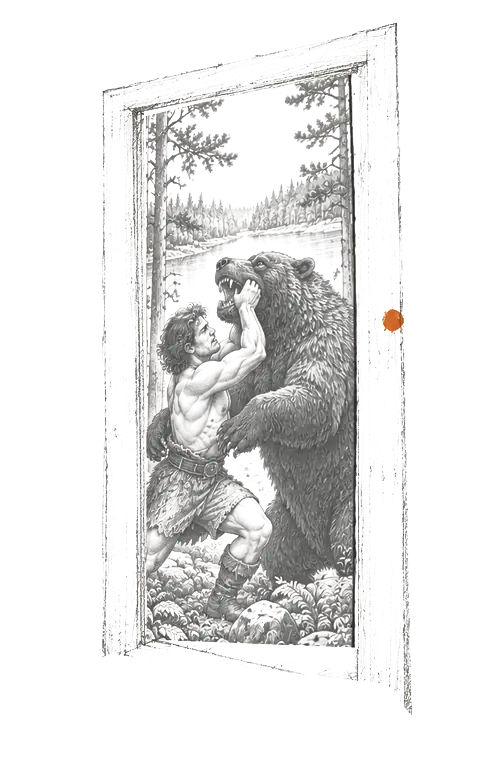
At the time of the Livonian crusades, a young man of prodigious strength earns the name Lāčplēsis, the Bearslayer, by overcoming a bear. He encounters the witch Spīdala, falls in love with Laimdota and befriends Koknesis, while the German knights threaten his people and the traitor Kangars seeks the secret of his strength.
Timeline
- 1856–1888National awakeningAlunāns, Auseklis, and Pumpurs's Lāčplēsis.
- 1897–1913Rainis and AspazijaTheatre and poetry turn political under the Russian Empire.
- 1920–1940IndependenceSkalbe, Čaks, Jaunsudrabiņš. Riga writes a state literature.
- 1944–1965Exile and occupationEglītis and Kraujiete leave; Upīts stays and serves the regime.
- 1966–1988Thaw and Singing RevolutionZiedonis, Belševica, Vācietis, then Podnieks's documentaries.
Reading keys
- Names and first names decline, and a woman's name takes an ending in a or e: Bērziņš in the masculine becomes Bērziņa, which makes two names appear for one couple.
- Surnames were assigned at the moment of emancipation, often drawn from trees, birds or trades, sometimes given by the German master.
- The name day, inscribed in the calendar, is celebrated more than the birthday, and forgetting it is a fault.
- Kinship through the mother is very present in the songs, in which the Mātes, the mothers, are divinities of function: mother of the sea, mother of the forest, mother of the graves.
- The deportations of 1941 and of 1949, the enlistment of Latvians in both armies and the commemorations of 16 March are the most disputed point of national memory.
- The place of Russian and the status of non-citizens since 1991 are raw questions, of which a text cannot fail to take account.
- The German past, seven centuries of landed property, is stated with an old rancour and without nostalgia.
- Restraint is valued, one does not speak of oneself, and direct complaint is almost absent from the texts.
- The country is divided between Lutherans in the west and the centre, Catholics in Latgale in the east, and Russian Orthodox, which distinguishes three regions by calendar and festivals.
- The pantheon reconstituted from the songs sets Dievs, the god who crosses the fields on horseback, Māra who guards material life, and Saule, the sun, a central female figure.
- The Mātes, mothers of places and of states, organise the invisible by functions rather than by narratives, and there exists almost no written narrative mythology.
- The neopagan movement that appeared in the nineteen twenties makes the dainas a sacred text, a position that remains debated.
- Midsummer, Jāņi, with oak wreaths for the men and flower wreaths for the women, fires kept up until daylight and caraway cheese, is the major festival of the year.
- The general festival of song and dance, every five years, gathers tens of thousands of participants and provided the setting of independence in 1991.
- The geometrical patterns of weaving are a system of signs, each figure referring to a divinity or a protection, and a described garment states which region a character belongs to.
- Mourning is marked by orphan songs, an entire genre of the dainas, and by the meticulous maintenance of graves.
- The dainas, quatrains published by Barons between 1894 and 1915, are the absolute common reference, quoted by a single line like a proverb.
- Lerhis-Puškaitis's collection of tales and legends, published between 1891 and 1903, gathers nearly seven thousand texts and completes the sung corpus.
- The bear-killing hero of the 1888 epic and Anna Brigadere's little Sprīdītis, in 1903, are the two figures that every child knows.
- The song days, the farmhouse and the crossing of the Daugava provide the shared images of the nation.
- Latvian is a Baltic language, related to Lithuanian only, and has nothing Slavic about it despite the Latin alphabet and the loanwords.
- Latvia, Lithuania and Estonia do not form a homogeneous ensemble: Estonian is Finno-Ugric, Lithuania was Catholic and Polonised, Latvia Lutheran and Germanised.
- Riga was mostly German and then Russian, and a great part of Latvian literature is written against that city before settling in it.
- The importance of poetry is not a national taste but the result of a history in which prose did not have time to establish itself before the occupations.
- A considerable part of the twentieth-century authors publish in Stockholm, Toronto or New York, and the Soviet catalogue does not measure the real production.
Tales and mythologies 1
- PoetryLatvju dainasKrišjānis Barons · 1894not translated into EnglishLivonia and Courland at the end of the nineteenth century, where the Latvian national awakening gathers the songs of the people.Literature
A selection to begin with 10 / 40
- PoetrySarkanās puķesAspazija · 1897not translated into EnglishLatvia in the 1890s, where a new generation of writers demands freedom and happiness for everyone.Literature
- TheatreFire and NightUguns un naktsRainis (Jānis Pliekšāns) · 1905Latvia in 1905, where a revolution has just failed and the old epic is being reread as a question about freedom.Literature
- CinemaZvejnieka dēlsVilis Lapenieks · 1940The Latvian coast of the late thirties, filmed by the state cinema of an authoritarian regime.Cinema
- PoetryMūžīgais mākonisLinards Tauns · 1958not translated into EnglishThe Latvian New York of the fifties, where young exiles make the great city the subject of their verse.Literature
- PoetryMelnā sauleGunars Saliņš · 1967not translated into EnglishThe Latvian New York of the late sixties, where a New Jersey professor makes the metropolis green again in his verse.Literature
- PoetryGadu gredzeniVizma Belševica · 1969not translated into EnglishSoviet Latvia in 1969, where a poet turns to the medieval chronicle of Livonia in order to speak of the present.Literature
- CinemaThe Devil's ServantsVella kalpiAleksandrs Leimanis · 1970Riga, a free city coveted by Sweden and Poland, told from the Soviet Latvia of 1970.Cinema
- CinemaA Limousine the Colour of Midsummer's EveLimuzīns Jāņu nakts krāsāJānis Streičs · 1981The Latvian countryside of the early eighties, where a new car is enough to rouse a whole extended family.Cinema
- CinemaIs It Easy to Be Young?Vai viegli būt jaunam ?Juris Podnieks · 1986Soviet Latvia in 1986, where a film like this one would still have been banned six months earlier.Cinema
- CinemaThe CrossroadŠķērsielaIvars Seleckis · 1988Riga in 1988, when perestroika shakes the city centre and leaves its suburbs almost intact.Cinema