Finland
- works
- 62
- 49 books · 13 films
- period covered
- 1726–1998
- language of writing
- Finnish
The most widely read novel in Finland appeared in a version cut by its publisher. Väinö Linna had handed in in 1954 a manuscript entitled War Novel; the house removed the harshest passages about the officers and the ruling classes, changed the title to The Unknown Soldier, and the book became the national classic. The text Linna had written appeared only in 2000, with the cuts marked in italics.
Read moreShow less
This country writes with a learnt prudence. It was Swedish for six centuries, a Russian grand duchy for another, and its literature was first written in Swedish, the language of the administration, of the towns and of some of its greatest authors. Finnish rose from the people towards the school in the second half of the nineteenth century. The epic that served as proof of existence was collected in Karelia, a region passed to the Soviet Union in 1944, and four hundred thousand people left it with their songs.
The Finnish form is a dialogue of people who do not speak of what matters. Linna has the war stated by a machine-gun company whose men each speak the dialect of their region, and refuses his soldiers the slightest heroism. The price is judicial and social. Hannu Salama was sentenced in 1966 for blasphemy to three months suspended for a novel of 1964, the unsold copies were destroyed, the following editions appeared expurgated until 1990, and the president pardoned him in 1968. Edith Södergran, who brought free verse into Swedish-language poetry, died in 1923, poor and without readers, in a village of that lost Karelia.
What awaits the reader is a literature of stubbornness, of the forest and of the silence between two replies, funnier than expected. The novel that opens this page, published in instalments in 1870, sends seven brothers who refuse to learn to read fleeing into the woods, and the leading critic of the day savaged it.
A way to begin
Seven Brothers
Aleksis Kivi · 1870
The first great novel in Finnish, free of rights: seven orphaned brothers who flee schooling for the forest.
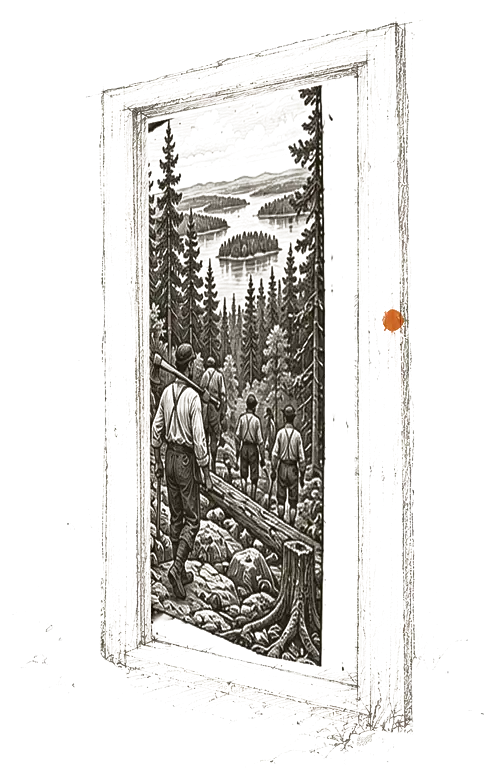
Seven brothers, the orphaned sons of Jukola farm, rough, quarrelsome and given to drink, refuse to learn to read and turn the whole village against them. They leave the farm for the solitude of the forest, where they must hunt, fell timber, shelter for the winter and live together, through burlesque or unhappy adventures and legends they tell one another.
Timeline
Reading keys
- Many families exchanged at the turn of the twentieth century a Swedish surname for a Finnish name composed of words from nature, and the date of that change is a political indication.
- Farm names serve as personal names in the rural world, and a man may be called by his holding, which is disconcerting when two names designate the same character.
- Swedish-speaking names do not designate Swedes but a Finnish minority of Swedish language, settled for centuries on the coast and in Åland.
- Formal address has disappeared, the use of the first name is general, and silence in a conversation is not an embarrassment but a part of the dialogue.
- The civil war of 1918, with its prisoner camps and its executions, was passed over in silence for forty years, and the vocabulary used to name it situates a text immediately.
- Military cooperation with Germany from 1941 to 1944, then the decades of accommodation with the Soviet Union, are a subject of lasting embarrassment.
- Lost Karelia, the evacuees and the question of its restitution come back regularly in public debate.
- Religion, alcohol and mental health are stated by understatement, and a character who explains his feelings passes for suspect.
- The Lutheran Church is in the majority and administrative, with weak practice, and the revival movements, above all Laestadianism in the north, impose strict rules that provide plots.
- An Orthodox minority, come from Karelia, forms the second national Church, with its calendar and its monasteries.
- The pre-Christian stock remains legible in the runic songs: Väinämöinen the singer, the bear whose name is not pronounced, the guardian spirits of the sauna and the forest.
- The sauna is a place of rite more than of hygiene, where people were healed, where women gave birth, and where silence is the rule.
- Midsummer, with fires at the water's edge and the emptying of the towns, is the central festival, and the setting of a considerable number of plots.
- 6 December, independence day, is solemn rather than festive, with candles in the windows and an official ball broadcast on television.
- Funerals are Lutheran and brief, and the cemeteries light up with candles at Christmas for the dead of the wars.
- Coffee accompanies every occasion, mourning included, and the number of cups offered measures a host's civility.
- The Kalevala, published in 1835 and then in 1849 from Karelian songs, provides the names, the metres and the figures that every text assumes are known, down to the Sampo, an object of indefinable wealth.
- The thirty-four volumes of the raw songs, published from 1908 to 1948 with the singer's name and the date, recall that the epic is a compilation.
- Salmelainen's collection of tales, published from 1852, and Tove Jansson's Moomins, from 1945, are the two stocks shared by all children.
- The Tales of Ensign Stål, poems of 1848 and 1860 about the war of 1808, gave the country its anthem and its patriotic formulas, in Swedish.
- Finnish is neither Scandinavian nor Slavic: it is a Finno-Ugric language, without gender, without articles, without a future tense, in which the casuistry of fifteen cases replaces prepositions.
- Finland is not Scandinavia in the strict sense, and its history is that of a periphery of two empires rather than of a Nordic kingdom.
- Swedish is an official language, and a notable share of the classic authors write in that language without being Swedish for all that.
- The Sami of the north are an indigenous people with a parliament, and their languages have nothing to do with the Finnish of the south.
- Silence, brevity and the absence of effusion do not signal a character's coldness but a convention of politeness.
Tales and mythologies 1
- EpicKalevalaElias Lönnrot · 1849In the middle of the nineteenth century, a district doctor brings back from his rounds in the eastern countryside the songs that will give a grand duchy with no written past a national antiquity.Literature
A selection to begin with 10 / 62
- PoetryDikterEdith Södergran · 1916not translated into EnglishOn the eve of the Russian Revolution, a young woman isolated on the border publishes free verse that nothing in her language had foreshadowed.LiteraturePublic domain
- CinemaRykmentin murheenkryyniToivo Särkkä · 1938In 1938, the barracks becomes a comedy setting, and Finnish cinema finds a lasting seam there.Cinema
- CinemaNiskavuoren naisetValentin Vaala · 1938In 1938, a farm in Häme and three women who decide what a man has the right to want.Cinema
- NovelThe EgyptianSinuhe egyptiläinenMika Waltari · 1945At the end of the war, a Nordic novelist has a physician of ancient Egypt tell of his life in the time of the heretic pharaoh.Literature
- NovelFinn Family MoomintrollTrollkarlens hattTove Jansson · 1948In the aftermath of the war, a painter from Helsinki settles her creatures in their valley for good.Literature
- CinemaThe White ReindeerValkoinen peuraErik Blomberg · 1952In the Lapland of the reindeer herders, a woman driven to despair by solitude pays dearly for what she asks of a sorcerer.Cinema
- NovelThe Unknown SoldierTuntematon sotilasVäinö Linna · 1954Ten years after the fighting, a spinning-mill worker who took part in it behind a machine gun writes what his country had not yet read about its own soldiers.Literature
- CinemaThe Unknown SoldierTuntematon sotilasEdvin Laine · 1955In 1955, ten years after the peace, the country has its war told to it by soldiers who are anything but heroic.Cinema
- CinemaInspector Palmu's MistakeKomisario Palmun erehdysMatti Kassila · 1960In 1960, a novel's inspector who had become a legend investigates on screen a pre-war case among Helsinki's polite society.Cinema
- NovelJuhannustanssitHannu Salama · 1964not translated into EnglishIn the mid-sixties, a young writer from the working-class world shows the national summer festival as it actually takes place.Literature