Sweden
- works
- 86
- 56 books · 30 films
- period covered
- 1642–1998
- language of writing
- Swedish
In 1911, the Swedish socialist youth opened a national subscription to give August Strindberg the prize that the Academy would never give him. Forty thousand people, workers for the most part, gathered forty-five thousand crowns, handed to the writer on his sixty-third birthday. He called it his anti-Nobel. He died four months later, in the city where the prize has been awarded since 1901.
Read moreShow less
This country records everything, and that is found again in its books. The parish registers have followed each inhabitant since the seventeenth century, a statistical office has existed since 1749, and the administration knows who is poor, who is ill, who leaves. One million three hundred thousand people emigrated to America between 1850 and 1930, material from which Vilhelm Moberg drew his novel cycle, and part of the literature of the twentieth century was written by self-taught men come from the agricultural labourers under contract.
The Swedish form is the inquiry. Ivar Lo-Johansson and Harry Martinson come from that world and write it from within, and state radio commissioned in 1938 from Ludvig Nordström a report on housing that describes a dirty country, then published it. The price is that of a state that classifies: the institute of racial biology at Uppsala, created and financed by the state in 1922, precedes a sterilisation law applied from 1934 to 1976 to about sixty-three thousand people, women for the most part, on the strength of the same files. Karin Boye had written in 1940 a dystopia in which the state has a product that makes people tell the truth, and the film censorship board was still banning a film in 1964.
What awaits the reader is a somewhat cold clarity, closed rooms, and an attention to relations of service and of money more than to the feelings that clothe them. The play that opens this page takes place on a single Midsummer night, between a count's daughter and his valet; its public premiere in Copenhagen was banned by the censor, and it was given in March 1889 as a private performance.
A way to begin
Miss Julie
August Strindberg · 1889
On Midsummer Night the count's daughter and the valet challenge each other: Strindberg's most performed play, free of rights.
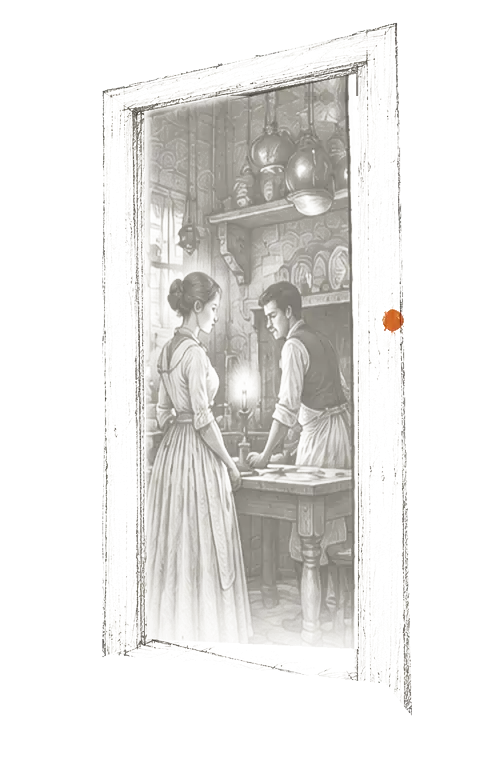
Midsummer Night, in the kitchen of a count's manor. The count is away; his daughter Julie, who has just broken off her engagement, has danced with the servants, then with Jean, the valet. Kristin, the cook engaged to Jean, watches them drink together and disapproves, then falls asleep. Between the high-born young woman and the valet a game of seduction and defiance begins, in which each dreams of escaping the role their rank imposes.
Timeline
- 1870–1910Modern breakthroughStrindberg blows it all up: the theatre, the novel, the language.
- 1900–1940The social novelSelma Lagerlöf, the first woman to win the Nobel in literature, in 1909.
- 1945–1980Bergman's cinemaOne man gives Sweden a place at the centre of world cinema.
Reading keys
- Surnames in -son were frozen in the nineteenth century, and many families then adopted a name composed of words from nature, Lindberg, Sjöström, Bergman, in order to be distinguished from the too numerous Anderssons.
- General use of the familiar form was imposed by a deliberate reform at the end of the nineteen sixties, and formal address today sounds distant or ironic.
- The first name in use is often the second or the third in the civil registry, which explains the discrepancies between the registers and the covers of books.
- Finnish and Sami names signal populations settled long ago, and not a recent immigration.
- Neutrality during the Second World War, the iron ore sold to Germany and the trains of German soldiers on leave are a point of embarrassment that literature approaches indirectly.
- The sterilisations decided until 1976, the policy of racial biology and the treatment of the Sami and the Roma were the object of official inquiries and of reparations, and the subject is open.
- The assassination of the prime minister in 1986, never convincingly elucidated, left a mistrust that runs through the detective novel.
- Consensus is a value: raising one's voice or claiming one's success passes for a fault of taste, which the law of Jante formulates.
- The Lutheran Church, separated from the state in 2000, keeps a strong ritual role with weak practice, and the revival movements of the nineteenth century left a severe pietism in the north.
- Popular beliefs bear on the spirits of places: the troll of the forests, the näcken of the rivers, the skogsrå who leads the woodcutter astray, all documented in the nineteenth century.
- Sami shamanism and its drum were repressed by the Church, and the witchcraft trials of the seventeenth century targeted above all women of the centre of the country.
- The relation to nature is one of regulated frequentation rather than of cult: the general right of access authorises walking and camping anywhere, which structures life and the narratives.
- Midsummer, with a leafy pole, dances and herring, is the great festival of the year and the setting of innumerable plots.
- Saint Lucy, on 13 December, stages a procession of young girls in white dresses with candles, in the darkness of December.
- The August crayfish, eaten outdoors with paper hats and drinking songs, are a codified social rite.
- Funerals are sober and discreet, death is not readily spoken of, and mourning is marked by withdrawal rather than by visits.
- The collection of Hyltén-Cavallius, published from 1844, and the tales transcribed in dialect by Djurklou in 1883 form the stock of tales, completed by his inquiry into the beliefs of Småland.
- The journey of a child on the back of a wild goose, written in 1906 as a school geography textbook, gave the country its common description, region by region.
- Pippi Longstocking, in 1945, fixed a figure of a child with no authority above her, and that freedom has become a national pedagogical reference.
- The cycle of the emigration to Minnesota provides the narrative of origin of the Swedes of America and of the families who stayed.
- The Swedish social model was not gentle with everybody: it was built with files, expert reports and internments, and literature documents it.
- The detective novel is not a minor genre here: it was the avowed vehicle of social criticism from the nineteen sixties.
- Neutrality is not the absence of military history: Sweden was a great warring power until 1721.
- The Sami are not Swedes of the north but an indigenous people present in four states, with its language and its parliament.
- Cultural Lutheranism explains the place of sin and duty in texts otherwise without faith, including in Strindberg and Bergman.
Tales and mythologies 1
- TaleSvenska folksagor och äfventyrGunnar Olof Hyltén-Cavallius · 1844not translated into EnglishThe tales of the southern provinces, noted down from those who still told them, in the first collection of its kind published in Sweden.Literature
A selection to begin with 10 / 86
- NovelStatarnaIvar Lo-Johansson · 1937not translated into EnglishOn the great Swedish estates, the life of day labourers paid in kind, over two centuries, up to the first strikes.Literature
- EssayLort-SverigeLudvig Nordström · 1938not translated into EnglishA report of 1938 on the unhealthy housing of the Swedish countryside, broadcast on the radio before becoming a book.Literature
- NovelKallocainKarin Boye · 1940A chemist invents a substance that forces people to give up their thoughts, in a state that already listens to everything.LiteraturePublic domain
- NovelThe EmigrantsUtvandrarnaVilhelm Moberg · 1949Peasants of a poor parish decide to leave for America, and first they must cross the sea.Literature
- CinemaThe Great AdventureDet stora äventyretArne Sucksdorff · 1953Two little boys hide an otter for a whole winter, while the forest follows its seasons.Cinema
- PoetryAniara: A Review of Man in Time and SpaceAniaraHarry Martinson · 1956A ship of emigrants leaves a poisoned Earth and is lost in space, in a long poem of the atomic age.Literature
- CinemaDocking the BoatAtt angöra en bryggaTage Danielsson · 1965A sailing boat loaded with the alcohol for a crayfish party cannot manage to dock at the island where it is awaited.Cinema
- CinemaNight GamesNattlekMai Zetterling · 1966A man brings his fiancée back to the house of his childhood, and what he finds there cannot be told.Cinema
- CinemaI Am Curious (Yellow)Jag är nyfiken – en film i gultVilgot Sjöman · 1967A young woman questions her country in front of a camera, and the camera ends up turning on those who hold it.Cinema
- CinemaHugo and JosephineHugo och JosefinKjell Grede · 1967A little girl from a parsonage who has no one meets a boy who obeys nothing, and the summer passes.Cinema