Luxembourg
- works
- 17
- 12 books · 5 films
- period covered
- 1829–1998
- language of writing
- French and German
On 10 October 1941, the German administration organised in Luxembourg a census with three questions: nationality, mother tongue, ethnic belonging. The expected answer was German for all three. The resistance called for the answer Luxembourgish three times, the preliminary soundings showed that the overwhelming majority did so, and the operation was cancelled. The country thus declared the existence of its language in a police form, forty-three years before giving it a legal status.
Read moreShow less
That language was until then only a spoken form. Luxembourg functions with three languages: Luxembourgish is spoken, French makes the law and the administration, German carries the press and primary school. An author there writes fluently in two or three languages without that constituting an event, and the law of 1984 made Luxembourgish the national language without removing from the other two their official use. The country today has nearly half foreigners, which redoubles the question.
The form is satire and chronicle, and the scale is that of a country of six hundred and fifty thousand inhabitants: a few hundred copies, no book industry, authors who are schoolteachers, journalists or civil servants. The price is there. Antoine Meyer published in 1829 the first poems in Luxembourgish and had to accompany them with explanations in order to be read. Batty Weber kept up for decades a daily column that stood in for a literary institution. And 1988 had to be waited for, with Roger Manderscheid's childhood narrative about a boy during the occupation, before a modern prose in Luxembourgish found a real audience, immediately brought to the screen.
What awaits the reader is a small-scale literature that has made the question of languages its subject, with more irony than solemnity. The poem that opens this page, published in 1872, puts a fox in a frock coat in a land where each animal speaks the dialect of its region and stands for a notable; only three hundred and thirteen copies sold in thirty years.
A way to begin
Reenert
Michel Rodange · 1872
The national epic of Luxembourg, free of rights: a fox fable that mocks the notables of the grand duchy.
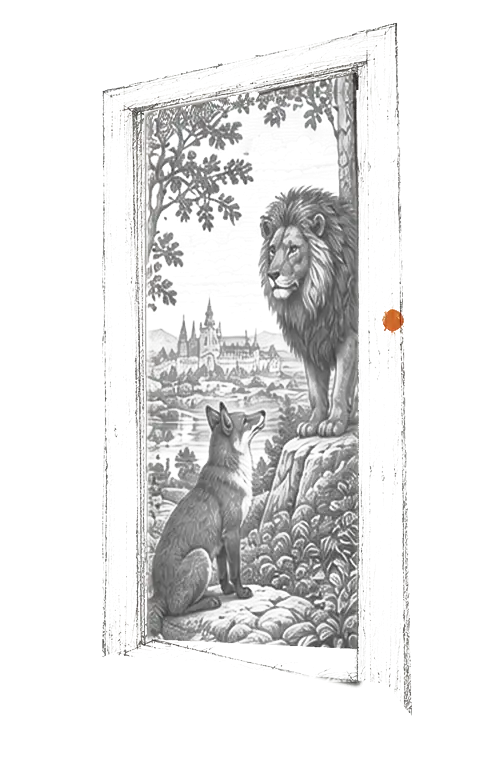
The Lion King summons all the beasts; the fox Renert, who has just killed a hen, does not appear. Brought to court at last by the badger, his cousin, and condemned to death, he gets himself out of trouble at the foot of the gallows by telling the king of a treasure and a plot. Each beast speaks the dialect of its region and represents a notable of the country.
Timeline
- 1829–1872Luxembourgish in writingMeyer, de la Fontaine, Lentz, then Rodange's Renert.
- 1891–1901Writing in GermanBatty Weber, Nikolaus Welter. Letters are shared among three languages.
- 1947–1981First filmsEvy Friedrich, Pol Tousch, and the AFO collective.
- 1983–1990ContemporariesManderscheid and Schacko klak, brought to the screen by Paul Kieffer.
Reading keys
- Surnames are Germanic and frequently repeated, Schmit, Muller, Weber, which explains the common use of the nickname or the house name to distinguish the families of one village.
- First names follow French fashion while the surname remains German, a combination that sums up the country's situation.
- One and the same author sometimes signs in three languages and is found in three forms in catalogues.
- Kinship through neighbourhood and belonging to a canton count in the narratives as much as filiation.
- The occupation from 1940 to 1944, forced enlistment in the Wehrmacht, the general strike of 1942 and its executions are the heart of national memory.
- The deportation of the country's Jews, almost all murdered, and the role of the local administration were established late by an official commission.
- The financial centre, its opacity and the tax advantages granted are a subject on which the country knows it is watched.
- The status of Luxembourgish, the command of it required for naturalisation and the weight of cross-border workers are permanent political questions.
- Catholicism is in the majority and discreet, with an education system and festivals that structure the calendar without imposing a strong practice.
- The octave of Our Lady, a spring pilgrimage towards the capital, gathers the whole country and serves as a landmark in the narratives.
- The dancing procession of Echternach, in which the pilgrims advance by hopping to the sound of a melody, has existed since the Middle Ages and is recognised by UNESCO.
- The local legends, Melusina shut beneath the Bock rock, the dwarfs of the Mullerthal, form a brief but living stock.
- The Buergbrennen of February, when a wooden cross is burnt to drive out winter, opens the year in every village.
- The national holiday of 23 June, the eve of the grand duke's birthday, is celebrated the previous night with fireworks and parades.
- The Schueberfouer, the late-summer fair in Luxembourg, has been an institution since 1340 and is a recurrent narrative setting.
- Funerals follow the Catholic rite, with a meal after the service, and the commune is present there as an institution.
- The fox in tails of 1872 is the founding text, whose lines serve as proverbs and whose animals still caricature national failings.
- Michel Lentz's patriotic song, written in 1859, became the anthem, and its formula about wanting to remain what one is is quoted everywhere.
- The threefold Luxembourgish of 1941 is the major civic reference, held to be a national plebiscite.
- The Melusina of the Luxembourg rock and the procession of Echternach provide the country's common images.
- Luxembourgish is not a residual German dialect: it is a national language since 1984, with a spelling, a dictionary and official examinations.
- The country is neither monolingual nor French-speaking: administrative writing is in French, the press is in German, conversation is in Luxembourgish, and a novel may move through all three.
- A catalogue of fourteen works does not measure a literary poverty but the size of the market and the rarity of translations.
- Financial wealth is recent: until the nineteen sixties, the country lived on steel and exported emigrants.
- Luxembourgish authors published in German or in French are not German or French authors, a distinction that libraries often blur.
Tales and mythologies 1
- PoetryReenertRenert oder de Fuuß am Frack an a Ma'nsgrëßtMichel Rodange · 1872The grand duchy emerges from the crisis of 1867, in which it nearly came to be absorbed by a neighbour, and then from the Franco-German war.Literature
Available in English 2
The books from this country that can be read in English, in the original or in translation.
- PoetryOur HomelandOns HeemechtMichel Lentz · 1859Twenty years after the Treaty of London fixed its borders, the Grand Duchy seeks to express its identity in its own language.LiteraturePublic domain
- NovelDr. Mabuse, Master of MysteryDr. Mabuse, der SpielerNorbert Jacques · 1920A prosecutor tracks down a criminal genius who hypnotises his victims, in the novel that inspired Fritz Lang.Literature
A selection to begin with 10 / 17
- PoetryE' Schrek ob de' Lezeburger ParnassusAntoine Meyer · 1829not translated into EnglishA year before the Belgian revolution, no book has yet been printed in the speech of Luxembourg.Literature
- PoetryOur HomelandOns HeemechtMichel Lentz · 1859Twenty years after the Treaty of London fixed its borders, the Grand Duchy seeks to express its identity in its own language.LiteraturePublic domain
- NovelFenn KaßBatty Weber · 1913not translated into EnglishThe grand duchy is then divided between a Catholic camp, rooted in the countryside, and a liberal, bourgeois camp.Literature
- NovelDr. Mabuse, Master of MysteryDr. Mabuse, der SpielerNorbert Jacques · 1920A prosecutor tracks down a criminal genius who hypnotises his victims, in the novel that inspired Fritz Lang.Literature
- CinemaWat huet e gesot ?Paul Scheuer · 1981No feature-length fiction film has yet been shot in the language of the country.Cinema
- NovelSchacko klakRoger Manderscheid · 1988not translated into EnglishThe novel written in Luxembourgish is only just beginning to exist, and the author has just left German for his mother tongue.Literature
- CinemaTroublemakerAndy Bausch · 1988Luxembourg fiction cinema as yet has neither an industry nor public funding, and this film begins shooting without an assured budget.Cinema
- Feature filmDe falschen HondMenn Bodson, Gast Rollinger and Marc Olinger · 1989A 1948 narrative on the birth of Luxembourg, brought to the screen for a national anniversary.Cinema
- CinemaSchacko KlakPaul Kieffer and Fränk Hoffmann · 1990For the one hundred and fiftieth anniversary of independence, the State holds a competition for the screenplay of a film on the country's identity.Cinema
- Feature filmWedding Night – End of the SongHochzäitsnuechtPol Cruchten · 1991A wedding night turns into a desperate search, in the first Luxembourg film selected at Cannes.Cinema