Martinique (France)
- works
- 7
- 6 books · 1 film
- period covered
- 1939–1992
- language of writing
- French
In 1941 André Breton, fleeing the war to reach America, stopped over in Fort-de-France. In a shop where he was looking for a ribbon for his daughter, he came across the first issue of a review that Aimé and Suzanne Césaire had just founded with other intellectuals of the island, Tropiques. He would write that he could not believe his eyes. The review appeared until 1945, under an administration loyal to Vichy that ended up refusing it paper.
Read moreShow less
Martinique is an island made by the plantation. Slavery was abolished there in 1848, and tens of thousands of freed people then received a surname, often forged as an anagram of their first name. From 1853 some twenty-five thousand indentured labourers arrived, almost all from the Tamil country. In 1902 the eruption of Mount Pelée destroyed the town of Saint-Pierre and killed some thirty thousand people. In 1946 the island became a French département, the year Césaire entered the National Assembly.
Literature is written in this face-to-face with France. Mayotte Capécia told in 1948 the life of a woman of colour under Admiral Robert, Joseph Zobel in 1950 a childhood in the shacks of a sugar cane plantation, Édouard Glissant in 1958 a militant youth at the time of the 1945 elections. In 1989 Jean Bernabé, Patrick Chamoiseau and Raphaël Confiant signed Éloge de la créolité, and the Goncourt crowned Texaco three years later. Euzhan Palcy brought Zobel's novel to the screen in 1983. The price, here, is distance: almost all these books were published in Paris, and Confiant first wrote in Creole before moving to French.
What awaits the reader is a language that takes French and makes something else of it, and books in which the island's history is told from the shacks rather than from the plantation houses. The poem that opens this page appeared in August 1939 in a Parisian review, Volontés, and went almost unnoticed; Breton discovered it in 1941, and it has become the most translated and most read work of négritude.
A way to begin
Journal of a Homecoming
Aimé Césaire · 1939
Published in 1939 in a Parisian review, almost unnoticed, then revealed by André Breton: the most read work of négritude.
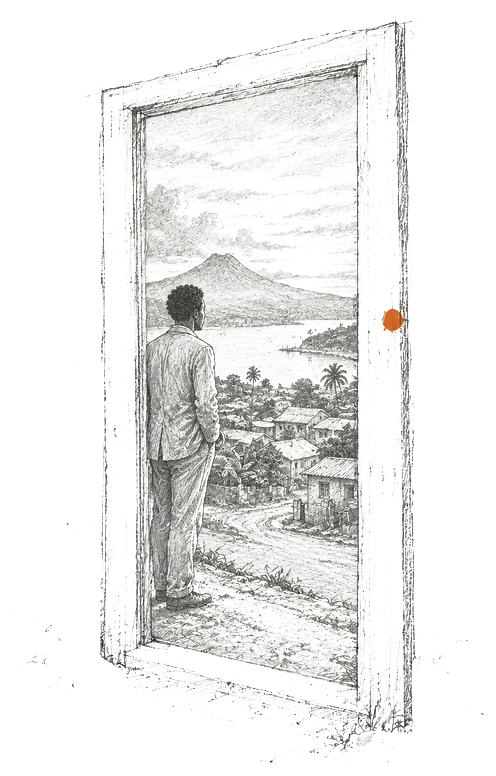
On his way back to his native island, the poet looks at Martinique as it is: a land marked by the poverty and shame inherited from colonisation. Punctuated by the refrain “At the end of the small hours”, the long poem mixes verse and prose. The poet refuses to contemplate this poverty as a spectator, wants to lend his voice to those who have none and asserts a black pride.
Timeline
Reading keys
- The surnames given to freed people from 1848 onwards are often anagrams of the first name, or names drawn from Antiquity, geography and nature: a family name may go back no further than that date.
- The descendants of the Indian indentured labourers bear names of Tamil origin, fixed late, and the administration long imposed Christian first names on their children.
- The békés, descendants of the first colonists, form a small white minority, and their name is enough to place a family in the history of the plantation.
- The mother, or the grandmother, is often the “poto mitan”, the pillar of the family: single-parent families are far more frequent there than in mainland France, 42% against 24% in 2020, and the father often remains on the margins of the children's upbringing.
- The concentration of land and business in the hands of a few béké families is a constant subject, which every text approaches at its own risk.
- Chlordecone, a pesticide used in the banana plantations until 1993, contaminated the soil and the population; the dismissal of the case pronounced by the courts in 2023 is experienced as a denial.
- The cost of living provoked major social movements in 2009, in 2021 and in 2024, and a story that speaks of it immediately takes sides.
- The years of Admiral Robert, from 1940 to 1943, when the island lived under Vichy, remain a vivid memory, as does the departure of young people for the English islands to join the dissidence.
- Catholicism dominates, with its processions and patronal feasts, and sets the rhythm of the family calendar.
- Quimbois, a practice of protection and spell-casting inherited from African traditions, is still consulted, and a novel may mention it without explaining it.
- The Hinduism brought by the Indian indentured labourers survives in a few temples, where the goddess Maryamman is honoured as a healer.
- The dead remain present: on All Saints' Day families keep vigil at night in the cemeteries, by candlelight.
- Carnival lasts several days before Lent and ends on Ash Wednesday with the burning of King Vaval.
- On this last day the crowd dresses in black and white as a sign of mourning, and Vaval's “widows” parade weeping for their king.
- After a death, the wake over the body is in decline, but the prayers of the nine days persist.
- Bèlè, music and dance to the drum, is still sung in Creole.
- Césaire, mayor of Fort-de-France and deputy for decades, is the figure against whom every Martinican writer measures himself.
- Négritude, born in Paris in the 1930s, then Glissant's “Antillanité” and the “créolité” of 1989 form three successive answers to the same question of identity.
- The Saint-Pierre disaster of 1902 is the island's great collective narrative, and the destroyed town often returns in literature.
- Frantz Fanon, born in Fort-de-France, and his reading of colonial alienation serve as a reference, often debated.
- Martinique is a French territorial collectivity, with the euro and national elections, and not an independent state.
- Martinican Creole is not that of Guadeloupe nor that of Haiti, even if the speakers understand each other to a large extent.
- Most works are written in French, even when they defend Creole; the French in them is worked by the island's language.
- Literary Martinique is not a happy island: the books speak of cane, hunger, the colony and exile more than of beaches.
Available in English 5
The books from this country that can be read in English, in the original or in translation.
- PoetryJournal of a HomecomingCahier d'un retour au pays natalAimé Césaire · 1939A young poet returns to his island and refuses to look at colonial misery there as a mere spectator.Literature
- NovelI Am a Martinican WomanJe suis MartiniquaiseMayotte Capécia · 1948A Martinican childhood and youth told in the first person, up to the war years.Literature
- NovelBlack Shack AlleyLa Rue Cases-NègresJoseph Zobel · 1950A childhood among the cane cutters of Martinique, told by one who escaped it through school.Literature
- NovelThe RipeningLa LézardeÉdouard Glissant · 1958The Martinique of 1945, its elections and its militant youth, in the first novel of a poet and philosopher.Literature
- NovelTexacoPatrick Chamoiseau · 1992Martinique from slavery to the modern city, told by the founder of a threatened district.Literature
A selection to begin with 6 / 7
- NovelI Am a Martinican WomanJe suis MartiniquaiseMayotte Capécia · 1948A Martinican childhood and youth told in the first person, up to the war years.Literature
- NovelBlack Shack AlleyLa Rue Cases-NègresJoseph Zobel · 1950A childhood among the cane cutters of Martinique, told by one who escaped it through school.Literature
- NovelThe RipeningLa LézardeÉdouard Glissant · 1958The Martinique of 1945, its elections and its militant youth, in the first novel of a poet and philosopher.Literature
- CinemaSugar Cane AlleyRue Cases-NègresEuzhan Palcy · 1983The childhood of a young Martinican boy in the time of the plantations, in the director's first feature film.Cinema
- NovelLe Nègre et l'AmiralRaphaël Confiant · 1988not translated into EnglishThe war as lived in a colony cut off from the world, between propaganda and resistance, in the author's first French novel.Literature
- NovelTexacoPatrick Chamoiseau · 1992Martinique from slavery to the modern city, told by the founder of a threatened district.Literature