Haiti
- works
- 25
- 18 books · 7 films
- period covered
- 1804–1996
- language of writing
- French and Creole
Haiti paid France for having ceased to be its slave. In 1825, twenty-one years after independence, a French fleet anchored off Port-au-Prince and presented a bill: a hundred and fifty million gold francs, in compensation for the property lost by the colonists, property which was the Haitians themselves. The country accepted in order to avoid war, borrowed from French banks in order to pay, and the last instalments were made in 1947. A hundred and twenty-two years of repayment for a freedom taken with weapons in hand.
Read moreShow less
That history begins in 1804, when revolted slaves founded the second independent state of the Americas and the first to issue from a victorious slave revolt. No other people has done that. The country was then placed in quarantine by the slave-holding powers, occupied by the Americans from 1915 to 1934, and governed by two hereditary dictatorships. Its literature, in French and then in Creole, is one of the oldest and most abundant in the Americas, with collections of poems from as early as the eighteen thirties.
The form that characterises it is the affirmation of a stock of its own. Jean Price-Mars published in 1928 a book that takes vodou and peasant tales seriously as objects of knowledge, and thereby founded Haitian ethnology and the idea of negritude. Jacques Roumain wrote in 1944 a novel of peasants in which Creole works French from within. Frankétienne took the step in 1975 with the first novel written entirely in Haitian Creole. Raoul Peck has filmed the dictatorship and memory since 1993. The price was the exile of almost every generation of writers.
What awaits the reader is a French language worked by another, and a literature that has never needed to have its dignity explained to it. The novel that opens this page tells of a man back from Cuba who seeks the water that would save his village and the peace that would let it be shared.
A way to begin
Masters of the Dew
Jacques Roumain · 1944
A man back from Cuba seeks the water that would save his village and the peace that would let it be shared: a Haitian classic, free of rights.
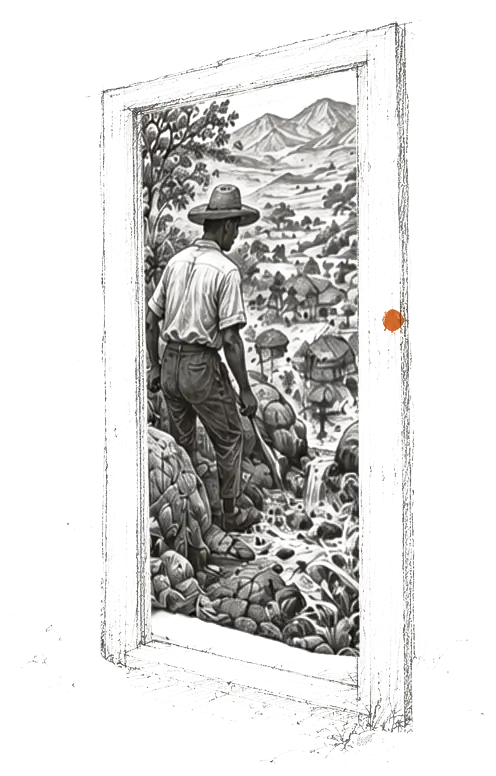
Manuel returns to Fonds-Rouge, his native village, after fifteen years cutting cane in Cuba. He finds it ruined by drought and deforestation, and torn by the hatred between two families; he falls in love with Annaïse, from the enemy clan. He searches the mountain for a spring that could irrigate the land, and sets out to reconcile the villagers so that the water may benefit them all.
Timeline
- 1804First Black republicHaiti frees itself alone, and pays for it for two centuries.
- 1915–1934American occupationHumiliation gives rise to indigenism: a turn towards Africa and vodou.
- 1928–1960IndigenismPrice-Mars, Roumain, Alexis. Peasant culture becomes literary matter.
- 1957–1986DuvalierThe dictatorship empties the country of its writers. Haitian literature is written in exile.
Reading keys
- Family names are French, inherited from the colonists or chosen at independence, and some are names of battles or of virtues.
- The family is often matrifocal and extended: children circulate between relatives, and the practice of the restavèk, a child placed in another family to work there, is a social fact that literature denounces.
- The lakou, a family yard grouping several dwellings around a common space, is the traditional unit of residence and the place of the cult.
- Godparenthood creates a lasting kinship, and adults with no blood link are called compère and commère.
- The indemnity of 1825 and the debt that followed from it are an active political subject, with demands for restitution.
- The Duvalier dictatorships, from 1957 to 1986, and their militias are recounted by a literature of exile, and a 1968 novel cost its author her country and its publisher withdrew the book from sale.
- The American occupation from 1915 to 1934 is the starting point of modern literary consciousness.
- Vodou was repressed by the Church and by the state, notably during the anti-superstition campaigns, and it has been officially recognised only since 2003.
- Haitian vodou is a structured religious system, with its lwa, its rites of initiation, its temples and its clergy. It was born of the crossing of the cults of Dahomey and of the Congo with Catholicism, and the two are practised together.
- The formula according to which the country is eighty per cent Catholic and a hundred per cent vodou sums up the situation better than the statistics.
- Legba at the crossroads, Erzulie love, Ogou iron and Baron Samedi the cemetery are the same powers as at Ouidah and in Havana.
- The Haitian zombi is not a cinema undead but a person deprived of their soul and reduced to labour, which makes it a figure of slavery.
- Funerals include a wake, a mass and a distinct vodou ceremony, the dessounin, which detaches the spirit from the dead person.
- White is the colour of the initiates, and each lwa has its colours, its days and its prohibitions.
- The Catholic patron saints' festivals double the festivals of the corresponding lwa, and one goes to both.
- The rara, a musical procession of the Lenten period, with its bands and its bamboo trumpets, occupies the roads.
- The ceremony of Bois-Caïman, in August 1791, where a vodou pact is said to have sealed the beginning of the insurrection, is the national founding narrative.
- The Creole tales, with Bouqui the heavy and Malice the cunning, are the narrative stock that every Haitian knows, and the formula Krik? Krak! opens the session.
- Vodou and its pantheon are a common knowledge that the texts do not translate.
- Pané's Relación, written in 1498 on Hispaniola, preserves the Taíno cosmogony of the island, with Yúcahu and Atabey.
- Vodou is not sorcery: it is a religion with its theology, its clergy and its temples, and the word has been charged by American cinema.
- The Haitian zombi is a figure of slavery, not a monster of fiction, and its meaning is political.
- Haitian Creole is a language in its own right, an official language since 1987, and not a deformed French.
- Haiti is not a country without literature: its written production is one of the oldest and densest on the American continent.
Tales and mythologies 2
- TaleLa Reine des poissonsMimi Barthélémy · 1990not translated into EnglishA tale from the Haitian tradition, which its storyteller adapted, told and sang, between Creole and French.Literature
- TaleBouqui and MaliceBouki ak MalisAnonymous · 1900Two companions of the oral tradition, the naive one and the cunning one, whom Haitian storytellers bring to life at the evening gathering.Literature
Available in English 9
The books from this country that can be read in English, in the original or in translation.
- NovelMimola or the Story of a CasketMimola ou l'histoire d'une cassetteAntoine Innocent · 1906The only novel of a lycée teacher, which leads a Haitian family and its sick child towards the rites of Vodou.Literature
- NovelPretenders: The Hellénus Cato AffairLes SimulacresFernand Hibbert · 1923A vain politician and a Cuban charlatan in the Port-au-Prince of the occupation: Fernand Hibbert's last satire.Literature
- EssaySo Spoke the UncleAinsi parla l'OncleJean Price-Mars · 1928A defence of the peasant and African culture of Haiti, against an elite that wished to be French.Literature
- NovelMasters of the DewGouverneurs de la roséeJacques Roumain · 1944A man back from abroad searches for the water that would save his village and the peace that would allow it to be shared.Literature
- NovelGeneral Sun, My BrotherCompère Général SoleilJacques Stephen Alexis · 1955The first novel by a Haitian doctor, which follows a poor man of the capital from prison to social struggle, then on to the plantations of the neighbouring country.Literature
- NovelLove, Anger, MadnessAmour, Colère et FolieMarie Vieux-Chauvet · 1968Three narratives of the terror under Duvalier, which a novelist saw vanish from bookshops as soon as they appeared.Literature
- NovelDézafiFrankétienne · 1975A Haitian village ruled by a priest who makes zombies work, told in Haitian Creole.Literature
- NovelHadriana in All My DreamsHadriana dans tous mes rêvesRené Depestre · 1988A bride dead before the altar in the middle of carnival, and the suspicion that she was turned into a zombie.Literature
- NovelStreet of Lost FootstepsRue des pas perdusLyonel Trouillot · 1996A night of insurrection in the Haitian capital told by three voices from below: Lyonel Trouillot's third novel.Literature
A selection to begin with 10 / 25
- EssaySo Spoke the UncleAinsi parla l'OncleJean Price-Mars · 1928A defence of the peasant and African culture of Haiti, against an elite that wished to be French.Literature
- NovelGeneral Sun, My BrotherCompère Général SoleilJacques Stephen Alexis · 1955The first novel by a Haitian doctor, which follows a poor man of the capital from prison to social struggle, then on to the plantations of the neighbouring country.Literature
- NovelLove, Anger, MadnessAmour, Colère et FolieMarie Vieux-Chauvet · 1968Three narratives of the terror under Duvalier, which a novelist saw vanish from bookshops as soon as they appeared.Literature
- NovelDézafiFrankétienne · 1975A Haitian village ruled by a priest who makes zombies work, told in Haitian Creole.Literature
- CinemaMap palé nètRaphaël Stines · 1976A monologue by Cocteau rendered into Creole, filmed in Haiti in the days of the dictatorship.Cinema
- CinemaOliviaBob Lemoine · 1977A peasant woman who has come to try her luck in the capital, in one of the few films made in Haiti under the Duvaliers.Cinema
- CinemaAnitaRassoul Labuchin · 1980A little peasant girl placed as a domestic servant in the city, in a film in Creole made under the dictatorship.Cinema
- CinemaBitter CaneCanne amèreJacques Arcelin · 1983A documentary shot in secret, which dismantles the mechanisms of Haiti's economic dependence.Cinema
- NovelHadriana in All My DreamsHadriana dans tous mes rêvesRené Depestre · 1988A bride dead before the altar in the middle of carnival, and the suspicion that she was turned into a zombie.Literature
- CinemaThe Man by the ShoreL'Homme sur les quaisRaoul Peck · 1993The terror of the Duvalier years seen by an eight-year-old girl, hidden with her sisters at their grandmother's house.Cinema