New Caledonia (France)
- works
- 8
- 8 books
- period covered
- 1885–1999
- language of writing
- French
In September 1975, two thousand Kanak from the Grande Terre and the Loyalty Islands settled on a piece of waste ground on the edge of Nouméa and held a festival there. Fifty thousand people came to see dances, ceremonial exchanges, speeches by orators, and a play in three tableaux written by Jean-Marie Tjibaou, which tells the history of his people before, during and after colonisation. The event was summed up in one phrase: the tribe in the town.
Read moreShow less
The gesture is political as much as cultural, because the town in question was the one where the Kanak were in fact foreigners in their own country. The territory was built on settler colonisation, a penal colony, the exploitation of nickel and a code of native status that was not repealed until 1946. Two memories coexist there without overlapping, that of the clans and that of the families come from Europe, and the question of who may say "we" runs through all the written production. Twenty-eight Kanak languages are spoken in a territory smaller than Brittany.
The form that follows is a particular one: speech precedes and structures writing. The customary address, with its exchange of gestures and words on the arrival of a visitor, is a codified genre that authors know and work on. Tjibaou chose the theatre because it allowed a collective speech that the book did not carry. Nicolas Kurtovitch writes a poetry of the encounter between the two memories, in a deliberately bare language. The price was heavy: the confrontations from 1984 to 1988, then the assassination of Tjibaou in 1989.
What awaits the reader is a writing that looks for common ground without pretending it already exists, attentive to the land, to prohibitions and to what speech commits one to. The collection that opens this page is written in two voices, a Kanak poet and a poet from Nouméa answering each other poem for poem, a few months before the Nouméa Accord.
A way to begin
To Tell the Truth
Déwé Gorodé and Nicolas Kurtovitch · 1999
A Kanak woman poet and a poet from Nouméa write together, poem answering poem, on the eve of the Nouméa Accord.
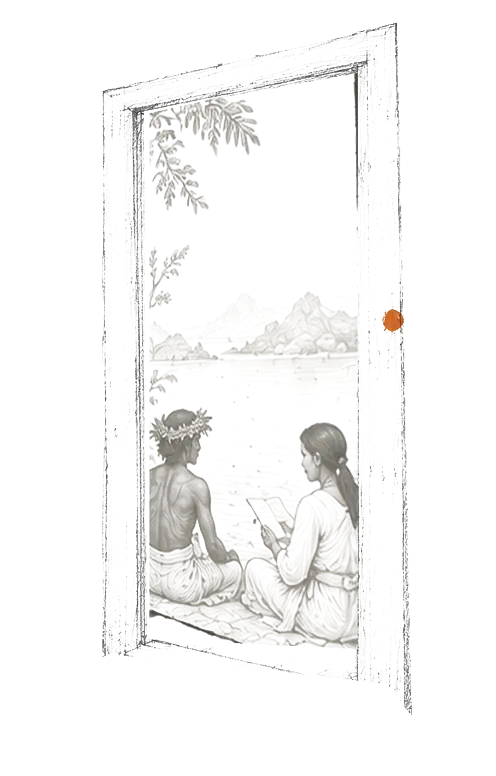
During a journey to Australia, each of the two authors set out to write a poem every day. The texts answer each other around eighteen themes, from one voice to the other, and the book gives them in French with their English translation.
Timeline
- 1864–1900Penal colonyThe penal colony provides the island's first written literature, memoirs and accounts by deportees.
- 1900–1970Kanak collectionsKanak tales and narratives are collected and published, notably by the pastor Maurice Leenhardt.
- 1975Melanesia 2000The festival organised by Jean-Marie Tjibaou puts Kanak culture back on stage before the whole country.
- 1984–1988The EventsThe period of barricades and deaths runs through Caledonian novels, poetry and theatre.
- 1990–2020Déwé GorodéThe first Kanak woman novelist, she opens a French-language literature written from the archipelago.
Reading keys
- Kanak names refer to the clan and to the land of origin, and clan belonging determines land rights. The twenty-eight Kanak languages give very different forms from one region to another.
- Names of European origin, called Caledonian, often indicate a line of settlers, convicts or civil servants, and that origin is locally known.
- Among the Kanak, the maternal uncle plays a decisive role in decisions concerning his sister's children.
- The term "Caldoche" designates Caledonians of European origin settled long ago, and its use is not neutral.
- The events of 1984 to 1988, including the ambush at Hienghène and the Ouvéa affair, remain raw and are spoken of by allusion.
- The code of native status, the setting aside of land into reserves and forced labour are facts that Kanak narratives summon without developing them.
- Custom regulates speech: one does not take the floor without having been welcomed, and one offers a gift before speaking. A scene of "doing the custom" is a precondition and not a politeness.
- Certain narratives are the property of a clan and are not told outside it.
- Catholicism and Protestantism took root by dividing the territory between them, and confessional belonging often coincides with clan geography.
- The ancestors and the spirits of places remain present, and the yam has a sacred value: its cultivation calendar organises the ceremonial year.
- Clan totems, animals or plants, identify the lineages and impose prohibitions.
- The taboo, a word that entered French from the Pacific, designates here precise prohibitions attached to places and to moments.
- Kanak mourning is accompanied by exchanges of yams, cloth and shell money, and the gifts are counted and announced.
- Kanak money, made of shells and flying-fox fur, seals alliances and reparations.
- The round house, with its carved roof spire, is a political object as much as an architectural one, and mentioning it summons the whole clan.
- 24 September, the date of the French taking of possession in 1853, is commemorated differently by each community, which makes it a disputed day.
- Téa Kanaké, a figure of origin from the east coast, became through the play of 1975 the name of a narrative common to all Kanak.
- The narratives collected by missionaries and by ethnologists at the beginning of the twentieth century, notably the Houaïlou texts published in the original language, constitute the reference corpus.
- The yam and the first yam of the season serve as a constant ritual and literary reference.
- The customary address and its formulas of welcome are an oral heritage that authors quote and divert.
- "Kanak" is not an insult, contrary to the colonial use of the word "canaque": the term was reclaimed and its spelling fixed by the independence movement.
- New Caledonia is not an island but an archipelago, and the Grande Terre and the Loyalty Islands have distinct cultures.
- The taboo is not an exotic superstition but a customary legal regime that produces real effects on access to land.
- The word "tribe" designates here an administrative district recognised by French law, not a stage of civilisation.
Tales and mythologies 1
- NarrativeDocuments néo-calédoniensMaurice Leenhardt · 1932not translated into EnglishKanak legends written by Kanak, at the request of a missionary who became an ethnologist.Literature
Available in English 4
The books from this country that can be read in English, in the original or in translation.
- TaleKanak Legends and Chants de GestesLégendes et chants de gestes canaquesLouise Michel · 1885Kanak legends, songs and customs collected by a Communard deported to the island.Literature
- TaleTales of PoindiContes de PoindiJean Mariotti · 1939A Kanak hunter passes on to his child the old tales of the woods and the animals of the island.Literature
- NovelChân Đăng: The Tonkinese of Caledonia in the Colonial EraChân ĐăngJean Vanmai · 1980Tonkinese indentured workers in the mines of colonial New Caledonia, amid separations and toil.Literature
- PoetryTo Tell the TruthDire le vraiDéwé Gorodé and Nicolas Kurtovitch · 1999A Kanak woman writer and a writer from a European family write together, on the eve of the political agreement of 1998.Literature
A selection to begin with 6 / 8
- TaleKanak Legends and Chants de GestesLégendes et chants de gestes canaquesLouise Michel · 1885Kanak legends, songs and customs collected by a Communard deported to the island.Literature
- TaleLégendes canaquesGeorges Baudoux · 1928not translated into EnglishKanak stories and customs of the Caledonian north, transcribed by a miner who lived among the tribes.Literature
- NovelLe Rocher à la voileAlin Laubreaux · 1930not translated into EnglishFour intertwined destinies in colonial Nouméa, in the grip of a powerful trading house.Literature
- TaleTales of PoindiContes de PoindiJean Mariotti · 1939A Kanak hunter passes on to his child the old tales of the woods and the animals of the island.Literature
- NovelChân Đăng: The Tonkinese of Caledonia in the Colonial EraChân ĐăngJean Vanmai · 1980Tonkinese indentured workers in the mines of colonial New Caledonia, amid separations and toil.Literature
- EssayD'Ataï à l'indépendanceApollinaire Anova · 1984not translated into EnglishThe past of the Kanak under colonisation, seen by a Kanak priest in 1965 and published in 1984.Literature